Thursday, September 04, 2008

The Black Cloud: Citizen air-quality monitoring in south central LA


A typical black cloud sensor, sniffing VOCs from a marker.

Over the past summer, high school seniors at L.A.'s Manual Arts High School pored over graphs from environmental sensors like the one above as part of the "Black Cloud Citizen Scientist League," a game designed by Berkeley artist Greg Niemeyer.

Niemeyer and teacher Andy Garcia hid these sensors in various places inside the students' neighborhood where they expected to find big difference in pollution levels: a dry cleaner's, a gas station, a nail salon, and inside the classroom itself. The object of the game, for the students, was to discover where the sensors were - mostly by analyzing the data from the sensors and learning about the factors that influence air quality in their neighborhood.
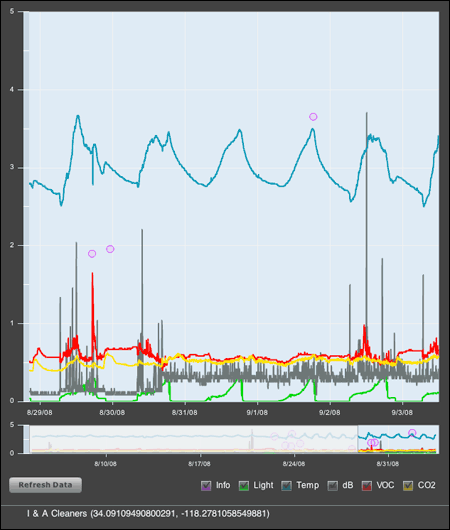

Sensor output from an Echo Park drycleaner business, showing data on light levels, temperature, noise, volatile organic compounds (VOCs), and carbon dioxide. Image courtesy of Planetizen.

Some of the project's outcomes were surprising. On his blog, Niemeyer writes that the gas station's VOC levels were relatively low: the sensor was placed inside, next to an ice cream freezer, and gasoline vapors rarely reached it. But students also learned that their neighborhood's carbon dioxide levels, at 600 parts per million, were almost twice as high as most places.

Most disturbingly, students learned that their own classroom had CO2 levels around 3,000 parts per million - high enough to cause fatigue and poor attention span in most people. Students responded by opening doors and windows to improve ventilation, and they watched the CO2 levels decline. But the lessons of the classroom's conditions can be applied to the whole city, according to Neimeyer in a blog post he wrote at the project's conclusion:
After 6 weeks of tracking Black Clouds in LA, our observation is that in some places the air recovers, and in others, it gets worse. Recovery happens either because powerful HVAC systems run all night to clear the air, say, in the Metro Transit Authority office building, or because someone put many plants in their space, such as at Machine Project. In places like the Manual Arts High School room p74, pollutants concentrate throughout the week and get barely a chance to clear up during the weekend. If we scale these observations up to the whole city, well, LA’s air does not recover because it moves offshore at night just to move onshore again the next morning. Our conclusion is that we must find ways to let the air recover. We call it eco-fasting. How about not using the car every other day, voluntarily? How about growing plants indoor to clear the air while we’re at work? How about using no electricity all weekend?

The Black Cloud sensors are now monitoring conditions at various locations in Los Angeles's Echo Park neighborhood and around the UC Berkeley campus. Visit the Black Cloud website to look at graphs of current conditions.

You can also read more on Planetizen, where I learned about this project.

Tuesday, September 02, 2008

Portland Combined Sewer Overflow Outlets

Labor Day's come and gone, which means that there are scant opportunities left to enjoy Maine's beaches. The ocean's temperature is at its warmest this time of year, and a stretch of dry weather means that Portland's combined sewers haven't overflowed into Casco Bay since mid-August.

But if we do get any wet weather, you might want to avoid swimming near any of the markers on the map below. These are Portland's combined sewer overflow outlets, where a toxic combination of street runoff and raw sewerage overflow into local watersheds during wet weather (read all the details here):


View Larger Map

Circles on the map are outlets that continue to function as combined CSOs (mixed sewage and street runoff); stars are outlets that only dump street runoff (which is bad enough, but at least the amount of feces in it is limited to that produced by the population of city dogs with irresponsible owners).

Monday, September 01, 2008

New title image

Here's the new title image for the blog, modeled after the National Park Service's "black band" design. The typeface is Frutiger, and a city skyline and rat replace the mountain and buffalo, respectively, in the Park Service's shield emblem.

The full-sized version is now at the head of every page at vigorousnorth.blogspot.com:

Thursday, August 14, 2008

Nature Abhors a Statue


Central Park's memorial to Richard Morris Hunt, a prominent 19th-century American who is best known today for his pompous memorial in Central Park.

I'm currently reading The Politics of Park Design, by Galen Cranz. It's a history of the dominant political forces behind the landscapes of our city parks, and it has this to say about statues in parks:
"Statuary reminded the viewer of man's handiwork, not nature's, and, because it was associated with European aristocratic formal gardens, it was an anethema to democrats... Most designers objected to statuary in general."
Cranz also includes this 1903 quote from Mrs. Herman J. Hall of the American Park and Outdoor Art Assn.:
"There should be no place in [parks]... for granite pantalooned remembrances of deal musicians and soldiers and statesmen. If we cannot teach people to realize that they should keep their effigies of statemen where they belong, then let us hide them in thickets... We should put nothing in our parks which suggests unrest or anything disagreeable, or that will frighten children, but we should put in objects that will suggest woods, trees, water and nature.
And more explicit is Charles S. Sargent, editor of Garden and Forest magazine, who wrote that "the public is only half-educated in matters of taste, and not only admires these very bad figures, but is continually pestering the commissioners to put up more like them."

And the rabble prevailed: German immigrant groups erected monuments to Schiller, temperance activists built fountains to proclaim the virtues of pure drinking water, and the pastoral refuges of our largest cities grew cluttered with Ozymandiases.

But what Sargent and Mrs. Hall fail to note is how their "natural" parks are every bit as man-made as the statues are: the rustic aesthetic of nineteenth century pleasure grounds required a great deal of excavation, planting, and maintenance to come by their "natural" appearance. We're more prone to being fooled these days, when the trees and undergrowth have attained a maturity that really does look primeval. But nineteenth-century city dwellers, who witnessed these parks' transformations from sand dunes and swamps, might well have wondered why it was all right to build a pond, but unacceptable to build a statue.

In spite of the memorials, nature survives, and children manage to show remarkable courage when confronted by a rusty bronze general.

Monday, August 11, 2008

Migratory Industries

Late last week, a ship unloaded dozens of huge steel tubes on Portland's waterfront - the first activity at Portland's cargo terminal since a container-shipping barge ceased operations a few weeks ago. These were the segmented towers that will soon be assembled into the state of New Hampshire's first large-scale wind farm, in Lempster.


According to the local paper, "The turbines, produced by the Spanish company Gamesa, were originally headed for Fairless Hills, Pa., but were diverted because Portland proved to be a more efficient and affordable option for the shipment of the freight."

What's in Fairless Hills? A quick google search reveals that Fairless Hills is an industrial city west of Trenton, New Jersey, where Gamesa recently invested millions of dollars to build modern windmill factories on the former site of U.S. Steel. The news article is scant on specifics, but apparently these turbine parts will be shipped directly to New Hampshire and assembled there, instead of being routed through Pennsylvania, in order to save on shipping costs.

So here, on the Portland waterfront, the changing industrial migration patterns of the early 21st century are coming together like Matryoshka dolls. With a weakening economy, Maine's exports of container-shipped goods dry up. The state's only container-shipping terminal goes dormant, leaving room for a Spanish corporation to open a temporary logistics office.

Meanwhile, an abandoned steel mill in Pennsylvania witnesses millions of dollars of new investment from a European wind-energy corporation. On a site that had once imported coal and iron ore from Appalachia and exported finished steel, a Spanish company now imports steel from China to export renewable energy generators to American prairies and hilltops.

And as always, huge oil tankers come and go in a regular, unceasing beat, delivering increasingly expensive crude oil into Portland's pipeline and to the refineries of New Jersey.

Wednesday, August 06, 2008

Worth Watching


"On July 2, 2002, Jean and Harlow Cagwin watched as their home, the last remnant of their 118-acre cattle farm in Lockport, Illinois, was torn down clearing the way for a new housing development. Several years later, Ed and Amanda Grabenhofer and their four children moved into the new Willow Walk subdivision, their house just yards from where the Cagwin's home once stood."

Photographer Scott Strazzante documented both of these families, living on the same land, over a 14-year period.

Watch this multimedia slideshow on MediaStorm.

Wednesday, July 30, 2008

This is what self-reliance looks like: Maine's Fox Islands will become entirely wind-powered


Via today's Bangor Daily News: the member-customers of the Fox Islands Electric Cooperative, which provides power to the islands of North Haven and Vinalhaven in Penobscot Bay, have overwhelmingly voted to go ahead with a wind power project that will provide enough electricity for the islands' 1500 permanent residents.

The islands currently import their electricity via an undersea cable. That cable will continue to provide back-up power during calm periods, but over the course of the year, the Cooperative expects to export 10,000 surplus megawatt-hours of electricity to the mainland - enough to pay for the project and reduce local electric rates. You can learn more about the complete proposal from the Fox Islands Electric Cooperative website.

It's interesting to compare this project with last year's Black Nubble proposal in Carrabasset Valley. That project was larger, with more turbines, but also further away from homes and less visible than the Fox Islands project will be. Why such overwhelming support for a project on Maine's prized coastline, and such bitter opposition for a project in one of Maine's poorest regions?

I was at one of the public hearings for the Carrabassett Valley project. The people opposing it were classical Jackass Environmentalists: dregs of the baby-boom, the Crummiest Generation, who had for decades fetishized a fantasy idea of "wild nature," and in their retirement sought out their dream of living in an isolated little cabin next to a huge ski resort. Wide, permanent clearcuts on Maine's second-tallest mountain don't bother them (because that's where they ski!), but a few wind turbines on the horizon would have been an unforgivable blight on the landscape. These are people who love quoting Thoreau but hate the actual practice of self-reliance.

Living on an island, on the other hand, does require real sacrifices and independence. The Fox Islands are a 75 minute ferry ride - in fair weather - from the mainland and its conveniences. Many islanders still make their living by harvesting the ocean's natural resources. These are people whom Thoreau would admire, even if they themselves would be more likely to judge Henry David as an insufferable Masshole.

I guess Fox Island residents just have more spine and less whine than the Quixotes of Carrabassett Valley. Thank goodness for that.

Thursday, July 24, 2008

We'll dig our way out.


Note: this cartoon came from Nick Anderson at the Houston Chronicle. Houston, of course, is the one American city that is not suffering at all in the current recession, thanks in large part to trillions of dollars' worth of activity in the city's oil industry.

But even Houston knows that it won't last. When I lived there in 2005, I spoke with several oil industry geologists who freely admitted that peak oil had either already happened or would happen very soon. The Chronicle sounded the same alarm in a May editorial, noting that Exxon Mobil's crude production is one the wane in spite of record-high prices.

In the midst of all this, my rather indifferent response to John McCain's offshore drilling proposals is to shrug and say, "you're welcome to try, but it won't do a damned bit of good." By the time new offshore oil wells come online, you'll probably have to shell out over $300 to buy a barrel of oil from them.

But hey, if Americans and their car manufacturers really think that they can stave off bankruptcy by continuing the failed energy policies of the past eight years, why shouldn't we humor them? It will amount to another multi-billion dollar giveaway to the oil companies, but using tax money to bail out failed business models is what America is all about these days.

You guys keep on trying to drill your way out of the hole you've made. I'll be over here, on my bike.