Thursday, September 24, 2009

Cryptozoology

I've just learned that THE International Cryptozoology Museum will be opening a permanent exhibit space just two blocks away from my apartment in downtown Portland, Maine.

(logo courtesy of Loren Coleman, www.cryptomundo.com)

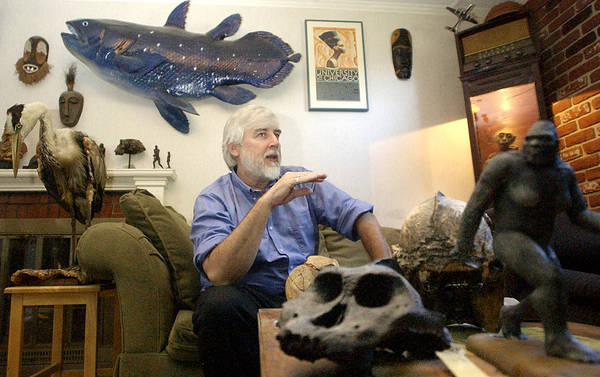
Local cryptozoologist Loren Coleman has an impressive collection that includes life-sized Bigfoot replicas, lake monster models, and a Coelacanth, among many other curiosities. These objects had been crowding his living room (BoingBoing wrote about a visit to his home two years ago), where he'd offered private tours of the collection by appointment. The new museum space on Congress Street, in the middle of the city, will give his exhibits a more prominent, public display.

Coleman, the museum's founder, also blogs about cryptozoology at the website www.cryptomundo.com. A blog post announcing the new museum was published two weeks ago:
The mission of the museum is to share the many items I have collected during the last half a century, with tourists, teachers, researchers, scholars, colleagues, students, documentary filmmakers, news people and the general public...

[the collection includes] hundreds of cryptids toys and souvenirs from around the world, one-of-a-kind artifacts, a life-size 8 feet tall Bigfoot representation, a full-scale six-foot-long coelacanth model, over a hundred Bigfoot-Yeti-Yowie footcasts, jackalopes, furred trout, along with such Hollywood cryptid-related props as The Mothman Prophecies’ Point Pleasant “police” outfit, the movie P. T. Barnum’s authentic 3.5 feet tall Feejee Mermaid, the TV series Freakylinks‘ 11 ft long “Mystery Civil War Pterodactyl,” and some of the movie Magnolia’s falling frogs.
The museum is also looking for donors: "For any patron who wishes to send in a donation of $1000 (one thousand dollars) or more, I shall be sending to you ~ anywhere in the world ~ a first generation copy of an Orang Pendek footcast," writes Coleman. If you're interested, follow this link.

Coleman at his home, which he had been sharing with the museum's collections. Photo by Amber Waterman of the Lewiston Sun-Journal.

Coleman seems aware that his field is substantially influenced by pop-culture silliness, and to his credit he seems OK with that.

But cryptozoology is really interested in making new zoological discoveries, and there's still plenty we don't know about the world's biological diversity. A recent post on Coleman's blog heralds the official scientific description of a new deepwater species of ghostshark, and the museum's logo (above) features a Coelacanth, a species known only from prehistoric fossils, and believed to be extinct, until fishermen caught a live specimen off the South African coast.

If modern science can discover a living fossil, who's to say it won't someday discover the real Abominable Snowman?

Wednesday, September 16, 2009

The Recession Armada and Air Force

A fascinating article in Britain's Daily Mail describes the enormous armada of cargo ships that have been idled off the coast of Signapore for the summer (thanks for the tip, Jim).

Above: idle cargo ships off the coast of Signapore.

"Their numbers are equivalent to the entire British and American navies combined; their tonnage is far greater," writes reporter Simon Parry. "Container ships, bulk carriers, oil tankers - all should be steaming fully laden between China, Britain, Europe and the US, stocking camera shops, PC Worlds and Argos depots ahead of the retail pandemonium of 2009."

Of course, the pandemonium of 2009 turned out not to be the sort where frenzied shoppers mobbed shopping malls. Asia won't underwrite our credit card debt and lousy mortgages anymore, which means we can't afford to by container-loads of their manufactured goods.

The Daily Mail article also notes that these ships are being manned by skeleton crews, doing basic maintenance and guarding against piracy. What an incredibly lonely job that must be - it must be kind of like working as a salesperson at Sears (right: inside the Schuylkill Mall, courtesy of DeadMalls.com).

The cargo armada off of Signapore isn't the only idled fleet of the recession, though. Seeing all those ships reminded me of Don Delilo's Underworld, a novel in which there's a character who re-paints and arranges abandoned airliners as huge landscape art pieces in the Mojave desert. Such aircraft boneyards really do exist in the desert southwest, and sure enough, they're filling with new arrivals during this recession. Via an April CBS News report:
The number of planes in storage has jumped 29 percent in the past year to 2,302, according to aerospace data firm Ascend Worldwide. That includes 930 parked by U.S. operators alone....

That makes for busy times at facilities like Evergreen Maintenance Center near Marana. Its super-sized hangar fits a 747, and there are plenty of active planes on hand, including one 747 used to test Pratt & Whitney engines and another converted to fight forest fires.

But outside there's a ghost fleet of 204 parked planes. Some of Northwest's retired 747s are here. Planes from defunct ATA Airlines, 767s from Air Sahara and MaxJet, and a hodgepodge of other airlines from around the world are here, too.
Here's a glimpse through the fence from Flickr user DannyMcL:

And here's another particularly good photo of the Mojave airliner storage lot. Enjoy!

Tuesday, September 15, 2009

Cities, Buried by Signs

"Your gaze scans the streets as if they were written pages: the city says everything you must think, makes you repeat her discourse, and while you believe you're visiting Tamara you are only recording the names with which she defines herself and all her parts. However the city may really be, beneath this thick coating of signs, whatever it may contain or conceal, you leave Tamara without having discovered it. Outside, the land stretches, empty, to the horizon; the sky opens, with speeding clouds."
-Italo Calvino, Invisible Cities
They say that if you take someone who has never been to New York City, but has watched plenty of American movies - a Korean shopowner, for instance, or a Greek hotel clerk- and dropped them in the middle of midtown Manhattan, they would not feel completely lost, because American movies have created a global, subconscious familiarity with the city and its landmarks.

It's possible to wander through Harlem and navigate by landmarks like the university from Ghostbusters and the diner from Seinfeld, for instance, or to navigate through Central Park by recognizing the places where Harry Met Sally or where Macaulay Culkin feeds the pigeons in Home Alone 2.

In most movies, though, the city is only a backdrop. In my experience, books can have a bigger impact on how a city feels, especially with authors who create a strong sense of place in their writing - as though the city itself becomes a character.

Via the Strange Maps blog, I've come across two "literary maps" of cities with strong presences in literature. Here's one of San Francisco, originally published in the Chronicle earlier this summer:

The quotes in this map roughly match the neighborhoods they reflect: Joan Didion's passage about Janis Joplin singing in the Panhandle spans the southern edge of Golden Gate Park near Haight-Ashbury, and a Kerouac quote spans the Russian Hill neighborhood where the beat poets lived.

Today, of course, both Haight-Ashbury and Russian Hill are the opposite of bohemian, full of franchise stores and yuppies with expensive cars. And yet the song lyrics and sentences we've read about these places still somehow imbue them with a bohemian aura, contrary to all reality: aging hippies still come to Haight-Ashbury, wander among the high-end restaurants and boutiques, and manage to keep a few holdout head shops in business.

So where is the real Haight-Ashbury - the neighborhood that exists independently of the writers and musicians who wrote about it? Are the hippies and head shops merely the ghosts of the neighborhood that Joan Didion and Hunter S. Thompson wrote about? Or are the fancy boutiques the impostors, there only because the Haight has become a cultural icon and hence a desirable neighborhood?

Thinking about it, I've concluded that both of these are true: Haight-Ashbury has become a product of our cultural expectations of it. The "real" neighborhood isn't so much concealed by the "thick coating of signs" by which we know it, as defined by it. It's no wonder that these kinds of places in our cities - Times Square, The Alamo, the Las Vegas Strip, and all the other places we think we know from books, movies, or songs about them - can simultaneously feel very familiar and very strange when we finally experience them in person.

Here's another literary map of Saint Petersburg, a city with a much richer literary tradition than San Francisco's. Unfortunately, I've never been there - my understanding of St. Petersburg is completely defined by what I've read by Pushkin, Gogol, and Dostoyevsky. I studied Russian in college, but a part of me is actually afraid to visit the real St. Petersburg, lest I ruin the glorious nineteenth-century city of my imagination.

The St. Petersburg map is a limited-edition print, and if you really love this blog and want to give the author a great surprise, feel free to send a copy to 64 Winter Street, Portland, ME 04102.

Thursday, August 27, 2009

The Aral Sea Is Gone

Via NASA's Earth Observatory, an image of the (former) Aral Sea, this August:


Near the dry harbor of Aral, Kazakhstan. Via Wikipedia.
The Aral Sea used to straddle the border between Uzbekistan and Kakakhstan as the world's fourth-largest saltwater lake. A Soviet industrialization program in the 1940s diverted most of its source water to irrigation projects for thirsty cotton farms in the desert. By the 1960s, most of the sea's water supplies had been diverted, and it began to shrink.

As the sea evaporated, a new desert, known locally as the Aralkum, took its place. The desert's soils consist of fine marine deposits mixed with highly polluted runoff from the former industrial cotton farms that used to surround it. Massive dust storms have blown this soil and its pollutants all over the world. The disappearance of the Sea has also removed a tempering influence on the regional climate: winters are now colder, summers are hotter, and there's less rainfall. Ironically, these problems haven't helped the industrial cotton farms that continue to divert water from the former sea's source rivers.


The Aral Sea seen from space in 1985. Via Wikipedia.
At the same time, as the lake shrank, its waters became increasingly saline. The water that remains in the disappearing southern lagoon is now three times saltier than typical ocean water.

The Kazakh government has undertaken a number of projects to restore the northern part of the sea, where water levels have recently stabilized and a fishing industry has even been able to re-establish itself. But the much larger southern portion has been written off as a lost cause, and continues to shrink at rapid rates.

Pretty amazing: in roughly half a century, a sea that was once the size of Missouri has essentially disappeared.

So long, Aral Sea.
We hardly knew ye.

Monday, August 24, 2009

A Field Guide to North American Seafood Menus


The Monterey Bay Aquarium has put together a consumers' guide to sustainable seafoods. The idea is to encourage grocery shoppers and restaurant patrons to support responsible fisheries, like wild Alaskan salmon, and to avoid fisheries that are environmentally harmful or near collapse, like farm-raised Atlantic salmon.

Snapper, Red

Rating: Avoid


Red snapper is in decline worldwide, and fishing pressure on this species remains excessive. Red snapper should therefore be avoided.

Market Names:
Mule Sow, Rat, Tai, American Red Snapper
The guides started as printable pocket versions that you could fold into your wallet and consult at the supermarket. But now there's an even better, more discreet version for mobile phones, accessible at mobile.seafoodwatch.org (part of the mobile-phone webpage about Red Snapper, a species that's in serious decline, is shown at right). Or, if you prefer, get the iPhone app. There's even a guide tailored for sushi restaurants that translates common Japanese fish names.

These guides are meant to accompany your menu at the restaurant, but I find them pretty fascinating in their own right. For instance, the Aquarium's guide for the Northeast region endorses Pacific halibut as "best choices," but we're advised to "avoid" Atlantic halibut and flounder caught here in the Gulf of Maine.

Clams (both farmed clams and wild steamers) are also endorsed as a "best choice." Which is good news, as long there's no red tide.

And Monterey is lukewarm about Maine lobster, a fishery that's long been hailed for its socially-driven sustainable management techniques. Maine lobster ranks as merely as a "good alternative," not as one of the "best choices," since the "current population status is considered weak or unknown" and there are concerns about right whales getting trapped in the buoys and lines attached to traps. Haddock also falls into the middling "good alternatives" category, with the caveat that "the majority of U.S. Atlantic haddock is caught using bottom trawl gear [which causes] considerable habitat damage to seafloor habitats."

So maybe I'll switch my preferred clam-shack order from fried haddock with tartar sauce to fried clams, and just opt for salad during red tides or after big rainstorms.

If you're a chef looking for sustainable-fisheries cred, Monterey Bay and a number of other marine research institutions also recently launched fishchoice.com, a tool for restaurants and other commercial seafood buyers.

Wednesday, August 19, 2009

Why I Lately Haven't Been Blogging As Much As Usual

In a couple short months, when it's 36 degrees and freezing-raining and you leave work in the dark at 4:30, are you going to be saying to yourself, "I can't believe I didn't go to the beach after work that day while the water in the ocean was twice as warm as it is outside right now."

OR would you rather say to yourself, "Look at this tan I still have, even in November!"

Carpe diem, buddies.

Sunday, August 02, 2009

Beneath the corn, the husks of ancient Venice

This is a farm field near the small village of Altino, Italy, about two miles northeast of the Venice airport, and a mile from the northern edge of the Venetian lagoon:


Look carefully at this aerial view and you can see lines of darker and lighter vegetation slicing across the crop rows. This week's issue of Science magazine features an article by Paolo Mozzi, an Italian geomorphologist who surveyed this same field with infrared cameras during the severe drought of 2007 to analyze subtle variations in plant hydration.

He was looking for crop marks, an archaeological technique that looks at variations in plant health on the surface as a way to discover ancient walls and building foundations that have since been buried beneath three feet of soil. At right is a sketch from Wikipedia that shows how it works: a stone wall just below the surface (on the left side of this sketch) limits the amount of topsoil and stunts the growth of the plants growing above, while an old ditch (on the right) helps the plants above it grow taller with extra topsoil.

Here's what Mozzi's infrared survey found:


This is the ancient Roman city of Altinum, a place that became an important strategic and commercial center thanks to its position at the edge of the Venetian lagoon and at the crossroads of the empire's Via Annia and Via Claudia Augusta. In the fifth century C.E., it and several other Roman cities nearby were conquered and burned by Attilla the Hun, and subsequent barbarian invasions from the north forced the Romans to retreat from the mainland cities to the marshy islands of the lagoon.

Altinum was abandoned completely by the 11th century, but its island refugee settlements grew in size and prosperity to eventually become the city of Venice.

The Roman historian Strabo wrote that "Altinum too is in a marsh... and hence subject to inundations"(see note below). The engineering behind the canals of Venice was pioneered in Altinum, where the Romans built a network of canals to drain the marshes and carry the water away from their buildings. One of the canals is clearly visible in the infrared image above, and, if you know where to look, it's also visible as a slightly darker band of green in the aerial view at the top of this post. When the Romans left, the canals filled in and the marshes took over once again, until the nineteenth century, when the land was reclaimed for farms.

This makes Altinum one of the few Roman cities that wasn't subsequently buried underneath more modern settlements. Instead, it sank into the marshes, only to be re-discovered a thousand years later as a shadow cast over an unwitting farmer's agricultural yield.


Note: Here's the translated source text from "The Geography of Strabo." Strabo calls Altinum similar to the nearby city of Ravenna, which sounds even more like modern Venice: he calls it "a city built entirely of wood [another possible translation is "built on piles"] and coursed by rivers, and it is provided with thoroughfares by means of bridges and ferries. At the tides the city receives no small portion of the sea, so that, since the filth is all washed out by these as well as the rivers, the city is relieved of foul air."

Wednesday, July 15, 2009

Picket Lines and Prairies

Above: An unmown pedestrian bridge in Windsor, Ontario.
Photo courtesy of
wreckingball.org

In Windsor, Ontario (the city directly across the river from Detroit), 1,800 municipal workers have been on strike for several months now. Among other things, this means that no one is mowing the lawns in the city's parks, which are transforming from riverfront esplanades and soccer fields into wild prairies as the summer wears on.

The re-wilding of Windsor's parks has inspired some nice nature writing from Anne Jarvis, a columnist from the Windsor Star, and her readers:

At first, the flood of comments and letters on the strike by 1,800 city workers, including those who cut the grass in the usually manicured parks, expressed anger about the unsightly overgrowth.

Then the grass matured, the wildflowers began blooming and wildlife returned. And the letters began to change.

This one is almost poetic in its description:

"The long grass is now home to so many singing birds and insects and there is such a wide variety of colourful native plants in bloom. The wind can be heard as it blows through the grass ... Such a difference from the plain, flat and empty space it was before."

The park? The soccer pitches at the Ford Test Track [which is exactly what it sounds like: a former proving ground for Detroit's dying manufacturers] in the heart of the city.

"Today was the first time that I have ever considered that park to be beautiful," wrote the woman.

A colony of bobolinks and some eastern meadowlarks, declining species known and loved for their beautiful song, were discovered there last month. They surprised and delighted birdwatchers. A grassland species, they're rarely seen in the city because there isn't much grassland.

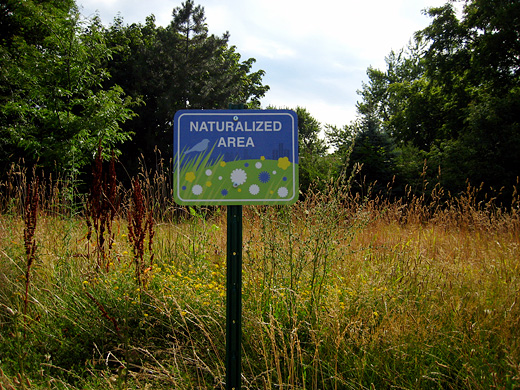
I found out about Windsor's strike and unintentional re-wilding project via the Broken City Lab, whose latest project has been to unofficially recognize the city's overgrown meadows with these signs, which they designed and installed themselves:

Above: Strike commentary from Windsor's Broken City Lab.

I love how these signs tweak peoples' perceptions of these places: suddenly, it's not an overgrown lawn or a symbol of municipal neglect: it's a wildlife refuge!

As the Summer Without Lawnmowers wears on, people in Windsor are growing fond of the new wildflower meadows and flocks of bobolinks. In the same Windsor Star column, Jarvis reports that the City has resolved to leave a couple hundred acres of parkland unmown, even after the strike eventually ends.