Friday, January 29, 2010

Ski Your City!

Last week, most of Maine got a soaking 3 inches of rain, which washed away most of the season's snow. It was a sad day.

But as I write this, an unlikely alliance of scaffolders, public works employees, and snowmaking crews from the Sunday River ski resort in western Maine are converging in Monument Square, the center of downtown Portland, to put together an artificial ski hill and cover it in snow. Tonight, hotshot skiers and snowboarders will spend the evening running dozens of loops up the scaffold's stairs, down the short hill and its stunt-rails, and up the stairs again. Here's a video of last year's event:


Admittedly, the main intention of this is to get the kids to drink more Red Bull and surrender $60 for a day's lift ticket at the big ski resorts that are sponsoring this. Still: a temporary ski-slope installation in the central public space of your city's downtown is pretty cool. They've brought the mountains to the people.

It also reminds me of a proposal to redevelop Berlin's Templehof airfield as a giant mountain, girdled at its base by the Nazi-era terminal building. It wasn't a serious proposal, but it was meant to inspire more creative and interesting ideas for redevelopment beyond the typical mix of apartments, parks, and office buildings:


Templehof Mountain, by Jakob Tigges and Malte Kloes, via Der Spiegel

And it also reminds me of the mid-century craze for winter carnivals, with the massive ski-jump constructions they brought to the nation's big stadia. Pruned posted a good compendium of those historic photos last year - my favorite might be this one from Dodger Stadium:


Ski jump in Dodger Stadium, 1963. Photo by Tom Courtney, via Pruned.
Note the palm trees in the photo. Skiing in Los Angeles required both architectural and meteorological interventions.

Historically, skiing has always served to open up new ways of crossing the landscape in the winter. Before it became a "sport," it was a mode of transportation for Swedish postal carriers, soldiers in Italy, and Ernest Hemingway. It wasn't until the sport was commercialized and commodified after World War Two that skiing became limited to something that you primarily did downhill, on mountains with elaborate and expensive cable lifts.

Why should it be that way, though? The ski slope in Monument Square doesn't particularly make me want to drive 2 hours to the ski resorts. Instead, I look up at the even taller buildings that surround the Square and think about what it would take to ski down the four-story terraces on the office building at One City Center.

Two or three times a year, there are snowstorms big enough to overwhelm plowing crews downtown, and it actually is possible to ski through the streets. And in back alleys, snowdrifts pile up and open up new, otherwise inaccessible shortcuts between buildings.

Skiing in the city can be, like skateboading or parkour, a radical act to rearrange our understanding of and relationships with the urban environment. As such, we should probably expect these attempts to commercialize and control it, but that doesn't mean we have to buy it. Skiing in the city is free - and fun.

Wednesday, January 27, 2010

A Walk to Wachusett

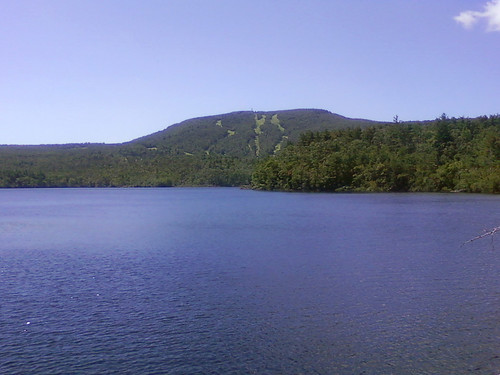
In 1842, a 25-year-old Henry David Thoreau walked from his home in the town of Concord, Massachusetts to the summit of Wachusett Mountain, 34 miles away. It's a small mountain, barely cracking 2,000 feet in height, and today it's best known for hosting a ski area where one can take a few runs on winter evenings after getting off of work in Boston.

When he got back to Concord, he wrote this:
"And now that we have returned to the desultory life of the plain, let us endeavor to import a little of that mountain grandeur into it. We will remember within what walls we lie, and understand that this level life too has its summit, and why from the mountain top the deepest valleys have a tinge of blue; that there is elevation in every hour, as no part of the earth is so low that the heavens may not be seen from it, and we have only to stand on the summit of our hour to command an uninterrupted horizon."
I can't claim that I've read a lot of Thoreau's writing, but this little passage might be my favorite of what I've come across.

Wachusett isn't much of a mountain, even by New England standards - it's eroded over long eons into a round-shouldered, leafy hill. Still, what humble "mountain grandeur" this hill has clearly made an impression on Thoreau.

He's telling us two things in this passage: first, that we don't need to fly to the Himalayas to awe ourselves with big mountains - we can experience the same feelings in our own backyards, if we care to look for them.

Mount Wachusett. Photo by flickr user ornoth / CC BY-NC-ND 2.0

Second, he's also telling us that we can carry that inspiration with us "in every hour" - that is to say, through the humdrum routines of everyday life. If only we raised our heads to look up, we can command the "uninterrupted horizon" of a summit view.

In my personal reading of this, Thoreau is asking us to continue thinking about our connections to the natural world even in the level life of the city, and in our daily work. If we can manage that, he tells us, we'll be rewarded with a sense of perspective and humility not unlike the sense we get from a clear mountaintop view.

It's common for people and our popular culture to misinterpret Thoreau's later experiment at Walden Pond as a rebellion against civilization. Indeed, this confused reading may be responsible for - and is certainly associated with - the destructive old orthodoxy that environmentalists' activities should be focused on places where there aren't (or don't seem to be) any people - whether the Arctic National Wildlife Refuge or the northern Maine woods. The participants of anti-urban, white-flight environmentalism in the 1960s, '70s, and '80s tried to realize this false conception of Thoreau's experiment in back to the land movements, and the result was widespread urban sprawl along with brutal economic and racial segregation in American inner cities.

The real Thoreau wasn't at all interested in turning his back on the problems of civilization. Unlike the back-to-the-land hippies, Thoreau's time at Walden was intentionally temporary, and mixed with frequent trips back to (and engagement with) society in the busy town of Concord. Being an active, engaged member of society - whether by protesting the institution of slavery, or publishing his writings, or selling the pencils he manufactured in his family's Concord factory - was extremely important to Thoreau.

He loved mountains - even humble ones. But he didn't climb them for bragging rights, or exercise, or to fool himself that the problems of the world didn't exist. He climbed them to bring a sense of clarity and perspective into his everyday life in the valley.

And that's a perspective that I wish more mountain-climbers would embrace.

Wednesday, January 20, 2010

The Cosmopolitan Winters of Corvus brachyrhynchos

Here in Maine, we get thousands of migrants who arrive here every summer and stake out their own tiny territories in seaside cabins or camps in the woods, turning Maine's quaint villages into far-flung suburbs of New York and Boston. And every fall, as the days get darker, they flock back south to console themselves against the cold and the dark with the social opportunities of cities.

As it happens, the common American crow does the same thing.

Around this time of year, all over the country, huge swarms of crows flock across the skies and mob the trees at city parks every afternoon and evening. Here in Portland, they seem to start around the northern end of the Eastern Promenade, then they flock over to Lincoln and Deering Oaks Parks before settling in for the night near the new Mercy Hospital buildings near the Fore River.


A few months ago I started working at Maine Audubon, and I asked the staff naturalist, Eric Hynes, what these crows were doing. He told me that, essentially, they're just socializing. While crows are fairly territorial in the summer, in the winter, when food is scarce and predators are more of a threat, they prefer the company of other crows. Thousands of other crows.

It's not all for fun: "They get together every afternoon and check each other out," said Eric. "They might say, 'hey, that guy looks fat and happy today, we'd better follow him and find out where he's getting his food.' Or, 'that one looks sick and scraggly, stay away from him.'" When it gets dark, they bed down together by the thousands to provide safety in numbers against predators.

Crows have also figured out that they're safer in cities, where their biggest nemesis, the Great Horned Owl, is less likely to venture. As a result, these wintertime social flocks tend to gravitate towards urban areas.

To see them for yourself, head out to your local city park this afternoon around 4 pm and walk towards the noise of a thousand crows cawing.

Sunday, January 17, 2010

Fort Gorges, Portland, Maine

Here's a post to remind us of the halcyon days of summer.

Fort Gorges (pronounced "gorgeous") is a military installation that dates to the Civil War era, when Portland's harbor was still a strategic military target. It was built more or less in the ocean on top of Hog Island Ledge. Its thick granite walls were built to withstand cannon blasts, which means that they're still in good condition to withstand the constant waves of Casco Bay.


Its construction continued during wartime, but by the time of its completion in 1865, wartime advances in artillery had already made its walls obsolete against the largest cannons. According to this history, "a modernization plan was begun in 1869, but funding was cut off in 1876, with the third level of the fort still unfinished." That third level was instead covered over in a mound of sand, to insulate the interior of the fort and its stores of gunpowder against attack. Today, that mound of sod grows wild with small trees and shrubs.

Inside the fort's walls is a large open parade ground, which is remarkably calm and quiet:


Granite staircases are still in good condition and lead up to the second and third levels, where there are dark tunnels that lead into the pitch-black powder magazines. The northern side of the fort, facing the city, houses the remnant woodwork of the officers' quarters. Walk on the rotted-out floors at your own risk.


During World War Two, the Fort was basically used as a military storage unit, and there's a concrete pad in the central field where sea-mines were allegedly stored. In 1960, the military finally decided that it had no further use for it, and they donated it to the City of Portland, which has maintained it as a public park ever since. The military cleaned out everything that wasn't nailed down or made of granite, with one exception: a large, Civil War cannon on the eastern side of the third level, which was apparently too large to move out and melt for scrap. It's still there, pointing towards the harbor, half-overgrown in grass and daisies:


The Fort is wide open to the public, but you need a boat to get there - some water taxis will take you there at high tide, or you can rent a kayak (as we did) and paddle there from the East End boat launch. It is a pretty excellent adventure.


Monday, January 11, 2010

Haliaeetus leucocephalus in the Heights


The people at the Trinity Church Cemetery and Mausoleum in Manhattan's Washington Heights snapped these photos of an American Bald Eagle, enjoying a lunch plucked from the Hudson in a tree near the cemetery offices. It's a big fish - maybe a striped bass?

This just happens to be the same cemetery where the famed naturalist John James Audubon has been buried since 1851. During most of Audubon's lifetime, bald eagles were a common sight in the ecologically-rich Hudson River estuary, which had been a teeming mixing-basin of saltwater and freshwater habitats. But by the mid-nineteenth century, sewage and industrial waste from the booming city (in an era without pollution controls) laid waste to the estuary's food chain -from the oysters near the bottom to the bald eagles at the top.

The Clean Water Act and other environmental laws of the 1960s and 1970s gave the Hudson River a chance to recover, though. Fish came back, but state and federal wildlife programs had to resort to importing eagles from Canada in order to lure the big birds of prey back to the city.

In the summer of 2006, when this blog was just getting started, I was part of the Urban Park Rangers team that maintained a bald-eagle hack site in Inwood Hill Park on the final year of a five-year program (here are some of my photos). Eagles typically wander around for a five-year adolescence before returning to nest near the place where they were raised, so it tickles me to think that this bird in the Trinity cemetery might be one that was raised in Inwood Hill Park.

Birdwatchers in New York City can look for this eagle themselves at 770 Riverside Drive, between 153rd and 155th streets.

10031

Saturday, December 26, 2009

Portlandhenge: Winter Street


These photos were taken the morning after the winter solstice - December 22nd at about 7:30 am - on Winter Street in Portland, Maine.

As you can see, the length of Portland's "Winter Street" is almost perfectly aligned with the rising sun on the winter solstice (as well as on the days immediately preceding and following).

Coincidence?

More on Portlandhenge, Manhattanhenge, and other city-henges here.

Friday, December 18, 2009

Using Bikes, and the Social Web, for Environmental Monitoring

MIT's Senseable City Lab has a lot of great projects loosely organized around the idea that a proliferation of cheap sensors, hand-held electronics, and mobile networks offers people more ways to collect and interpret data about their city.

So, for instance, you can embed a cheap radio beacon into a piece of garbage and learn about your city's waste-handling practices (something that city governments rarely like to talk about publicly). The Senseable City Lab did it.

The Lab has a new project they're launching in Copenhagen now, in conjunction with the global climate suicide pact treaty negotiations.

Copenhageners love riding their bikes: it's the dominant mode of transportation in the city, and how 57 percent of workers and students commute. The Senseable City Lab designed a new bicycle wheel (pictured at right) that includes a small electric motor and a 3-speed internal hub, which can transform any bike into a hybrid human-powered/electric bike.

But the hub also includes a GPS unit and an array of environmental sensors that measure levels of pollutants like carbon monoxide and nitrogen oxides, plus temperature and weather conditions. As users ride through the city, they can share their data online with others, and offer real-time environmental transects on a daily basis.


As more users use the wheel and share their data, the city can get a bigger, more complete sense of environmental hotspots, how pollutant levels change over the course of a day, and how to better-manage pollution sources.


I want one. Imagine being able to do your environmental ground-truthing on a leisurely bike ride, or a crowd-sourced revelation of the embarrassing hotspot of volatile organic compounds (from the basement laundry) next to the luxury hotel downtown. I'm hoping these come to the mass market soon.

Wednesday, December 16, 2009

The Boom: Portland's Spoils of the Naughts

The naughts are almost over. This was the decade of the real estate bubble, but it would be easy to assume that the bubble passed by Portland, Maine. After all, the city's skyline, as viewed from Falmouth or across the harbor in South Portland, hasn't changed much in the past 10 years.

But take a closer look, by walking along the city's main streets and through its neighborhoods, and it's clear that Portland is substantially newer and more vibrant than it was in 1999, when I graduated from Bonny Eagle High School and left for college in that other Portland. Many of the buildings are the same, but they've been refurbished and re-inhabited with households and businesses that care more about them. And elsewhere, abandoned lots and under-utilized parking spaces have given way to new housing and businesses.

The Portland peninsula has sprouted dozens of new buildings in the past decade. Here are five of my picks for the best, in no particular order (I'll post five more in a follow-up post next week):

  • Bayside East. Corner of Smith and Oxford Streets, East Bayside. Designed by Scott Teas, TFH Architects. Completed 2008.

    While prosperity arrived in most of Portland's neighborhoods during the 2000s, East Bayside was largely left out. The neighborhood is centrally-located geographically, but it remains isolated thanks to the lousy ideas of 1960s urban renewal: a monopoly of government-owned housing and dead-end streets cut off by the wretched Franklin Arterial. It's Portland's most Detroit-like neighborhood.

    Bayside East is a another affordable housing project, but unlike its older neighbors, it doesn't look like one. The south-facing patio works well as a pleasant public space for the building's residents, and the solar hot water heaters take a prominent place as a sort of awning on the top floor.

    It's not at all flashy, but of all of Portland's new buildings, this one might be the most successful at integrating itself into the scale and context of Portland's central-city neighborhoods. It goes a long way towards healing East Bayside's tattered urban fabric.

  • 280 Fore Street, by SMRT Architects. Completed 2004.

    There was a time when banks invested in good, quality buildings to establish a public trust in the solidity of their institutions.

    During the 2000s, though, most banks were content to put up cheap offices ringed with drive-thrus. Banks literally sought to emulate fast-food joints, both in the facile idiocy of their products and in the shittiness of their architecture. And then they collapsed.

    Bangor Savings Bank wasn't immune from this impulse - they built Burger Bank franchises out on Brighton Ave. and over the bridge in South Portland's Mill Creek Strip Mall - but at least they put some effort into their downtown Portland branch and corporate offices. It's a quality building, and the curved acute angle of its northern corner adds a dynamic presence to the corner of Franklin and Fore Streets. I don't mind admitting that my admiration for the building led me to choose this bank over its competition.

  • 490 Congress St., by Jim Sterling. Completed 2007.

    Like the W.L. Blake Building addition below, this is an attractive modernist structure that fits in well with its historic surroundings on Congress Street. It's even more striking in the context of what it replaced, a pair of half-abandoned 2-story hovels that stuck out like a missing incisor in Congress Street's smile.

    The wide glass windows and striking metal siding probably make this building the city's most stereotypical example of naughts architecture. It's clearly making a hard sales pitch for "loft living" - you can even buy Eames chairs and contemporary art from the ground-floor retail tenants. Still, it's a damned attractive sales pitch, and even if it's a bit cliched I much prefer this to the urban abandonment that prevailed in the latter half of the last century.

  • W.L. Blake Building Addition, 79 Commercial St. By David Lloyd of Archetype Architects. Completed 2001.

    This was one of the first new buildings of the naughts, and it set a good precedent. The new building respects its historic neighbors on either side by adopting the same scale and massing. But it stops short of imitating their brick cladding and granite sills and lintels (unlike most other new buildings in the city, regrettably) with fine-looking building materials of our own era.

    The view from inside the offices must be incredible. But the view from the street ain't bad, either.

  • Unity Village, Stone, Oxford, and Cumberland Streets. By Winton Scott Architects. Completed 2001.

    At the beginning of this decade, the city was in the midst of a severe housing shortage, thanks to decades of pointlessly-restrictive zoning and a resulting lack of investment.

    Unity Village was one of the city's first proactive efforts to turn things around. City Hall offered up three city-owned parking lots behind city hall to developer Richard Berman (disclosure: I helped build his company's website) for a new, mixed-income housing complex. Today, it's a place where the newly-homeless can live comfortably and unassumingly next to white-collar downtown office workers and immigrant families. The homes have abundant porches that mesh the private life of the households with the vibrant public life of the narrow street and a nearby playground.

    If Unity Village hadn't been as successful as it is, the City could easily have slid back into the old habit of Not-In-My-Backyard zoning, which would have effectively stymied most of the other projects listed here. Instead, it helped spark the broader revitalization of Bayside. Unity Village demonstrated to Portlanders that new development - even if it brought poor people into the neighborhood - could be an improving asset for the community.