Thursday, February 18, 2010

The Curse of the Albatross

Photographer Chris Jordan's images of albatross carcasses, bloated with the plastic bits that starved them to death, are easily the most disturbing testimonials of the Great Pacific Garbage Patch I have seen so far.


Images from Midway: Message from the Gyre, by Chris Jordan, via www.chrisjordan.com

These photographs remind me of Coleridge's "Rime of the Ancient Mariner."
At length did cross an Albatross,
Thorough the fog it came ;
As if it had been a Christian soul,
We hailed it in God's name.

It ate the food it ne'er had eat,
And round and round it flew.
The ice did split with a thunder-fit ;
The helmsman steered us through !
Images from Midway: Message from the Gyre, by Chris Jordan, via www.chrisjordan.com

But the Ancient Mariner of the title senselessly slays the bird, which brings a curse on the ship and its crew. They are tortured with thirst before a visit from a death-ship, yet the Mariner survives to suffer:
I looked upon the rotting sea,
And drew my eyes away ;
I looked upon the rotting deck,
And there the dead men lay.
The Mariner eventually makes penance. "He beholdeth God's creatures of the great calm" and "blessed them unaware." Then, "by grace of the holy Mother," he survives to tell the tale.

Coleridge's dead Albatross curses the Mariner with "a rotting sea;" today a similar trail of death swirls throughout the Pacific Gyre.

In a new profile in SEED Magazine, Jordan identifies our culture of consumption with the appetites of the Albatrosses:
"To me, the birds look like us: filling themselves with something that is not nourishing, thinking that it is, and killing themselves in the process. Isn’t that what we’re all doing as a culture? Our spirits are dying from our overconsumption of toxic plastic crap."
So: will the same death-ship that condemned the Mariner's crew visit us as well?

Or will we find the grace to save the oceans from a trillion plastic lighters and bottle caps?

Related: The Great Pacific Garbage Patch, May 2008.

Monday, February 15, 2010

Postcard from Antarctica

Our friends Geoff and Cricket (a.k.a. 13 Falls) sent us a postcard a couple weeks ago... from ANTARCTICA. Here's a picture of the postmark from McMurdo Station, the American base on the continent's coast due south of New Zealand. Amazingly, it only costs 28 cents to send a piece of paper from Antarctica to my apartment - nice work, postal service.

They ought to be home by now, but it sounds like they had an amazing austral summer. They shared some great stories and photos on two blogs they started writing for the job - Geoff's Hoary Frost of Heaven and Cricket's At Least It's A Dry Cold. It's pretty easy to read both straight through in one sitting - there's so much that's incredible about their life and work on the ice, and the pictures they took. They also spent a few weeks at Byrd Station, near the middle of the continent, which Cricket describes this way: "It feels like you’re in an infinitely large white room. On sunny days, the whole ground sparkles. And I swear that the first night I slept in a tent there, I could feel the depth of the 7,000 feet of ice between me and solid ground."

Here's a photo Geoff took of their tent neighborhood at Byrd.

My other favorite highlight from their blog chronicles are the photos Cricket took of a glacial fjord, which she and some co-workers climbed after disassembling the storage floor for a giant robot (a lot of what they write about sounds like it could be the first-person domestic account of the civilian extras who keep the ice base on Hoth running before the big attack in The Empire Strikes Back). Anyway, here's one of her pictures:

Those aren't clouds among the mountaintops, they're glaciers. And what really boggles my mind is to think that New England's mountains once looked like this, as recently as 13,000 years ago.

Welcome back to North America, Geoff and Cricket. Enjoy photosynthesis.

Friday, February 12, 2010

Double Aurorae on Saturn

The planet Saturn takes thirty Earth-years to orbit the sun, which means that its equinoxes happen only once every fifteen years. One of those equinoxes happened last September, and astronomers took the opportunity to focus the Hubble telescope on the planet to photograph it with both poles visible at once, and equally illuminated by the sun. The result is this image, which shows two simultaneous aurorae (!) on the poles of the distant gas giant:


Hubble captured a series of images like this one to assemble a short film of the aurorae, which are helping scientists to better understand Saturn's magnetic fields. "Given the rarity of such an event," comments ScienceDaily, "this new footage will likely be the last and best equinox movie that Hubble captures of our planetary neighbour."

Friday, February 05, 2010

The Wasted Spaces of Bureaucratic Amnesia

Since writing my last post about the opportunities of empty lots in our city, I've come across a couple of other articles on the subject. Funny how this idea is cropping up different places simultaneously.

Although I've been thinking about this for a while, this article by the editor of Governing magazine is what motivated me to finally write about it. The article suggests trying lots of different, temporary uses for the nation's proliferating empty and abandoned lots, in a sort of urban laboratory. But the most striking part of the piece was this sentence: "The typical large city has 15 percent of its land sitting vacant or abandoned, according to the National Vacant Properties Campaign."

This is nuts - especially when we consider that most large cities also have real estate that sells for millions of dollars an acre. This is a clear indication that we have some serious market failures interfering with things. All this land could be used for jobs, or housing, or parks. But as long as they lie fallow, our cities are going to suffer from more income disparity, crime, homelessness, budget cuts, unemployment, and environmental problems than necessary.

I found the Governing article via a Twitter post from thisbigcity.net, a newish urban-issues blog from London that looks very promising. If you enjoy The Vigorous North, you should check it out.

Finally, the same day I published my post, the excellent Opinionator blog on NYTimes.com ran a similar post from architectural critic Alison Arieff. Her piece, "Space: It's Still A Frontier," talks about how Geographic Information Systems are giving cities new tools for identifying and inventorying the empty lots and in-between spaces that have been filed away and forgotten in the bureaucratic purgatory of City Halls. She writes:
"Neglected at the local level because they neither provide nor generate revenue, these sites are markers of larger patterns of neglect (much as we’re seeing with homes abandoned to foreclosure). In San Francisco, they often outline the shape of entire, mostly lower income neighborhoods like Hunter’s Point, Bayview and the Outer Mission. Abandoned by traditional development, such areas are precisely those in need of ecological and social attention."
Arieff also profiles an architecture school project in Berkeley called "Local Code," which has culled forgotten places from a San Francisco city database and proposes "a systemic re-greening of leftover pavement space on a large scale."


Empty lots in San Francisco, courtesy of Nicholas de Monchaux. Via the New York Times Opinionator blog.

The professor leading this project, Nicholas de Monchaux, and his students found 1,625 distinct sites throughout San Francisco - various overgrown lots and informal parking lots with "a combined surface area of more than half of San Francisco’s Golden Gate Park."

This in a city that might have the nation's most acute need for affordable and middle-class housing - unbelievable.

De Monchaux repeated the exercise in other big cities:
“When we examined all the leftover spaces in San Francisco, New York, New Orleans, Minneapolis — we found the same thing to be true in every city,” de Monchaux says. “You had a whole archipelago of city-owned lots lying fallow. In New York they add up to the size of Central Park and Prospect Park together. It’s a massive untapped resource that’s impossible to visualize without these contemporary tools.”
Granted, these empty and forgotten spaces can be really interesting as they are, as tiny refuges for urban wildlife and inner-city forest succession. That doesn't mean they couldn't be improved, though, and put to a better use while also enhancing their value as inner-city habitat - even if we redevelop some of them for new housing or space for businesses, which are critical components of urban habitat in their own right. De Monchaux's project actually calls for transforming San Francisco's forgotten lots into neighborhood-scale environmental infrastructure: small greenspaces designed to capture stormwater, clean the air, and reduce the heat-island effect.

As much as I love visiting abandoned places like these, I'm discouraged at the staggering scale of their proliferation. The fact that we've forgotten 15% of the landscapes in which billions of us live and work every day testifies to a general attitude of environmental neglect in our cities. Environmentalism calls for us to embrace a sense of stewardship and responsibility for our landscapes; these places owe their existence to a complete absence of stewardship or responsibility. It's the polar opposite of Aldo Leopold's land ethic.

We need to do better.

Wednesday, February 03, 2010

Cities aren't wasting money, they're wasting space.

Portland, like most governments in America these days, is in the middle of a big budget shortfall. They're cutting school programs, raising bus fares, and laying off social workers. The city's main source of revenue is a 1.8% property tax, which is already high by Maine standards - the city can't raise it much further without sending more development and investment into the suburbs, and sending more homeowners into foreclosure.

On the face of it, it looks pretty hopeless. But in fact, City Hall has millions of dollars in costs that, out of pure neglect, it's been hiding off of its balance sheets. They're not in the schools, or in homeless shelters.

They're the opportunity costs of the city's acres of parking lots.

Here's an example - the East End School has a half-acre off-street lot on North Street. It's got gorgeous views of Back Cove and Casco Bay, it's across the street from the community gardens, it's a desirable neighborhood - and we're using this space only 15% of the time, for private vehicle storage during school days. This is self-evidently stupid, isn't it? And yet, there it is.

What if, instead, we made those few drivers park in the abundant on-street spaces on North Street and the Eastern Promenade (or walk, or take the bus), then sold this half-acre on the open market, no strings attached? Even in this economy, such a desirable location would fetch a lot of money - probably at least $400,000, which happens to be roughly 5% of the school system's budget shortfall this year.

And that's not all. If this half-acre of hilltop land goes to the private sector, it's all but certain that some developer will want to build something there. Most likely it would be homes, which is something our city needs more of. Let's assume they build 8 townhomes for $210,000 each. Then the city will collect 1.8% every year in property taxes - or about $30,000 in new revenue total. That's enough to cover the entire East End School's annual supplies budget.

And another thing: if we sell a pointless parking lot on the open market, the East End School will save a few thousand dollars every year in avoided pavement maintenance and plowing costs. It would become somebody else's problem, instead of the taxpayers'.

What do you think would make the teachers at the East End School happier? Having very convenient off-street parking, or having their jobs and a reasonable number of kids in their classes?

This is just one single parking lot. There's also Reiche School's 1/4 acre parking lot on Brackett Street in the West End, the 1/2 acre of parking at the corner of Stevens and Pleasant Ave (the very center of Deering Center), and the huge 6 acre front lawn of the PACTS school on Allen Avenue. Selling all this land could recoup 1/3rd of the school budget cuts this year, and start generating new property taxes immediately for future years, and trim the school system's property maintenance costs.

And that's just the school system. The public Housing Authority is hoarding acres of parking lots in the West End and East Bayside. Redeveloping those lots wouldn't just mend the budget, it would also start to mend those neighborhoods' ugly scars of urban renewal, by providing new homeownership opportunities and a measure of economic diversity.

But the biggest opportunity is the city's parking management itself. By charging below-market rates for parking on the city's streets and in its garages, the tiny little Parking office might rank as one of the most expensive in City Hall: it's hiding tens of millions of dollars from the city's balance sheets, from unaccounted parking subsidies to lost tax revenues. Our city's parking manager could have worked for Bernie Madoff.

So, I ask you again: what's more important? Solvent schools, a social safety net, and decent public services, funded by the development of new housing opportunities?

Or free parking?

Tuesday, February 02, 2010

After-Work Safari: The Presumpscot River

For the last few weeks, a bald eagle has been hanging around the Presumpscot River estuary, on the border between Falmouth and Portland. The other evening, on my way home from work, I managed to take a couple of lousy photos of it as it flew upriver:


I swear it's an actual eagle, and not an eagle-shaped smudge on my point-and-shoot camera lens. It was more impressive in person, maybe you had to be there. Hopefully this picture can at least convey that bald eagles are very large birds.

In spite of its surroundings (a freeway on one shore, and Falmouth's sprawl of over-fertilized trophy lawns on the other), this tidal basin attracts a lot of wildlife. The Route One bridge from which I snapped this photo is an excellent spot to see critters, fish for stripers in the summertime, or watch the shipping traffic in the harbor. And it's only fifteen minutes by bike from downtown Portland, which makes it an excellent after-work safari destination.

Friday, January 29, 2010

Ski Your City!

Last week, most of Maine got a soaking 3 inches of rain, which washed away most of the season's snow. It was a sad day.

But as I write this, an unlikely alliance of scaffolders, public works employees, and snowmaking crews from the Sunday River ski resort in western Maine are converging in Monument Square, the center of downtown Portland, to put together an artificial ski hill and cover it in snow. Tonight, hotshot skiers and snowboarders will spend the evening running dozens of loops up the scaffold's stairs, down the short hill and its stunt-rails, and up the stairs again. Here's a video of last year's event:


Admittedly, the main intention of this is to get the kids to drink more Red Bull and surrender $60 for a day's lift ticket at the big ski resorts that are sponsoring this. Still: a temporary ski-slope installation in the central public space of your city's downtown is pretty cool. They've brought the mountains to the people.

It also reminds me of a proposal to redevelop Berlin's Templehof airfield as a giant mountain, girdled at its base by the Nazi-era terminal building. It wasn't a serious proposal, but it was meant to inspire more creative and interesting ideas for redevelopment beyond the typical mix of apartments, parks, and office buildings:


Templehof Mountain, by Jakob Tigges and Malte Kloes, via Der Spiegel

And it also reminds me of the mid-century craze for winter carnivals, with the massive ski-jump constructions they brought to the nation's big stadia. Pruned posted a good compendium of those historic photos last year - my favorite might be this one from Dodger Stadium:


Ski jump in Dodger Stadium, 1963. Photo by Tom Courtney, via Pruned.
Note the palm trees in the photo. Skiing in Los Angeles required both architectural and meteorological interventions.

Historically, skiing has always served to open up new ways of crossing the landscape in the winter. Before it became a "sport," it was a mode of transportation for Swedish postal carriers, soldiers in Italy, and Ernest Hemingway. It wasn't until the sport was commercialized and commodified after World War Two that skiing became limited to something that you primarily did downhill, on mountains with elaborate and expensive cable lifts.

Why should it be that way, though? The ski slope in Monument Square doesn't particularly make me want to drive 2 hours to the ski resorts. Instead, I look up at the even taller buildings that surround the Square and think about what it would take to ski down the four-story terraces on the office building at One City Center.

Two or three times a year, there are snowstorms big enough to overwhelm plowing crews downtown, and it actually is possible to ski through the streets. And in back alleys, snowdrifts pile up and open up new, otherwise inaccessible shortcuts between buildings.

Skiing in the city can be, like skateboading or parkour, a radical act to rearrange our understanding of and relationships with the urban environment. As such, we should probably expect these attempts to commercialize and control it, but that doesn't mean we have to buy it. Skiing in the city is free - and fun.


Wednesday, January 27, 2010

A Walk to Wachusett

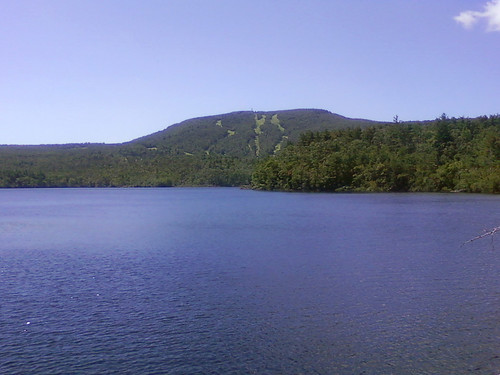
In 1842, a 25-year-old Henry David Thoreau walked from his home in the town of Concord, Massachusetts to the summit of Wachusett Mountain, 34 miles away. It's a small mountain, barely cracking 2,000 feet in height, and today it's best known for hosting a ski area where one can take a few runs on winter evenings after getting off of work in Boston.

When he got back to Concord, he wrote this:
"And now that we have returned to the desultory life of the plain, let us endeavor to import a little of that mountain grandeur into it. We will remember within what walls we lie, and understand that this level life too has its summit, and why from the mountain top the deepest valleys have a tinge of blue; that there is elevation in every hour, as no part of the earth is so low that the heavens may not be seen from it, and we have only to stand on the summit of our hour to command an uninterrupted horizon."
I can't claim that I've read a lot of Thoreau's writing, but this little passage might be my favorite of what I've come across.

Wachusett isn't much of a mountain, even by New England standards - it's eroded over long eons into a round-shouldered, leafy hill. Still, what humble "mountain grandeur" this hill has clearly made an impression on Thoreau.

He's telling us two things in this passage: first, that we don't need to fly to the Himalayas to awe ourselves with big mountains - we can experience the same feelings in our own backyards, if we care to look for them.

Mount Wachusett. Photo by flickr user ornoth / CC BY-NC-ND 2.0

Second, he's also telling us that we can carry that inspiration with us "in every hour" - that is to say, through the humdrum routines of everyday life. If only we raised our heads to look up, we can command the "uninterrupted horizon" of a summit view.

In my personal reading of this, Thoreau is asking us to continue thinking about our connections to the natural world even in the level life of the city, and in our daily work. If we can manage that, he tells us, we'll be rewarded with a sense of perspective and humility not unlike the sense we get from a clear mountaintop view.

It's common for people and our popular culture to misinterpret Thoreau's later experiment at Walden Pond as a rebellion against civilization. Indeed, this confused reading may be responsible for - and is certainly associated with - the destructive old orthodoxy that environmentalists' activities should be focused on places where there aren't (or don't seem to be) any people - whether the Arctic National Wildlife Refuge or the northern Maine woods. The participants of anti-urban, white-flight environmentalism in the 1960s, '70s, and '80s tried to realize this false conception of Thoreau's experiment in back to the land movements, and the result was widespread urban sprawl along with brutal economic and racial segregation in American inner cities.

The real Thoreau wasn't at all interested in turning his back on the problems of civilization. Unlike the back-to-the-land hippies, Thoreau's time at Walden was intentionally temporary, and mixed with frequent trips back to (and engagement with) society in the busy town of Concord. Being an active, engaged member of society - whether by protesting the institution of slavery, or publishing his writings, or selling the pencils he manufactured in his family's Concord factory - was extremely important to Thoreau.

He loved mountains - even humble ones. But he didn't climb them for bragging rights, or exercise, or to fool himself that the problems of the world didn't exist. He climbed them to bring a sense of clarity and perspective into his everyday life in the valley.

And that's a perspective that I wish more mountain-climbers would embrace.