Tuesday, March 16, 2010

Kabul, the Fulcrum of History


I've recently discovered, thanks to Jon Courtney at SPACE Gallery, the wonderful blog of Adam Curtis, a BBC documentarian and video archivist. The Medium and the Message mines a treasure-trove of old BBC clips, mostly from the Cold War era, to synthesize new historical narratives for our era. I think that it's the finest example of blogging I've come across yet, a seamless, beautiful, and compulsively engaging combination of words, photography, and video.

I'm currently poring through Curtis's ongoing series of posts on Kabul, and its historic role as the place where empires go to begin their decline. It begins with the British empire retreating from Kabul in 1841 - an event dramatized in 1971 BBC documentary - and traces the origins of Islam in Afghanistan, then discusses the West's 20th-century efforts to Westernize the city and the nation. There's a bit about Buckminster Fuller's pavilion for the Kabul International Trade Fair of 1956, and the establishment of the national airline, and the evolution of Afghan rock and roll. And the latest post, about the parallel lives of Benazir Bhutto - who helped to fund and empower the Afghan Taliban - and Yegor Gaidar, who implemented Russia's rapid, "shock therapy" transition to capitalism under Boris Yeltsin.

Here's some amazing footage that Curtis cribbed from a 1985 BBC report. It shows a modern Kabul factory, with middle-class workers, at the beginning of the Soviet invasion:


Also in that same post is a clip that shows the offices of GOSPLAN, the Soviet central economic planning bureau, just a few months before the collapse of communism. But do yourself a favor and read the whole thing - quoting bits and pieces here makes it sound like a mishmash, but Curtis weaves these different vignettes together beautifully.

Note: Unfortunately, BBC's video player is only designed to work in the UK, so only some clips on Curtis's blog will work. But this gives Americans a chance to see the internet the same way that savvy Chinese users do: by using proxy servers to fool the censors. Here's how.


Tuesday, March 09, 2010

Intermission Floods

Early last year I wrote a post about the sudden spikes in demand for electricity that happen nightly in Britain, when millions of Britons put on their teakettles at the conclusion of the soap opera Eastenders. A lone engineer sitting in a high-tech control room watches the program with the rest of the nation, and as soon as the credits roll, he opens the floodgates through dozens of European hydroelectric dams in order to deliver enough electricity.

It's a deluge equivalent to ten Niagara-sized waterfalls set loose for fifteen minutes every evening. On the surface, it's hard to see any connection between a cultural predilection for hot beverages, a television drama, and the ecosystems of European rivers. But it's certainly there - unfortunately, most Brits are too busy making tea to notice the hydrologic spectacle that their utility bills are paying for.

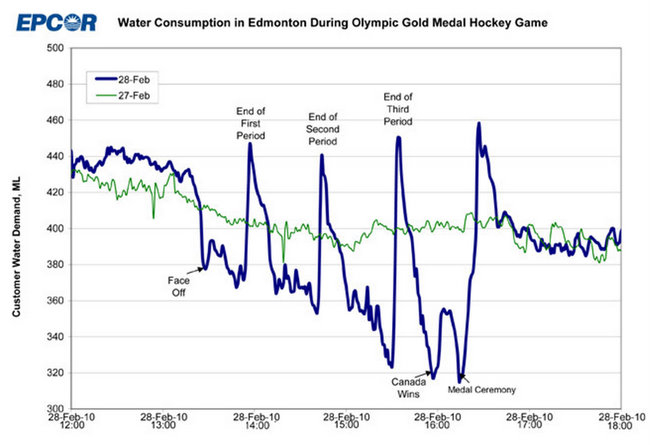
The big gold-medal hockey game between Canada and the United States provided another striking example of how a cultural phenomenon can set loose Biblical floods through the pipes of our modern infrastructure. EPCOR, the water utility in Edmonton, Alberta, recently published this chart of water consumption during the big game, which two-thirds of Canadians were watching (graph courtesy of Pat's Papers):

The scale of the y-axis is in megaliters, which means that between the final seconds of the third period and the pre-overtime intermission, water consumption spiked by 140 million liters, or 37 million US gallons - roughly the amount of water that flows over Niagara Falls in a two-minute interval. During the span of one commercial break, this water flowed from huge city reservoirs, through arteries of water mains and millions of bathroom pipe capillaries, then out through another mesh of pipes, into Edmonton's sewer system.

How's that for a natural wonder? Unfortunately, most Canadians missed the opportunity to witness it in person - they were locked in their bathrooms instead.

Friday, March 05, 2010

The working parking waterfront

Kudos to reporter Tom Bell for bringing attention to the over-supply of cheap parking - on waterfront property, no less, in today's Portland Press Herald. Bell notes that "Until the middle of the last century, when Portland's waterfront was a hub of transportation and fishing activity, the piers were covered with buildings, including warehouses for grain, molasses, coal and wood."

This was the city's working waterfront heritage, which everyone wants to preserve and protect.

However, Bell goes on to observe that "Most of those buildings have been demolished over the years, and today more than three-fourths of the area that could be developed in the central waterfront zone has no buildings. Instead, there is plenty of parking."

It's got some choice quotes, including:
“We don’t have a working waterfront. We have a parking waterfront,” said Don Perkins of the Gulf of Maine Research Institute.
This is kind of a dangerous idea. Portland prides itself so much on its working waterfront - the handful of bait shacks, trawler berths, and chandleries that still remain on the city's piers. Speaking the truth - that 3/4 of the "working" waterfront is really just a big parking lot - really deflates this big source of the city's pride.

Even the hotel and convention business, which is traditionally been seen as a prime economic adversary of marine industrial uses on the city's piers, agree that the acres of empty lots are a blight on the waterfront:

More public transit is the key to eliminating parking lots on the waterfront, said Barbara Whitten, executive director of the Convention and Visitors Bureau of Greater Portland. "A sea of cars," she said, "is not an attractive way to market the waterfront."

Read the full article here.

Wednesday, March 03, 2010

The Texting-While-Driving Solution: Park the Car, Take the Bus

Clive Thompson to Texters: Park the Car, Take the Bus

Excerpt:

"Texting while driving is, in essence, a wake-up call to America. It illustrates our real, and bigger, predicament: The country is currently better suited to cars than to communication. This is completely bonkers."

Monday, March 01, 2010

Portland's Unemployed Waterfront

My home city, Portland, Maine, takes great pride in its "working waterfront," and so do I. While most other cities have given over their central waterfront districts to luxury condos, hotels, and outdoor malls, Portland still reserves most of its downtown waterfront for lobster pounds, marine chandleries, and fish wholesalers.

The city has managed this by brute-force zoning laws: when the first tacky condos went up on Chandlers Wharf (pictured) in the 1980s, the city reacted quickly and viscerally to outlaw any non-marine activities on Portland's wharves. This kept rents low for the city's remaining marine businesses and let them continue doing business without fear of offending new neighbors.

But the 1980s, when kitsch like these condos and the "Dimillos Floating Restaurant" were introduced, was also the last time that the waterfront's creaking wharves attracted any real investment. Rental income from fishermen and other marine businesses alone isn't enough to maintain the docks and pilings, and after over two decades of the working waterfront protections, many piers are in dire need of repair and serious investment. Besides that, most of Maine's fisheries have collapsed, and there just aren't enough marine businesses operating anymore to fill up Portland's three-mile harborfront coastline. As a result, one gorgeous 19th-century brick warehouse has had its windows plugged with cinderblocks to be used for storage.

And on the western end of the waterfront, beyond the Casco Bay Bridge, is a mile-long stretch of waterfront that's been abandoned entirely for decades now:

A wrecked wharf and early-successional birch forest on the former Maine Central railroad yards of West Commercial Street, Portland.

This month, pier owners are lobbying the city to loosen its restrictive zoning, to make the business of operating a working waterfront a bit more feasible. Some of their suggested changes are productive: doing away with the requirement to set aside valuable waterfront real estate for parking, for instance. But others seem to be aimed at allowing hotels and other tourist catnip to replace the bait shacks and warehouses.

As many people have noted, though, the fishing piers and marine warehouses on the waterfront are a big part of what define's Portland's sense of itself - even if it isn't a huge part of the economy anymore. If those places get replaced with Hard Rock Cafe franchises and hotels, what's to distinguish our city from Baltimore or Boston or San Francisco or any other of the numerous cities that have auctioned off their historic waterfront districts to transform them into cheesy shopping malls?

The pier owners say that non-marine land uses are necessary to preserve what's left of the working waterfront. But five-star hotels and office buildings for lawyers are almost certain to drive up rents and displace what's left of the city's waterfront marine industries. The pier owners are telling us that in order to save the working waterfront, they need to kick out the working waterfront.

I'm not sure that the choice has to be such a stark distinction, between dilapidated piers and strict, industry-only zoning on the one hand, and Disneyfication on the other. On the one hand, I agree with the premise that the pier owners need their businesses to be more profitable than it is now so that they can repair their wharves and keep them from falling into the ocean. But I also agree that zoning can have a productive role in maintaining a place for struggling marine industries in the midst of development pressure from high-rent offices and hotels.

I've written here before about what I believe the solution would be: allow any kind of development on the city's waterfront wharves and piers, as long as a substantial portion of the ground level of those developments are constructed to be useful and adaptable for marine industrial tenants. Go ahead and build that hotel, on the condition that 3/4 of the ground level will be fitted out for lobster pounds and marine repair shops. The city could also dedicate a portion of new tax revenue from new developments to economic development programs for marine industries, in order to keep that ground-level space occupied.

Sure, we can make room for new development on the waterfront. But that doesn't mean we can't also preserve space for the marine industries that are already there.

This week, March 2nd and 3rd, the City will host (yet another) pair of public discussions about the working waterfront, in advance of a discussion about zoning changes. Details here.

Thursday, February 18, 2010

The Curse of the Albatross

Photographer Chris Jordan's images of albatross carcasses, bloated with the plastic bits that starved them to death, are easily the most disturbing testimonials of the Great Pacific Garbage Patch I have seen so far.


Images from Midway: Message from the Gyre, by Chris Jordan, via www.chrisjordan.com

These photographs remind me of Coleridge's "Rime of the Ancient Mariner."
At length did cross an Albatross,
Thorough the fog it came ;
As if it had been a Christian soul,
We hailed it in God's name.

It ate the food it ne'er had eat,
And round and round it flew.
The ice did split with a thunder-fit ;
The helmsman steered us through !
Images from Midway: Message from the Gyre, by Chris Jordan, via www.chrisjordan.com

But the Ancient Mariner of the title senselessly slays the bird, which brings a curse on the ship and its crew. They are tortured with thirst before a visit from a death-ship, yet the Mariner survives to suffer:
I looked upon the rotting sea,
And drew my eyes away ;
I looked upon the rotting deck,
And there the dead men lay.
The Mariner eventually makes penance. "He beholdeth God's creatures of the great calm" and "blessed them unaware." Then, "by grace of the holy Mother," he survives to tell the tale.

Coleridge's dead Albatross curses the Mariner with "a rotting sea;" today a similar trail of death swirls throughout the Pacific Gyre.

In a new profile in SEED Magazine, Jordan identifies our culture of consumption with the appetites of the Albatrosses:
"To me, the birds look like us: filling themselves with something that is not nourishing, thinking that it is, and killing themselves in the process. Isn’t that what we’re all doing as a culture? Our spirits are dying from our overconsumption of toxic plastic crap."
So: will the same death-ship that condemned the Mariner's crew visit us as well?

Or will we find the grace to save the oceans from a trillion plastic lighters and bottle caps?

Related: The Great Pacific Garbage Patch, May 2008.

Monday, February 15, 2010

Postcard from Antarctica

Our friends Geoff and Cricket (a.k.a. 13 Falls) sent us a postcard a couple weeks ago... from ANTARCTICA. Here's a picture of the postmark from McMurdo Station, the American base on the continent's coast due south of New Zealand. Amazingly, it only costs 28 cents to send a piece of paper from Antarctica to my apartment - nice work, postal service.

They ought to be home by now, but it sounds like they had an amazing austral summer. They shared some great stories and photos on two blogs they started writing for the job - Geoff's Hoary Frost of Heaven and Cricket's At Least It's A Dry Cold. It's pretty easy to read both straight through in one sitting - there's so much that's incredible about their life and work on the ice, and the pictures they took. They also spent a few weeks at Byrd Station, near the middle of the continent, which Cricket describes this way: "It feels like you’re in an infinitely large white room. On sunny days, the whole ground sparkles. And I swear that the first night I slept in a tent there, I could feel the depth of the 7,000 feet of ice between me and solid ground."

Here's a photo Geoff took of their tent neighborhood at Byrd.

My other favorite highlight from their blog chronicles are the photos Cricket took of a glacial fjord, which she and some co-workers climbed after disassembling the storage floor for a giant robot (a lot of what they write about sounds like it could be the first-person domestic account of the civilian extras who keep the ice base on Hoth running before the big attack in The Empire Strikes Back). Anyway, here's one of her pictures:

Those aren't clouds among the mountaintops, they're glaciers. And what really boggles my mind is to think that New England's mountains once looked like this, as recently as 13,000 years ago.

Welcome back to North America, Geoff and Cricket. Enjoy photosynthesis.

Friday, February 12, 2010

Double Aurorae on Saturn

The planet Saturn takes thirty Earth-years to orbit the sun, which means that its equinoxes happen only once every fifteen years. One of those equinoxes happened last September, and astronomers took the opportunity to focus the Hubble telescope on the planet to photograph it with both poles visible at once, and equally illuminated by the sun. The result is this image, which shows two simultaneous aurorae (!) on the poles of the distant gas giant:


Hubble captured a series of images like this one to assemble a short film of the aurorae, which are helping scientists to better understand Saturn's magnetic fields. "Given the rarity of such an event," comments ScienceDaily, "this new footage will likely be the last and best equinox movie that Hubble captures of our planetary neighbour."