Monday, November 29, 2010

The abandoned spaceport

I finally made it to Flushing Meadows Corona Park last weekend to visit the ruins of the 1964 World's Fair. Technically, the abandoned New York State Pavilion is closed to the public, but the fence is poorly maintained and it's easy to sneak in:


And here's how it looked in 1964:


The park is an hour's bike ride from the Queensboro Bridge, or you can ride the 7 train to the Mets-Willets Point station. If you're in NYC, visit soon before the Parks Department fixes the fence, or worse, tears down the historic structure altogether.

Much more to come about Flushing Meadows Corona Park in future posts here...

Tuesday, November 23, 2010

Atomic Age

I'm sharing Neil's comment on the last post (on 20th century atomic tests, and the associated spike in radioactive soil that dates to the 1950s) here on the front page, in case you missed it:
"And it's not just topsoil of course. Teeth and trees and deep sea corals and lichen and thereby reindeer piss all show bomb spikes."
Yes, teeth! Nuclear weapons going off in the upper atmosphere between 1955 and 1963 produced enough neutron radiation to create a dramatic spike in the world's supply of radioactive carbon-14 and strontium-90 (which are like regular carbon and strontium, but with extra neutrons fused on). These radioactive isotopes then lodged themselves into life all over the planet - including the tooth enamel of baby boomers.

This means that the degree of radioactivity in your teeth are can give a remarkably accurate determination (within 1-2 years) of when you were born. According to Dental Tribune (The World's Dental Newspaper), this forensic technique can be useful "in a large natural disaster or in an unsolved homicide case." Or if you're a biologist figuring out the growth rates of trees or corals.

So hey, the Cold War was good for something, wasn't it?


Image: advertisement for Detrifice Tho Radia, made from "a basic salt of thorium."

Monday, November 22, 2010

The 2,053 Nuclear Explosions of the 20th Century

Japanese artist Isao Hashimoto created this video timeline that shows the dates and locations of each of the 20th century's 2,053 nuclear explosions, 2,051 of which were detonated during "peacetime" as weapons tests.


When I was a college dilettante, I spent a semester's worth of evenings in training to become a NRC-certified operator of the chemistry department's research reactor. I dropped out of the effort when my economics coursework led me to balance the benefits of the effort - namely bragging rights - against the costs. It is justifiably difficult to pass the NRC's operator exam. But I did get a chance to power up the reactor under supervision in the control room, and it was a pretty great extracurricular lesson in nuclear physics and chemistry.

This video reminded me of one of the fascinating things I learned from that experience. All over the globe, undisturbed layers of topsoil that date from the early 1950s (when the Soviet Union detonated its first nuclear weapons and set off a rapid acceleration of tests worldwide) to October 1963 (when the Partial Nuclear Test Ban Treaty went into effect and sent subsequent tests underground) are substantially more radioactive than surrounding layers of soil - and will remain so for thousands of years.

The 20th century's close brush with self-annihilation is therefore a part of the geologic record. Future archaeologists, if there are any, will find it just beneath the chemical traces of the global suicide pact we're writing now - the rapid spike in atmospheric carbon dioxide.

Monday, November 08, 2010

History Repeating

NPR's Morning Edition reported today that gasoline and oil prices are on a steady rise once again. Though the US remains mired in a recession, many other large countries (like Brazil and China) are demanding more energy, while the supply for oil is flat or shrinking. The cost of crude oil is creeping towards $100 a barrel again.

When this happened in March 2008, forecasters correctly predicated that gasoline would soon be $4 a gallon. Over the summer, more and more suburban homeowners could no longer afford both to fill up their tanks and to pay their mortgages. And we all know what happened then.

But when all this transpired two years ago, people still had jobs and credit. That's not the case anymore - Americans have less purchasing power, which means that $4/gallon gas is going to hurt a lot more this time around.

One financial analyst quoted in the story brought up an interesting statistic: "A $10 increase in the price of oil is like a $200 million tax on the economy a day," said Gary Taylor, a principal with The Brattle Group. That's $1 billion every workweek.

Luckily, we have new government leaders coming in who are gung-ho to cut our taxes. I look forward to seeing how they'll set us free from the $1 billion/week oil dependency tax.


Monday, November 01, 2010

Up In Smoke

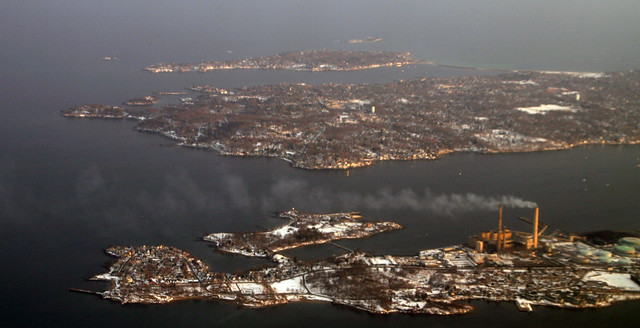
This is the Salem Harbor Power Station, a coal- and oil-fired power plant that's capable of generating 745 megawatts of dirty energy. That's more electricity than could be produced by all of New England's wind turbines, combined, on the windiest day.

The plant occupies a 65-acre site in the middle of historic Salem, Massachusetts. In fact, the plant's mountainous coal supplies - on a typical day, the plant burns over 700 tons - occupy a quay just a couple of blocks away from Nathaniel Hawthorne's birthplace.

Salem Harbor Power Station. CC-licensed photo by dsearls on Flickr.

According to New England's Conservation Law Foundation, Dominion Energy, the plant's owner, has filed documents to shut down the power plant in the near future. The combination of cheap power from wind turbines and cleaner-burning natural gas plants, combined with increasingly stringent Clean Air Act requirements, seems to be taking its toll on the 60 year-old plant.

This is good news. But New England still has work to do - there are still massive coal-burning power plants operating in our region, in places like Merrimack and Portsmouth, New Hampshire. Together, they send tens of millions of tons of greenhouse gas pollutants into the atmosphere on an annual basis, and these other plants have no closure plans in the works. The massive Brayton Point station in Fall River, Massachusetts, for instance, burns over 2 million tons of coal annually, and sent 148 pounds of neurotoxic mercury into the atmosphere in 2005 alone.

If the progressive and wealthy New England states can't shut down their climate-burning coal power stations, how can we possibly expect the rest of the world to do the same?

Thursday, October 28, 2010

Marble Hill in Manhattan (not the Bronx)

I recently discovered* Pathological Geomorphology, where various geobloggers share "images of extreme landscapes, landforms, and processes," organized around a monthly theme. Last month was dedicated to landslides, for instance. This month: "the juxtaposition (or superposition) of distinctly human-made landscapes with nature's geomorphic forms."

This immediately reminded me of Marble Hill, a neighborhood in the borough of Manhattan that is physically attached to the Bronx. Here's an aerial view - to orient you, this is the Harlem River ship canal where it curves around the northern tip of Manhattan. A small corner of the Hudson River is in the upper-left corner, and Broadway, and the West Side IRT subway lines, run diagonally from the middle of the bottom edge to the upper right-hand corner:


You can clearly see a looping s-curve through the middle of the picture. It's the old course of the Spuyten Duyvil Creek, which was widened and straightened in the nineteenth century for use as a ship canal between the Harlem and Hudson Rivers. On the left side of the photo is Inwood Hill Park, where I worked as an urban park ranger in 2005. The old creek is still more or less a waterway there, though it's been filled in substantially. The nature center and baseball field at the northeastern entrance of the park (the small peninsula left of center in the photo above) actually used to be connected to the Bronx.

The eastern loop is more interesting. It's been completely filled in - parking lots, warehouses, and big box stores now occupying the former creek bed. But the streets still trace the lines of the historic creek banks. The neighborhood between the new ship canal and the old creek bed is called Marble Hill. It was attached to Manhattan Island until 1895, when the ship canal sliced it off and marooned it as an island. Here's a map from that turn-of-the-century period, via Forgotten New York:


The creek was filled in 1917 to attach Marble Hill to the mainland of the Bronx, but the neighborhood, for political and judicial purposes, remained in New York County, and the borough of Manhattan.

I've heard, anecdotally, that a number of Marble Hill residents still insist on snubbing the borough that surrounds them by telling people they live in Manhattan, which sounds more upscale than the Bronx. So, while the historic geomorphology of the former Spuyten Duyvil Creek does survive to this day in a ghost-pattern of street layouts and land uses, it survives in a more tangible sense in the neighborhood's civic affairs and a general sense of inter-borough snootiness.

Of course, this is probably my best example of how ancient geomorphic forms have influenced human-made landscapes - but I've already written about that one.


*via mammoth, another blog I've discovered and really come to enjoy in the last couple of months - it writes extensively about urban infrastructure and how it relates to our economy and ecologies. If you like this blog, you'll enjoy theirs, too.

Friday, October 15, 2010

The global economy's kyūsho is in Denmark, Maine

The Japanese word kyūsho means vital point, or tender spot - the place where one applies the legendary "death touch" in kung-fu movies.

If you've been reading the news lately, you might be aware that a growing scandal over fraudulent foreclosures is consuming the entire global credit market in uncertainty. I was listening to a report on all this on NPR's "Marketplace" last night, and it occurred to me that, somewhere, there was a family that had been foreclosed on erroneously, fought the bank, and set into motion the events that are bringing credit markets to their knees once again.

In other words, somewhere out there was a single house that was powerful enough to shake the global credit markets to their very core. A kyūsho for the global economy.

And this morning, I found it, via the New York Times. Funnily enough, the house happens to be in the rural municipality of Denmark, Maine, just a few miles from where I grew up.


The Times reports:
Nicolle Bradbury bought this house seven years ago for $75,000, a major step up from the trailer she had been living in with her family. But she lost her job and the $474 monthly mortgage payment became difficult, then impossible.

It should have been a routine foreclosure, with Mrs. Bradbury joining the anonymous millions quietly dispossessed since the recession began. But she was savvy enough to contact a nonprofit group, Pine Tree Legal Assistance, where for once in her 38 years, she caught a break.
The story goes on to tell of how attorney Thomas Cox found and deposed the bank employee who had signed the foreclosure order. During that deposition, this employee "casually acknowledged that he had prepared 400 foreclosures a day for GMAC [the lender] and that contrary to his sworn statements, they had not been reviewed by him or anyone else."

The rest is more or less history. "Robo-signers" who approved hundreds of foreclosures a day without even looking at them were exposed nationwide, and foreclosures have now been frozen in 23 states.

This tiny $75,000 house in rural Maine is a lot like Bruce Lee's one-inch punch: we see the mighty banks knocked down, but it's damned hard to see how it happened. Mr. Cox and Ms. Bradbury are like Bruce Lee on the right, and the GLOBAL FINANCIAL SYSTEM is the sad sack on the left:


The entire story is extremely worth reading for anyone who wants to relish some schadenfreude at the expense of bankers and their lawyers, and as a case study for the lack of humanity in the financial system. Reporter David Streitfeld also tells us that Mr. Cox, the lawyer, had previously worked at a bank to call in loans on small businesses, often taking business owners' homes as collateral when they couldn't pay. The job ruined his mental health and his marriage, and he's since volunteered to work on behalf of borrowers "to make amends." I hope that this story redeems his conscience - it certainly ought to.

Ms. Bradbury's case deserves to make her a hero of modern times. It's already set a precedent that's letting thousands of families stay in their homes at the expense of negligent banks. And maybe someday, her humble house in the woods of Denmark will be memorialized as the place that finally foisted honesty on the banking system.


P.S. Pine Tree Legal Assistance, the group that Mr. Cox is volunteering for, is a nonprofit law firm. A judge ruled that GMAC would pay the legal expenses for Mr. Cox's work, but Pine Tree serves a good many clients who can't afford to pay, and here's how you can help them.

Wednesday, October 06, 2010

High-Rise Birdhouses

Artists in London have installed clusters of hundreds of birdhouses on Ailanthus Altissima trees (a.k.a. the Tree of Heaven, Ghetto Palm, or the Tree that Grows in Brooklyn) growing in the terrace gardens various public housing projects.


The high-density birdhousing is meant to mimic the high-density human housing of the surrounding human neighborhood. And also, perhaps, to mimic the proliferation of Ailanthus trees throughout most of the world's cities.