Friday, April 22, 2011

Tea Party Pity Party

Here's an entertaining story in today's Portland Press Herald:

PORTLAND - Eric Cianchette plans to sell the Maine Wharf on the city's central waterfront, saying he's tired of trying to come up with a mixed-use development plan that Portland officials will approve.

"I remember my father telling me, 'You can't just go through life saying what you don't want. At some point, you have to tell people what you do want,"' Cianchette said, and city officials "really don't want anything."
Eric is wrong - just like he was wrong about the inflated real-estate value of the wharf when he was suckered into buying it in 2004.

City officials most certainly do know what they want to have on our waterfront. They want successful marine-oriented businesses. They want a prosperous fishery. They want wharf buildings and businesses that take the fullest advantage of Portland's valuable deep-water harbor.

These kinds of businesses aren't easy to grow. They're challenging. They demand smart entrepreneurs who can think creatively.

By his own self-pitying words in this article, I can come to only one conclusion: Eric Cianchette isn't one of those creative businesspeople.

He bought a wharf. He proposed a formulaic, played-out business model instead of doing something challenging and entrepreneurial. And then he got fleeced when the real estate bubble popped. And now - he's blaming City Hall for his problems?

Give.
Me.
A.
Break.

I'm not a hard-assed business guru, but if I were, I'd probably say that this guy needs to stop looking for sympathy, and start looking for success.

There's a lot in common between Eric Cianchette's super sad story and the whole Tea Party zeitgeist of economic frustration. They're all fond of blaming the government. But when I look at those guys, I see a whole lot of failures who are bitterly trying to pin their shortcomings on politicians, instead of owning up to the pathetic reality of their circumstances.

Take, for instance, T.P. Governor LePage's resigning PR flack, Dan Demeritt, a man who made hay by defending businesses against "government regulation," only to succumb to bigger businesses when banks foreclosed on a number of his rental properties earlier this month.

And the Tea Party isn't just failing in business: it's also failing in governance. Just like Eric Cianchette's luxury hotel, the Governor's proposals are going nowhere fast. And true to form, even though he's the Governor now, the government's chief executive, he is STILL blaming the government: "I went on vacation last week because I had nothing to do," the Governor said last week at a Chamber of Commerce speech reported by the Sun-Journal's Steve Mistler. "Because I'm waiting. I'm waiting for legislation. I cannot do anything until the Legislature acts."

These are your tax dollars at work: a vicious cycle of finger-pointing. Who needs leadership when you've got scapegoats?

These guys act as though they hate government. But they need the government more than anyone. If the government weren't there, whom could they blame for their failures? Nobody but themselves.

The bottom line is this: business in Maine can't thrive until losers like these guys get out of the way. But for the time being, at least Eric Cianchette is getting out of Portland's waterfront.

Wednesday, April 20, 2011

Factory Nostalgia

Photo courtesy of tabism.com

Near the turn of the last century, Frederick Jackson Turner wrote his famous "frontier thesis": the idea that the frontier was what made Americans exceptional and unique - "the advance of the frontier has meant a steady movement away from the influence of Europe, a steady growth of independence on American lines. And to study this advance, the men who grew up under these conditions, and the political, economic, and social results of it, is to study the really American part of our history."

As many colonialist and racist problems as there are with Turner's frontier fetish, the idea still resonated. And that's probably because so many ordinary people behaved as though they agreed with Turner, whether or not they'd actually heard of him. For the entire subsequent century, Americans flooded into new frontiers of their own making: into suburban communities, into "ranch" homes on half-acre lots, into the nation's newly-dedicated national parks and forests.

America didn't start celebrating the wild frontier in earnest until it was already gone.

And now, at the turn of another century, we finally have something new - and newly lost - about which we can wax nostalgic: our industries.

Photo by flickr user Kyota.

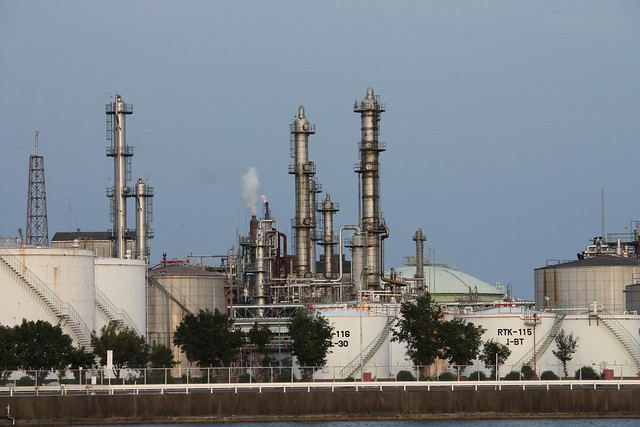
In Japan, an increasing number of charter bus tours and cruises are taking tourists on “kojo-moe” (工場萌え), or "factory love" tours of the country's remaining industrial areas. At a time when an intransigent recession and cheaper competition from developing nations are taking their inevitable toll on Japanese industry, tourist groups are kindling their nostalgia for the country's mid-century industrial boom, and getting sentimental over the steel and concrete landscapes that built their nation.

Yokkaichi oil refinery. Photo by flickr user Kyota.

And why should kojo-moe be limited to the Japanese? Isn't our cultural fascination with Detroit and all of its magnificent industrial ruins essentially the same thing? All the Japanese have done is come up with a name for it. "Factory love," the nostalgia that the 21st century feels for the 20th.


You can find many, many more "factory love" photos tagged on Flickr, here.


Monday, April 18, 2011

Vernal Pools of Portland

This evening I'll be giving a short talk about forest ecology at the Maine College of Art, as part of their FOREST show at the ICA. If you're in Portland, please come and save me from talking to an empty room.

To get ready, Jess and I took a bike ride on Sunday to explore the woods near the abandoned city dump, where there are several vernal pools at this time of year.

Above: a small vernal pool in the right-of-way of an unbuilt city street - that's a manhole in the background.

Vernal pools are temporary wetlands that fill up with snowmelt and spring rains and typically dry out by the midsummer. That important distinction keeps fish out and allows niche species - mostly amphibians - to breed and develop without competition from other wetland species.

This is another vernal pool closer to Ray Street. It's been a cold spring and so there wasn't much sign of life, but we did find what looked like some salamander jelly:


When a big rainstorm coincides with the first warmish evening of the spring, salamanders will come out of hibernation and venture down to breed in the same pools where they themselves had been born. Here in Portland, that probably happened last week or during Saturday night's drenching rains.

Male salamanders will deposit gelatinous packets of sperm on submerged sticks (like the one above), and later, females will deposit their eggs on top to fertilize them. Within the next few weeks, these will develop into tapioca-like sacs of salamander eggs.

Near "Stepping Stone Lane," a street name that tells you all you need to know about this neighborhood. You can actually make out some of the foreclosure boxes through the trees in the background here.

As the pools dry out in the summer, the amphibians they've nursed venture out into the surrounding woods as adults. These pools literally nurse the species near the bottom of the forest's food chain, providing food for critters in a wide radius.

These pools near Ray Street are just a 20 minute bike ride from downtown Portland - and there are similar pools located in the woods behind Evergreen Cemetery and in the uplands of the Fore River Sanctuary. No matter where you live in the northeastern U.S., there's probably a vernal pool not too far away. Finding them is half the fun.

At this time of year, they're neat places to visit: it's as though the entire forest's fecundity is concentrated here in these big puddles of water. It's also nice to take off your shoes and socks and wade into the water (which is still cool, but not cold) for the first time in months.

Monday, April 04, 2011

The Utopia Over the Freeway

The Bridge Apartments in Washington Heights. Photo used by permission from photographer Mario Burger,
Burger International, Inc.
.

Last fall, the Cooper Union hosted a show dedicated to Paul Rudolph's Lower Manhattan Expressway (or LOMEX) proposal - a design study intended to enamor New York City's modernist architectural elites with Robert Moses's freeway-building ambitions.

Rudolph was a genius draftsman, and he produced stunning drawings that manage to generate a sense of futuristic optimism and excitement around the idea of living above thousands of exhaust pipes stuck in traffic:


One of Paul Rudolph's LOMEX studies.


From at least the 1930s, when Moses was in charge of the Parks Department, New York's "Master Builder" wanted to build a freeway through lower Manhattan, connecting New Jersey to Brooklyn by way of the Holland Tunnel and the Williamsburg and Manhattan Bridges. Interestingly, Paul Rudolph's proposal came only during the Lower Manhattan Expressway's dying days, and only at the sponsorship of the Ford Foundation.*


Jane Jacobs had published The Death and Life of Great American Cities seven years previously, in 1961; a year after Rudolph began his study of the Expressway, in 1968, Governor Rockefeller would freeze Moses out of the city's transportation agencies. By the time Rudolph stopped working on this proposal in 1972, the city was on the verge of bankruptcy and grand building schemes like this one were relegated to the realm of fantasy. In a review on the Design Observer blogs, Mark Lamster wrote that Rudolph's was "an extraordinary vision, if not a practical one."


Rudolph's drawings are indeed amazing, especially the ones that compare the hugeness of his vision to existing landmarks (the red drawing above frames the towers of the Williamsburg Bridge, which is huge in its own right, in the center).

The show is powerful not just for its audacity, but for what we know now, forty years later, when the historic neighborhoods that Rudolph and Moses would have liked to have bulldozed are worth hundreds of billions of dollars. In hindsight, it's easy for us to say, "something like that could never actually happen."

Except for one thing: something like Rudolph's vision actually did happen. A few miles away, on the same island of Manhattan, urban renewalists and highway builders had actually finished a massive cross-island expressway, topped with apartment towers and a major transit hub, several years before Paul Rudolph started designing the LOMEX.


The new Trans-Manhattan Expressway seen from a tower of the George Washington Bridge. Photo from the LIFE Magazine archives.


This is the Trans-Manhattan Expressway, also known as I-95, the only Interstate highway that crosses Manhattan Island. It was opened in 1963, when a second deck was added to the George Washington Bridge to New Jersey. It crosses the island in Washington Heights, where the island is only one mile wide, but its construction still required the demolition and clearance of dozens of buildings on eight dense city blocks.
When the Expressway opened in 1963, Robert Moses, the freeway's champion, foreshadowed Paul Rudolph's work to come later in the decade:

"This is the first expressway to be built across Manhattan, and we hope that the Lower Manhattan and Mid-Manhattan expressways, both of which have been the victims of inordinate and inexcusable delays caused by intemperate opposition and consequent official hesitation, will follow. These crosstown facilities are indispensable to be effectiveness of the entire metropolitan arterial objective of removing traffic through congested city streets."

Of course, the scorn for opposition that Moses has on display in this quote was even then sowing the seeds of his downfall. And with the benefit of hindsight, it's easy for us to chuckle at the notion that building a fast and convenient route for cars and trucks to enter Manhattan would do anything to remove any traffic from New York's streets:

Photo by Zach K.


The Trans-Manhattan Expressway wasn't merely a freeway, though. It was a linear megastructure that stacked a complex of modernist transportation hubs and huge apartment blocks overhead. On the western end, Moses built a winged bus terminal that squatted over the freeway's entrance ramps:

Looking west towards New Jersey over the new Trans-Manhattan Expressway and the George Washington Bridge bus terminal. Photo courtesy of the Port Authority of NY-NJ.


George Washington Bridge bus terminal. Photo by gezellig-girl.com.


On the eastern end, the city sold development rights to private developers who built four enormous apartment towers, known today as the "Bridge Apartments." The New York Times did a story a few years ago called "Life on the Road," a chronicle of the apartments' history and what it's like to live there. "If the windows are open, the noise is most deafening on the middle floors, and people inside find that they need to raise their voices to hold a conversation or talk on the phone," writes reporter David Chen. "The winds carry vehicle exhaust upward, which is especially noticeable on the terraces. And on most floors, the vibrations of trucks can clearly be felt, along with those of any construction equipment."


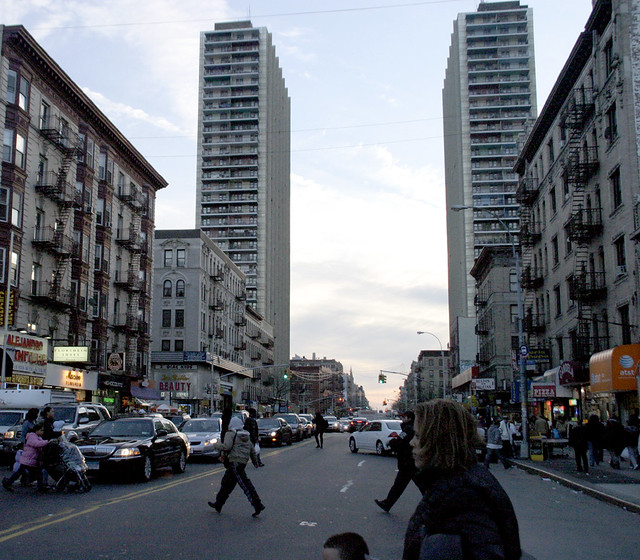
Two of the four Bridge Apartment towers, which mark the path of the Trans-Manhattan Expressway beneath. Photo by Zach K.


The Bridge Apartments loom over Washington Heights like mother ships from a sci-fi movie. I remember catching sight of them from time to time when I worked as a park ranger in Inwood Hill Park, two miles away, and being startled by their incongruous appearance on the skyline. This in a city known for its tall buildings - but the four towers, lined up in a row and hulking over a major freeway, have an otherworldly quality to them (Mario Burger's photo at the top of this post is the best illustration of this feeling that I was able to find online).

In all the reviews I've seen of Rudolph's show, I'm surprised no one has mentioned the Trans-Manhattan Expressway. It was obviously a major precedent in Rudolph's mind and in his designs - when he began working on LOMEX, the Trans-Manhattan Expressway would have still felt new and futuristic, not yet dated and dingy with soot and exhaust as it is now.

And for those modernist romantics who wonder at the ambitions of people like Robert Moses and Paul Rudolph, and yearn for a future that might have been: the gritty reality is on plain view to all in Washington Heights.


*The Ford Foundation's involvement in promoting LOMEX was probably not a self-serving effort to get more New Yorkers into Fords, as I'd initially suspected. By the late 1960s, the Ford Foundation, most famous for sponsoring the Corporation for Public Broadcasting, was separating itself from the Ford Motor Company through stock divestiture and new members of its Board of Directors (source). Instead, the Foundation seems to have hired Rudolph in a well-meaning - if misguided - effort to promote "urban renewal" in what were then some of the city's most impoverished neighborhoods.

Monday, March 21, 2011

Your Spouse is Radioactive: Radiation Risk in Perspective

Randall Munroe of XKCD has published an awesome visualization of radiation levels from various sources - view it here. Some points of interest:
  • People are radioactive: sleeping next to someone exposes you to 0.05 microsieverts, or 1/20th the dose you'd receive from an arm x-ray, thanks to trace amounts of radioactive isotopes we have in our bones and bodies - things like potassium-40 and carbon-14.

  • Bananas are surprisingly radioactive (thanks to all their potassium, a vital nutrient that also contains radioactive isotopes). Eating one single banana exposes you to a higher dose than living within 50 miles of a nuclear power plant for a year.

  • Coal power plants hit us with more radiation than nuclear plants do. This is because coal contains uranium and thorium, elements which are condensed and concentrated during the coal-burning process. And while nuclear waste is carefully confined, radioactive coal emissions go up the smokestacks and into our lungs, our cropland, and our fisheries. Living 50 miles from a coal plant will dose you with 0.3 microsieverts every year - that's like eating three bananas, for Christ's sake!

  • The Three Mile Island meltdown produced doses of up to 1 millisievert - about 1/6th the dose you'd receive from a chest CT scan. The Fukashima meltdown in Japan is producing doses of roughly 3.6 millisieverts per day at some sites within 50 km of the plant.

  • The lowest one-year dose clearly linked to increased cancer risk is 100 millisieverts. That would be equivalent to eating 2 million bananas, or spending a month in the neighborhood of the damaged Fukashima reactors. So avoid doing those things, and you should be fine.
I was also tickled to note that Munroe's chart was produced in association with "Ellen," the senior reactor operator at the Reed College Research Reactor. I spent a few months of my freshman year training (unsuccessfully) to become an NRC-licensed reactor operator, and even though I didn't follow through with it, I did learn a lot of excellent trivia about subatomic particles, nuclear history, and chemistry, which has been good material for party conversations these last few days.

Thursday, March 03, 2011

Glaciers at risk!

It's that time of year again when hundreds of truck-loads of snow get dumped near the bottom of Chestnut Street to form the Bayside Glacier (documented previously here, here, and here).

In last week's Portland Phoenix, I wrote a short follow-up piece about recent legislation that proposes to dump these icebergs of sewage directly into rivers and harbors.

PS - It's bullshit like this that has kept me from blogging much lately. Elections have consequences.

Wednesday, February 09, 2011

Hedging for the End of Civilization, Part II

While we're talking about the collapse of the global economy, and civilization in general, I should also mention that there are a lot of people who do expect something along these lines to actually happen. Perhaps not surprisingly, many of them can be found talking about it on the internet.

For instance, there's Wendy, the Surviving the Apocalypse in the Suburbs blogger, who lives and writes from somewhere near me in southern Maine, and is trying to transition her family to a more "self-sufficient" lifestyle.

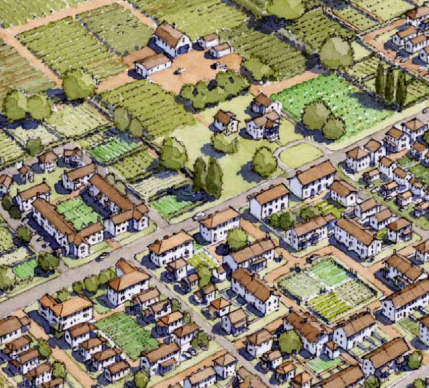
Architect Andres Duany thinks that peak oil and escalating food prices should convince real estate investors to build hobby farm collectives instead of golfing communities. For a million-dollar investment, your post-collapse future can look just like Tuscany! From "New Urbanism for the Apocalypse," by Greg Lindsay for Fast Company.

And I'm especially fond of the Urban Self-Sufficientist in Atlanta. He raises rabbits and grows veggies in the backyard of his in-town bungalow, but the best posts are about practicing falconry in local parks in order to enjoy homemade, free-range squirrel stew.

It's interesting how these different people pursue "self-sufficiency" in different ways. Wendy, for instance, makes much of growing her own food, but she still lives in a suburb where she's forced to pay for two cars and their fuel in order to acquire basic necessities. How's she going to find enough refined oil to fill her cars' tanks after civilization collapses?

Meanwhile, the Urban Self-Sufficientist takes an opposite tack, living in the middle of an urban neighborhood. If gasoline disappears, he won't be too put out - but won't his neighbors start taking an unsavory interest in the fruits of his backyard farm?

And architect Duany talks up economic collapse even while he tries to get real estate investors to build his planned communities, which will presumably be financed by 30-year mortgages. At least he's talking with people who ought to be experts in economic failure.

So even people who are planning for disaster clearly have different expectations of what it's going to be like: different people hedge for the end of civilization in different ways. Some believe that through the wreckage we'll figure out some way to keep our cars; others believe that we'll figure out a way to maintain a financial system.

I have my doubts on these counts - you're going to put more faith in American car culture than in America itself? - but then again, I also don't think it's much worthwhile to plan for any kind of collapse. Even if it does happen, it's going to be unpredictable.

Besides, I'm not much interested in self-sufficiency for its own sake. I'd rather rely on my neighbors for some things - there are plenty of people who are better farmers than I am, for instance, and I'd rather let others do the things they do well rather than try to do everything half-assed by myself. Specialization of labor is one of the innovations that got humanity out of the stone age, and even if civilization did collapse, I would hope that we wouldn't need to leave that idea behind - that we'd still be able to rely on our neighbors, families, and friends to help each other out.

Still, I do enjoy how the idea of self-sufficiency leads people to think about the places and the resources that provide their necessities for living. It's a roundabout way of thinking about our day-to-day relationships and dependencies on the natural resources that sustain us, and for some (like the falconer in Atlanta) it's a way to bring a little wildness home with us, even if we live in the middle of the city.

Self-sufficiency will not be any fun if it's forced on us. But as long as it's an elective activity, these bloggers make it clear that it can be a rewarding pursuit.

Monday, February 07, 2011

Hedging for the End of Civilization, Part I

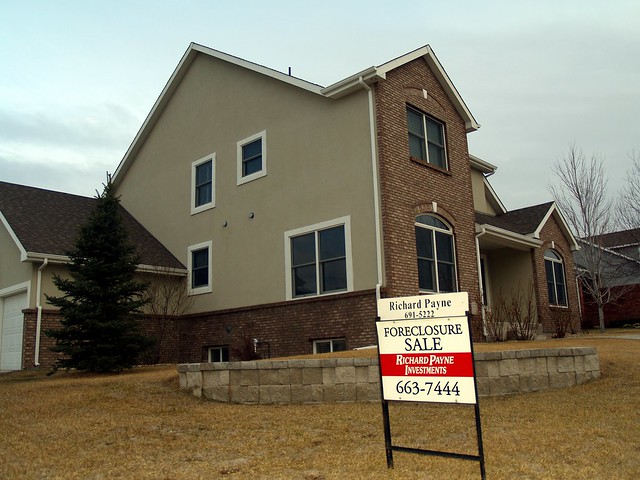
Tell me, would you trade 22 pounds of gold for this shoddily-built suburban confinement unit?

(creative Commons-licenced photo by David Shankbone, via his Flickr page).
Ever since the global financial crisis of 2008, when our mirage of real estate wealth dissolved faster than a mold-infested McMansion, and thousands of major employers looked into their bank accounts and realized that they wouldn't meet the weekend payroll without a bailout, it's become apparent to most people that "money" is only as valuable as everyone else thinks it is.

The paper bills we carry in our wallets are ultimately just paper. But they're valuable to us as a convenience of modern society: a means of exchange whose value we all agree on by consensus.

A few weeks ago, This American Life broadcast another great show from the economist-reporters at Planet Money all about the fiction of money. It made the point that money's value is a collective act of faith: we all trust that every store, bank, and employer will be more or less in agreement about the value of our dollar bills.

But societies have lost faith in the value of their currencies before - many, many times. When it happens, people are forced to rely on theft and barter in order to feed themselves. Faith in money is closely bound with the cohesion of civilization itself. If people can't trust their neighbors to value their currency, then they are less likely to trust their neighbors in general.

So far, because money is convenient and civilization is important to people, societies have invariably come back to trust money once again - no matter how badly it burned them before. It helps that, for the last century, the United States Dollar has lorded over everything as the world's papal currency. It's been the one kind of money that everyone could have faith in and rely on. Even when pesos and rubles collapsed, Argentines and Russians could still use tattered U. S. dollar bills as a trusted means of exchange.

But recently, the world has been questioning even its faith in the dollar. Which is not to say that anyone is losing faith in money: they're just looking for a new idol. And guess what it's made of?

In the past five years, the price of gold has more than doubled. Right-wing radio propagandists are making "money" hand over fist by sowing doubt in their followers' faith in dollars, and selling them overpriced gold as a "safe" alternative.

Gold has always been used as currency. It's compact, relatively rare, and impossible to counterfeit. It's still widely used as a reserve for the world's national treasuries - here's a great field report on Manhattan's Federal Reserve Bank gold vault, where 7,000 tons of gold are stored under the streets of the financial district in order to shore up our faith in the financial stability of national governments.

But if we're questioning our faith in the value of dollars, shouldn't we also question our faith in the value of gold? At the end of the day, it's just a shiny metal. Gold can't feed anyone, or generate energy. Just like paper bills, it's only valuable if lots of other people think that it's valuable. And if we really come to a circumstance where the dollar collapses and the world's economy comes crashing down, I can't see how a gold brick is going to do anyone a damned bit of good, unless you're using it to smash windows in a looting spree.

I don't consider that a realistic possiblity by any means, but it's an interesting thought experiment to consider what kinds of currencies would actually be valuable in that kind of situation. How about solar panels? If the dollar collapses, then utilities would lose the means to buy up supplies of natural gas and other fuels from overseas. Blackouts could become widespread. Homegrown electricity would be more valuable than gold in such a situation.

So if there's a real risk of that happening, then solar panels should be very, very valuable for anyone who's hedging their investments against the end of civilization, right?

Well, that's not happening: solar panels are actually getting less expensive, largely thanks to improved technology.

This tells us two things:
  1. The market doesn't seriously expect civilization and the dollar to collapse. And, as a corollary: the price of gold, which has more than doubled in four years, is an asset bubble just like McMansions and stock in Pets.com. Instead of a real estate craze or an internet craze, we're going through an Apocalypse craze.
  2. Glenn Beck's listeners would be much better off if they started buying bought renewable energy while it's still cheap, instead of overpriced gold coins.