Monday, June 20, 2011

Where not to go swimming in Casco Bay

Tonight, Portland's City Council will vote on a 25-year plan to reduce the amount of sewage that gets dumped into Casco Bay during wet weather.


The green warning signs like the one pictured above (located next to the city's cruise ship dock) mark the locations of Portland's combined sewer overflow outlets. During wet weather, when millions of gallons of rainwater flow into storm drains and overwhelm sewer pipes, these outlets keep sewerage from backing up into the streets, by dumping it into local waterways instead (read all the details here).

These combined sewer outlets can be found in surprising places: there are three in the heart of the Old Port, the city's tourism district, including one right next to the outdoor dining area of the Portland Lobster Company, another at the busy ferry terminal, and a third next to the city's cruise ship berth. Along with a few more further down the waterfront, these outlets collectively dump 145 million gallons of sewage into Portland Harbor in a typical year.

Seventeen more outlets ringing Baxter Boulevard, a popular city park, dump over 400 million gallons of mixed sewage into the shallow, stagnant waters of Back Cove. By way of comparison, last year's BP oil spill in the Gulf of Mexico dumped about 210 million gallons of oil into the Gulf.

Nearly twenty years into the city's efforts to separate storm drains from toilet flushings, the city has managed to shut down ten CSO outlets, including the one located nearest to the city's East End Beach, as well as most of the outlets that had dumped into Capisic Brook in the city's western suburbs. But dozens of overflow outlets still remain. The map below shows where they all are (the handful of star icons represent former outlets that have been closed):


As disgusting as this problem is, solving it won't be cheap, quick, or easy. The City is looking at a range of strategies, from building new green infastructure that can absorb rainwater into the ground before it flows into storm drains, to building huge underground storage tanks that can expand the system's capacity to hold sewage without spewing it out into the harbor.

Altogether, the recommended projects will cost the city $170 million - about $2,500 for every individual resident of the city - over the course of 25 years. That would roughly double our sewer bills, and not even then would we have a sewer system that avoids dumping sewage into Casco Bay altogether (the engineers estimate that we'd still dump 87 million gallons a year, an 88% reduction over current levels).

A fair and effective way to pay this bill would ask property owners who contribute the most to the city's sewer overflows to pay a greater share, by charging a fee in proportion to the amount of sewage and stormwater their properties send into the pipes. A one-inch rainstorm on an acre of pavement sends 26,000 gallons of oil-soaked stormwater (the equivalent of 15,000 toilet flushes) down the drains, so the owner of a large parking lot ought to pay substantially more to fix our sewers than an apartment dweller or a homeowner with a rain-absorbing garden.

This wouldn't just be a fairer way to pay for the city's sewer upgrades - it would also encourage property owners to make their own small efforts to help relieve the amount of stormwater flowing into our sewers, whether by tearing up some pavement to install a rain garden, or by fitting in more housing units on smaller lots. Small efforts multiplied thousands of times across the city's watersheds could substantially reduce the impacts of Portland's sewer problems, and the costs of fixing them.

Monday, June 13, 2011

Psychosis and the Suburb

I just finished reading J. G. Ballard's novel Super-Cannes, a scary psychological thriller that runs its gruesome course in the Silicon Valley of the Euro zone, the high-tech suburban office parks in the hills above the French Riviera.


Ballard convincingly asserts that the suburban office park is the architectural manifestation of nihilism. "Thousands of people live and work here without making a single decision about right and wrong," writes Ballard. "The moral order is engineered into their lives along with the speed limits and the security systems."

In Super-Cannes, the absence of moral agency drives executives into bouts of managed psychosis, employed to advance the greater good of executive productivity and shareholder value. As the novel advances, the degree of this executives' violence, sexual predation, and racist xenophobia become more and more intense and unnerving, but Ballard anchors it all in realism by name-dropping familiar corporations (a next-door neighbor who clubs Arabs by night is a Mitsubishi executive by day, a gruesome gunfight takes place on the roof of the Siemens carpark) - and mundane descriptions of the familiar office park landscape.

It's like a right-wing Fight Club, where repressed men band together to enforce corporate power instead of taking it down. And frankly, Ballard's vision - the Man sticking it to us with clubs, a private police force, and a hefty bribery budget to keep other authorities quiet - seems a lot more realistic than any of us sticking it to the Man.

Interestingly, right after I finished reading this, my wife had me listen to a recent This American Life podcast about psychopathy. In Act 2, Jon Ronson (author of the recent The Psychopath Test) interviews a successful business executive and finds that a lot of the traits he considers intrinsic to his success could also be interpreted as indicators of psychosis (actual doctors may find that a stretch, but the guy definitely has antisocial tendencies).

Also interestingly, there's been a flurry of articles this week about the decline of suburban office parks. A special report in Crain's Chicago Business declares that "Like the disco ball, the regional shopping mall and the McMansion, the suburban corporate headquarters campus is losing its charm," and goes on to profile several large corporations that are moving their headquarters offices back downtown.
"The whole corporate campus seems a little dated,” says Joe Mansueto, chairman and CEO of Morningstar... “We've always liked being in Chicago. It helps keep employees on the pulse of what's happening in our society. It keeps them current with cultural trends and possibly technological ones.”
Corporations moved their employees into the highly-controlled landscapes of office parks so that workers would be cloistered from competing job offers and isolated from social distractions for 60-hour work weeks. But maybe killing their workers' social connections and isolating them from creative ideas wasn't so good for profits, after all. Maybe there's still hope for sanity.


Sunday, June 05, 2011

A Self-Reliant Way to Walden

As noted last week, the preferred means of attaining transcendental enlightenment at Walden Pond is by burning petroleum to drive 70 miles per hour down the Concord Turnpike, just a few minutes past the corporate office parks of the 128 corridor.

Thoreau preferred to walk there, of course, from his family home and business in downtown Concord. But as Robert Sullivan discovered and reported in his book The Thoreau You Don't Know, most modern-day Concordians will tell you that it is now impossible to cover the 1.6 mile distance on foot, and will insist on giving you driving directions.

However, if you are lucky enough to have legs strong enough to withstand 30 minutes' worth of movement at an easy pace, it can be done! And so this post offers detailed walking and bicycling directions to Walden Pond from downtown Boston or Cambridge.

To go by foot, take the commuter rail line (which Thoreau rode frequently) from North Station to Concord village. Then head southwest on Thoreau Street, past the Starbucks and the strip mall parking lots. After 10 minutes, turn right on Walden Street, passing Concord High School (you're halfway there). Climb a short hill and wait for the walk signal to make your way safely across the four-lane Turnpike, then take the trail into the woods, past the site of Thoreau's cabin, to the shore of Walden Pond.

Alternatively, you could ride your bike, which makes for a great day trip and lets you take in a couple of good rest stops en route to Concord.

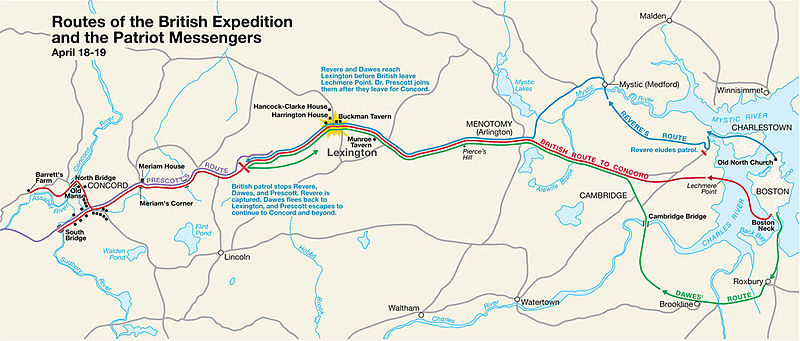
From downtown Boston, there are two good ways to bike to Walden Pond: via the Minuteman Bike Path, which roughly follows the course of the Battles of Concord and Lexington, or by way of Trapelo Road, which is a more direct route through Belmont, Waltham, and Lincoln, but also has more traffic and hills. Personally, I like to go out on Trapelo Road, stopping by the Gropius House on my way out, and come back in on the flat Minuteman Bikeway at the end of the day when my legs are tired.

Either way, you'll need to get through Cambridge first. If it's Sunday, you can weave footloose and fancy-free through the four lanes of Memorial Drive, which is closed to cars on summer Sundays until 7 pm between Western Avenue and Mt. Auburn Street.


At Mt. Auburn Street, either make your way north along the edge of Fresh Pond to get to the Minuteman, or grit your teeth a few blocks through heavy traffic to get to Belmont Street, which turns into Trapelo Road.

Belmont is "thickly settled."


On the other side of Route 128, Trapelo Road enters Lincoln, one of those fancy suburbs where abundant conservation lands clearly serve the dual purposes of maintaining a nice view for wealthy residents while also excluding the condo-dwelling hoi polloi from becoming their neighbors. Notwithstanding the elitism, it's a nice place to ride bikes on shady roads.

On the other side of Lincoln's main intersection, Trapelo Road turns into Sandy Pond Road. You'll pass by the Decordova Museum and Sculpture Park. If you enjoy your art in a setting of overwhelming privilege and cultural homogeneity, it's worth a stop. When we visited, though, we got passive-aggressively talked to for not paying the car-parking fee (because we were on bikes, a "problem" that the Decordova management apparently isn't accustomed to).

Performance art concept: get a crew together to visit the Decordova on foot or by bike, and see how long you can avoid then Gulf oil-funded security detail.

A better place to stop lies a mile or so further down the road. Passing by the Decordova, you'll take a left onto Baker Bridge Road, where, in an old orchard on the left side of the road, you'll pass Walter Gropius's house, now a publicly-accessible historic site owned and managed by Historic New England.

Gropius was the founder of the Bauhaus, and designed this house in 1938, when he came to Massachusetts to teach at the Harvard Graduate School of Design. It's a small and simple dwelling that fits in unassumingly with its rural surroundings (unlike most of its neighbors), and the home's caretakers have preserved the family's possessions, including a lot of original Bauhaus furniture. Tours run hourly until 4 pm, Wednesday through during the summer.

The Gropius house is just a mile away from the main park entrance to Walden Pond - Gropius probably walked there often, and it's interesting to think about the parallels between Walden and the Bauhaus philosophy (maybe a subject for a future post).

At the end of Baker Bridge Road, take a right on Concord Road, and after half a mile further, you're at Walden Pond.

With stops, the bike ride takes 2 to 2.5 hours. On the way back, continue northward on Concord Road to make the 1.5 mile trip into Concord village (where there's ice cream), then take the Reformatory Branch Trail towards the Minuteman in Bedford. With flatter terrain and fewer stoplights, the trip back to the Alewife T station takes about 90 minutes.

I swam in Walden Pond last weekend; the water was refreshing and not too cold. If you're in Boston, it's not hard to get there. Go visit!

Wednesday, June 01, 2011

From Skid Row to Starbucks

The alleged etymological origins of the term "skid row" are in the Pacific Northwest, in districts where lumbermen "skidded" logs down towards mills and ships lining the waterfront, and where disreputable trades served lumbermen who were eager to spend their earnings on vices after long and sober months in the woods.

One of the most famous skid rows is in the neighborhood around Seattle's Pioneer Square, centered around Henry Yesler's sawmill. The neighborhood followed a familiar skid row trajectory: first, the waterfront industry moved away. Then, urban renewal projects manifested the city's disrespect for the neighborhood by demolishing lots of buildings and leaving the rest to wither in the shadows of ugly, soot-soaked freeway viaducts. Under the traffic, intentionally hidden from view, strip clubs, drug vendors, and homeless agencies flourished.

And then, when developers realized how close these skid rows were to downtown, and how cheap the real estate still was, the skid rows quickly flipped into yuppie pleasure districts, from New York's Bowery to San Francisco's Tenderloin District. And Pioneer Square attained the ideal embodiment of this post-industrial destiny when Starbucks built its complex of corporate headquarters offices in the neighborhood.

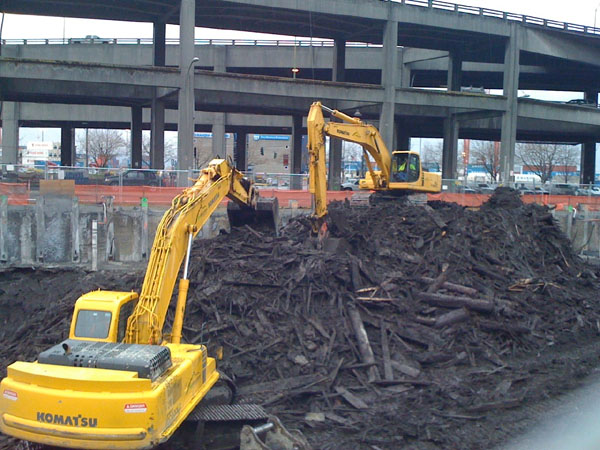
By the time crews started excavating for the 4-level underground parking garage, they confirmed that the old age of logging was dead and buried. Literally.


Photo by Scott Durham, of centraldistrictnews.com

Instead of digging down into post-glacial gravel, backhoes found a morass of rotting timber instead: the discarded slash from the old mills, the century-old pilings of old wharves and railroads, and the miscellaneous debris that nineteenth-century land developers had tossed into the city's marshy waterfront to transform wetlands into dry quays above sea level.

This item came to my attention via hugeasscity, which noted that the city's plan to renovate the aging Alaskan Way Viaduct (the concrete urban renewal scar visible in the background of the photo above) calls for putting the freeway underground. Which sounds like a neat-o plan for a Tomorrowland version of Seattle, until you consider that the whole gleaming, modern Seattle waterfront district is actually built atop an unstable, sinking pile of wood. Plus an active fault line.

In the end, it doesn't matter how many lattes and condos you sell above ground: the roots of the city will always be in Skid Row.


PS- the bike tour to Walden post I'd promised yesterday is still coming - check back tomorrow! I'm going on a blogging tear this week to make up for lost time.

Tuesday, May 31, 2011

Walden

While in Boston over the weekend, we took our first swim of the summer in Walden Pond, the famous suburban retreat where Henry David Thoreau lived for two years.

Walden was never a wilderness - even when he lived there 150 years ago, it was still within a 30 minute walk of Concord's busy downtown, where Thoreau managed the family's pencil-manufacturing factory. The commuter rail line that skirts the western edge of the pond today was still there in Thoreau's time (he'd often walk along it as a shortcut from his cabin to the town).

But, inspired in part by Thoreau's writings, people have changed the woods around Walden tremendously in the past century and a half. Americans following Henry David's suburban impulse ("I have, as it were, my own sun and moon and stars, and a little world all to myself," Thoreau bragged in a chapter of Walden titled "Solitude") have transformed Concord from a small agricultural and manufacturing center into a convenient bedroom community halfway between Worcester and Boston.

Three miles east of Walden Pond, modernist cubicle farms for software and pharmaceutical companies crowd along the Route 128 corridor, surrounded by greenery designed to be enjoyed at 55 miles per hour.

From there, a four-lane expressway, the Concord Turnpike, runs within a hundred yards of Thoreau's homestead site. In the time it took him to make his daily 2-mile walk to Concord, modern Thoreauvians can drive themselves all the way to Logan Airport (albeit with less self-reliance).

The road goes two ways, of course, which means that Walden Pond has also become an extremely popular destination for anyone in the metro Boston region who wants to live deliberately and front only the essential facts of life for a few hours after a rough day of shopping at the nearby Burlington Mall.

The state has gradually tried to buy up the land around Walden Pond to turn it into a state reservation. Still, in doing so, the remaining privately-owned parcels nearby have become increasingly valuable as tourist traps and highway rest stops, making additional land conservation asymptotically difficult.

And as a public park, several acres of Walden's former Woods have been cleared to make way for parking lots, a replica of Thoreau's cabin, and the "Thoreau Society Shop" (Thoreau's famous quotation on poverty - "Do not trouble yourself to get new things, whether clothes or friends... Sell your clothes and keep your thoughts. God will see that you do want society" - graces the shop's best-selling t-shirts).

A large bathhouse overlooks a tiny beach on the eastern end of the pond near the parking lots and souvenir shop. The spring-fed pond itself is facing serious erosion problems in the face of all the foot traffic and bootleg sunbathing clearings on every shore, and the state has built a long concrete wall to keep the land nearest the beach from sliding into the pond:

The pond's circumferential footpath in many places runs within inches of the water, compacting the forest soils and making it difficult for plants to take hold and establish their natural filtration functions.

Thankfully, the agency in charge is taking a more aggressive stand against erosion, and erecting fences that keep people from treading on every inch of shoreline. The conserved forestlands that surround Walden Pond do a good job of filtering out the oil- and pesticide-soaked runoff pollution from surrounding freeways, parking lots, and McMansion developments, and so Walden Pond itself is remarkably clean, in spite of its metropolitan surroundings. It's one of my favorite swimming holes anywhere - and I say this as a connoisseur who lives in a place with a bounty of swimming holes.

In a follow-up post tomorrow, I'll write about one of my favorite Boston bike rides: downtown to Walden Pond in about 2 hours, which makes for an ideal summer day trip.

Monday, May 02, 2011

Terrorism Survives

I'd had a nice weekend. A great weekend, even - one that made me feel grateful to live in Portland, Maine, with spring weather, sunny skies, and the company of good friends on my 30th birthday.

And then, on my bike ride to work this morning, I passed by our neighborhood mosque, just a few blocks from my house, and I saw this.


And, in addition to this, more graffiti that said "Long live the west" and "Go home."

I've been in a funk all day. The mosque is a nondescript building; there's nothing on the outside to indicate that it's a place of worship, which leads me to suspect that it was someone from our own neighborhood who did this. Somewhere in this city I love there is at least one cowardly neo-Nazi who has the disgusting gall to believe that religious persecution is somehow an American value.

Seeing this provided a visceral demonstration of how rage can beget more rage. I found myself wishing I'd had the presence of mind to head outside and check on our neighbors last night when I'd heard the news. With a baseball bat.

But what good would that really have done? This is just graffiti, and it's already been painted over. American Muslims, unfortunately, have suffered much worse. The real damage is the toxic, self-consuming hatred that still persists, not only in the bitter minds of those who did this, but even in the dim intellects of presumably "upstanding" members of our community. Let's not forget our daily newspaper's publisher, Richard Connor, the dimwit who apologized for running a front-page story about local Ramadan celebrations last September 11, and then humiliated himself and his city by broadcasting his racist cowardice on national radio.

Make no mistake: the fact that Americans among us could behave this way is much more of a threat to the American republic than Osama bin Laden ever was.

If Osama Bin Laden's death spurs cowardly, Klan-like hate crimes like this one, then there is nothing to celebrate today. The terrorists are still among us.

Friday, April 22, 2011

Tea Party Pity Party

Here's an entertaining story in today's Portland Press Herald:

PORTLAND - Eric Cianchette plans to sell the Maine Wharf on the city's central waterfront, saying he's tired of trying to come up with a mixed-use development plan that Portland officials will approve.

"I remember my father telling me, 'You can't just go through life saying what you don't want. At some point, you have to tell people what you do want,"' Cianchette said, and city officials "really don't want anything."
Eric is wrong - just like he was wrong about the inflated real-estate value of the wharf when he was suckered into buying it in 2004.

City officials most certainly do know what they want to have on our waterfront. They want successful marine-oriented businesses. They want a prosperous fishery. They want wharf buildings and businesses that take the fullest advantage of Portland's valuable deep-water harbor.

These kinds of businesses aren't easy to grow. They're challenging. They demand smart entrepreneurs who can think creatively.

By his own self-pitying words in this article, I can come to only one conclusion: Eric Cianchette isn't one of those creative businesspeople.

He bought a wharf. He proposed a formulaic, played-out business model instead of doing something challenging and entrepreneurial. And then he got fleeced when the real estate bubble popped. And now - he's blaming City Hall for his problems?

Give.
Me.
A.
Break.

I'm not a hard-assed business guru, but if I were, I'd probably say that this guy needs to stop looking for sympathy, and start looking for success.

There's a lot in common between Eric Cianchette's super sad story and the whole Tea Party zeitgeist of economic frustration. They're all fond of blaming the government. But when I look at those guys, I see a whole lot of failures who are bitterly trying to pin their shortcomings on politicians, instead of owning up to the pathetic reality of their circumstances.

Take, for instance, T.P. Governor LePage's resigning PR flack, Dan Demeritt, a man who made hay by defending businesses against "government regulation," only to succumb to bigger businesses when banks foreclosed on a number of his rental properties earlier this month.

And the Tea Party isn't just failing in business: it's also failing in governance. Just like Eric Cianchette's luxury hotel, the Governor's proposals are going nowhere fast. And true to form, even though he's the Governor now, the government's chief executive, he is STILL blaming the government: "I went on vacation last week because I had nothing to do," the Governor said last week at a Chamber of Commerce speech reported by the Sun-Journal's Steve Mistler. "Because I'm waiting. I'm waiting for legislation. I cannot do anything until the Legislature acts."

These are your tax dollars at work: a vicious cycle of finger-pointing. Who needs leadership when you've got scapegoats?

These guys act as though they hate government. But they need the government more than anyone. If the government weren't there, whom could they blame for their failures? Nobody but themselves.

The bottom line is this: business in Maine can't thrive until losers like these guys get out of the way. But for the time being, at least Eric Cianchette is getting out of Portland's waterfront.

Wednesday, April 20, 2011

Factory Nostalgia

Photo courtesy of tabism.com

Near the turn of the last century, Frederick Jackson Turner wrote his famous "frontier thesis": the idea that the frontier was what made Americans exceptional and unique - "the advance of the frontier has meant a steady movement away from the influence of Europe, a steady growth of independence on American lines. And to study this advance, the men who grew up under these conditions, and the political, economic, and social results of it, is to study the really American part of our history."

As many colonialist and racist problems as there are with Turner's frontier fetish, the idea still resonated. And that's probably because so many ordinary people behaved as though they agreed with Turner, whether or not they'd actually heard of him. For the entire subsequent century, Americans flooded into new frontiers of their own making: into suburban communities, into "ranch" homes on half-acre lots, into the nation's newly-dedicated national parks and forests.

America didn't start celebrating the wild frontier in earnest until it was already gone.

And now, at the turn of another century, we finally have something new - and newly lost - about which we can wax nostalgic: our industries.

Photo by flickr user Kyota.

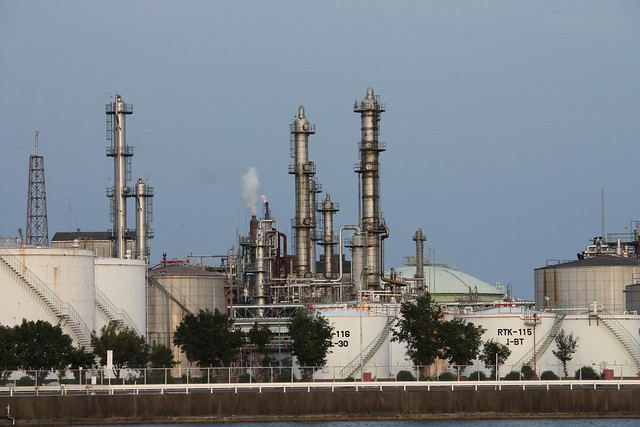
In Japan, an increasing number of charter bus tours and cruises are taking tourists on “kojo-moe” (工場萌え), or "factory love" tours of the country's remaining industrial areas. At a time when an intransigent recession and cheaper competition from developing nations are taking their inevitable toll on Japanese industry, tourist groups are kindling their nostalgia for the country's mid-century industrial boom, and getting sentimental over the steel and concrete landscapes that built their nation.

Yokkaichi oil refinery. Photo by flickr user Kyota.

And why should kojo-moe be limited to the Japanese? Isn't our cultural fascination with Detroit and all of its magnificent industrial ruins essentially the same thing? All the Japanese have done is come up with a name for it. "Factory love," the nostalgia that the 21st century feels for the 20th.


You can find many, many more "factory love" photos tagged on Flickr, here.