Monday, October 29, 2012

Buried Wetlands Rise from the Grave

This evening, Hurricane Sandy's storm surge will combine with astronomical high tides to give eastern seaboard cities an exciting preview of sea level rise. Forecasters are predicting storm surges up to 10 feet above the average high water mark — especially in western Long Island Sound and New York Harbor, where the storm is funneling massive volumes of seawater into the right-angled corner formed by New Jersey and Connecticut.

As I wrote last week in Grist, most big cities have buried their wetlands and creeks underground. But big storms and flood events like this one have a way of making those hidden waterways reassert themselves, as underground sewers and stormwater channels fill up beyond their design capacity and overflow into the streets above.

That can happen in unexpected places. Here in Portland it wasn't even particularly stormy today, and there was only light rain. But the astronomical high tide did push water up to the surface of Somerset Street, four blocks away from Back Cove (note the empty tree wells — similar events killed the street trees planted here in 2006 due to salt water in the roots).

Meanwhile, in Philadelphia, heavy rains may once again cause problems in the sewer-bound Mill Creek.

And in New York City's Boerum Hill and Park Slope neighborhoods, the old marshes of the Gowanus Canal may once again take over the streets. This overlay of the Brooklyn section of the 1782 British Headquarters Map shows (roughly) how far the old marshes of the Gowanus used to extend across central Brooklyn:

Wednesday, October 24, 2012

On Grist.org: "Sewer Discretion is Advised"

I've just published a new film review on the environmental news site grist.org about two new documentaries that profile the new watersheds. Here's an excerpt:

Most urban streams and creeks are hidden from sight — in huge sewer tunnels under streets and expressways, in concrete ditches behind razor-wire fences, and sometimes even in pipes under the manicured lawns and gardens of city parks.

These are hardly the kinds of places you’d see on the cover of an L.L. Bean catalog — although you might find a few L.L. Bean catalogs in these concrete creeks.

But a growing network of urban explorers, who sometimes call themselves “drainers,” are sneaking into the storm sewers and aqueducts to rediscover these long-hidden waterways. They’re finding lush forest groves among the concrete ditches and waterfalls and grand vaulted grottoes in underground sewers. Their photography and field notes remind residents that the rivers and streams that nursed their cities’ early growth still survive below the pavement, and are still worthy of appreciation — maybe even restoration.

Now, not one, but two new documentary films follow this small subculture of urban river enthusiasts, and celebrate the outsized impact of their civilly disobedient urban river expeditions.
Read the rest at grist.org.

Tuesday, September 18, 2012

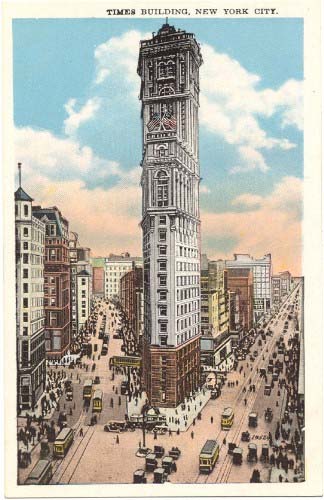
How an Icon of Journalism Became a Hollowed-Out Billboard

When it was built at the southern end of Longacre Square in 1903, the new headquarters of the New York Times became a landmark of midtown Manhattan, and helped publisher Adolph Ochs convince the city to rename the famous intersection in front of the building as Times Square.

One Times Square in 1904 (source).One Times Square in 2010.
Photo: Bernt Rostad/Flickr
By the mid-20th century, though, the Times had sold the building, and a new owner dismantled the intricate granite and terra-cotta facade to replace the exterior walls with plain concrete panels. In 1996, shortly after the City Council passed new laws that expelled porn theaters from the area, the building got sold again, to Sherwood Outdoor, an advertising firm. By then, the building's signage was covering most of the exterior windows, leaving the offices inside rather dark and dreary.

Rather than spend money to renovate, the new owners decided to simply abandon the building's interior above the 3rd floor, and use the top part of the building exclusively as a billboard (the lower 3 floors are still used, periodically, as retail space — it's currently a Walgreens drug store).

So for the past 15 years, the iconic building that was the namesake of Times Square itself, and a major headquarters of journalism, has become a hollowed-out shell, a mere scaffold for electronic signs.

At the Crossroads of the World, the value of advertising has trumped the value of journalism, and of work in general. 


Postscript: Illustrator Joe Mckendry has made a gorgeous before-and-after elevation drawing of the building's eastern facade in 1904 and in 2010, for his book One Times Square.

Monday, September 10, 2012

The Indian Burial Ground in the Basement

I was walking the dog this weekend along Hammond Street, a quiet residential block squeezed on the hillside between busy Washington Avenue and the industrial district of lower East Bayside here in Portland. They're building two new apartment buildings on a lot at the end of the street, and have started digging out the foundations.

Fascinatingly, the basement excavation has revealed a cross-section of the hillside, which is full of shells. Mostly longneck clams, with a few oysters here and there:


The dense layers of shells are sandwiched between clayey marine soils that are typical of our neighborhood, and they follow the slope of the hillside, such that the same layers are visible twice in the excavation: once against the vertical wall on the uphill side, and once again on the floor:


I'm pretty confident that this is a Native American shell midden — a trash heap from seafood feasts of centuries past. Though it's several blocks and a freeway crossing away from the ocean today, this hillside used to drop straight down into the tidal flats of Back Cove, as you can see in this 1837 map of Portland. The red dot shows the site of this construction site, smack dab on the old shoreline:


Back Cove is a tidal basin — exactly the kind of place where longneck clams thrive, although you wouldn't want to eat them these days. Other parts of the shore around Back Cove were probably marshy and difficult to access from land, but this location, next to a steep hillside, probably offered more direct access to the flats for humans, and for clams, there was relative proximity to the nutrient-rich tidal flows at the Cove's outlet.

I've been kind of stumped by how the shell heaps are interspersed with layers of clayey soil. This photo shows the horizontal cross-section of two layers (on the future basement floor in the foreground) as well as the sloping vertical cross-section (on the street-facing wall, in the center of the photo). At the left edge of the photo is Anderson Street, which was once the shoreline. How did all that clay get in between? 


Stranger still is how some of the shell layers seem to overlap with each other:


My guess is that the steep slopes of the hillside probably set off occasional landslides, which would periodically bury a heap of shells under a thick layer of mud washed down from the higher ground above.

Any archaeologists care to comment?

Related post: Longfellow's Garbage

Update: Howard Reiche e-mailed me this this morning (Sept. 11):
The Knudsen home, which
stood on the site until this
summer. From the City of
Portland's 1924 tax records
.
 Good for you. That was my grandfather’s (Knud Knudsen) house where he raised 13 children after immigrating from Denmark. We have a family photo of my mother, Laura Christine (Knudsen) Reiche, feeding the ducks in the water which came to the foot of their garden which I walked in many times..
    Hammond St. was named after the Hammond rope walk which was originally at that site. Possibly the “layers of clay” mystery had something to do with the construction or changing of the rope walk. 

Tuesday, August 28, 2012

The Pizzashed

PBS has commissioned an amazing-looking documentary series called America Revealed (partially based on the popular BBC series "Britain from Above," from which I learned about the Teatime Deluge). In this segment, they attach a GPS device to Dominos Pizza delivery guys in Manhattan to animate the patterns of pizza delivery on a Friday night.

And then the camera zooms out, revealing the routes of the pizza shops' daily deliveries from a distribution center in northern Connecticut.

And then the camera zooms out more, to show the routes of satellite-embedded, refrigerated trucks moving across the continent, bringing dough, toppings, cheese, and tomato sauce from farms and food processing facilities to the distribution centers.

Behold, the American pizzashed:

Watch Pizza Delivery on PBS. See more from America Revealed.

Tuesday, August 14, 2012

Pussy Riot's April 29 Letter to President Medvedev

This is a bit off-topic from this blog's usual fare, but very much worth reading, I assure you. A friend here in Portland has been coordinating a lot of international activism on behalf of Pussy Riot, the Russian feminist punk group whose members were jailed last fall for provoking the regime of Vladimir Putin.

The three imprisoned members are currently in the midst of a show trial, and expect to receive a sentence later this week. I'm dusting off my Russian to help compile and edit a collection of the group's translated texts, including letters from jail, manifestos, essays, and court statements, for a public reading in New York later this week.

These texts are heartbreaking, angry, and brilliant. But they also have a dark, cynical humor to them. The irony of suffering at the hands of the Russian state as they pursue their hopes for a better Russian society is not lost on them — indeed, it puts them in good company with dozens of other Russian artistic geniuses.

Of the pieces I've edited so far, this April letter to lame-duck president Dmitry Medvedev (whose "presidency" was merely a benchwarming interlude for Vladimir Putin, whose dictatorship at least has the modesty to make shallow gestures towards constitutional term limits) is among my favorites, for the way it relentlessly, humorously skewers the impotence of the figurehead president.

Note: this translation is mostly my own. There was a rougher English translation previously available at freepussyriot.org, but I spent an evening polishing the language and diving into the original Russian to get the tone closer to the intent of the original. If any native Russian speakers have suggestions for further edits, I'll happily take advice in the comments. Here's a link to the Russian source.


Letter to President Medvedev
Here is the response Pussy Riot gave regarding D. Medvedev’s comment that the members of the group had “achieved their goal,” in a TV interview the Russian President gave to journalists from five TV networks on April 26 2012.

This response was written after the President refused to consider the evident violation of the principles of the law in the Pussy Riot case.


“Freedom is when you forget the name of the tyrant.”
    Josef Brodsky, 1975

“Freedom is a unique feeling, which is different for each person.”
    D. Medvedev, 26.04.2012
  

Dmitry Anatolyevich!

    Exactly four years ago, in May 2008, a few days before your inauguration as a President, members of the art group Voina [translated as"War" in English — ed.] visited some police stations near Moscow to place your portrait on the wall as a newly elected president, next to the existing portrait of Putin.

    Activists of the group Voina called your inauguration day “a great achievement of the Russian people”, “a victory of freedom,” and declared the seventh of May an important holiday, even more important than the other May holidays.*

    Your portrait fixed to the prison bars of the police departments around Moscow encapsulated the hopes of millions of Russians in 2008. Your bright image was meant to penetrate into the darkest corners of the judicial, political, and incarceratory systems of the country, and was ready to confront the monstrous medieval barbarity that characterizes Russian law today.

    Four years passed.

    Atrocities and torture in your so-called police force have become increasingly systemic. Magnitsky, a lawyer, was executed in prison; his persecutors got a raise and were nominated for awards. Khodorkovsky and Lebedev got another big prison term. Taisiya Osipova has been in prison already for one and a half years without any medical help; she might hope that, after your regal attention to her case, she might embrace her daughter again a year or two before her ten-year sentence is due to end.

    It’s touching, what you said in your interview: that you see a “lot of sense” in the fact that today, “all of these cases have become public, transparent.” During the last four years it has become absolutely transparent that in every serious situation in which conflicting interests demand legal justice, the Russian court will take the side of the stronger party, who has never bothered to pay attention to the law.

    You proudly consider yourself a practicing lawyer. In reality, as you have repeatedly emphasized, a period of four years was not long enough to carry out the reforms which could bring Russia closer to a constitutional state. It was not enough time to educate a new judiciary and a new police force. Four years were not enough to wean public officials from bribes and to keep them from hating their own people. Four years were not enough to develop and implement your beloved electronic systems that were supposed to make the stuffing of ballot boxes impossible.

    Four years: also the age of the children of our group’s imprisoned members – Gera and Phillip, a daughter and a son of Nadia Tolokonnikova and Masha Aliokhina, respectively. The court which you carefully and slowly reformed during the last four years has left these children without their mothers, indefinitely.

    What is going on in the mind of our practicing lawyer, as he observes (as the head of the state, of course, he is not able to influence justice before the verdict is made, as you have already mentioned several times) how the court of our nation first refused to detain professional sadists — the policemen who tortured and killed people with bottles of champagne — and then twice extended the detention of women who, from the point of view of a religious institution, made a prayer in church with the wrong intonation?

    As a “practicing lawyer,” does it not trouble you that that Ekaterina Samutsevich, one of the members of Pussy Riot, is placed to the same cell in the Pechatniki prison where Major Evsukov [a convicted former police officer who, while drunk and in uniform, opened fire in a crowded grocery store — Ed.] awaited trial in 2009? Is it possible to still keep self-respect as a law professional, and accept the authority of the court, when someone whose crime was a prayer in church should be isolated from society in the same conditions as a police chief who shot civilians with his service weapon?

    During the interview you responded quite cynically concerning Pussy Riot. You mentioned that the participants of the act accomplished what they had hoped to. Not without reason, the journalists around you presumed that you were referring to the accomplishment of getting into prison. But you, after a dramatic pause, clarified your belief that we were merely seeking popularity and celebrity.

    We would like to assure you, Dmitry Anatolyevich, that it is the monstrous reaction of the Russian authorities to the punk-prayer “Virgin Mary, Put Putin Away,” and the widespread outrage of a huge number of people, who can not understand why three women are in prison — these are the things that brought about our so-called “celebrity.”  It is not on our merit that Pussy Riot gained international attention. Even you, at the end of your reign, forcefully emphasized in the same interview that nothing has actually changed during the last 50 years in Russia, and it was you who made the candid observation that, just as it was a half a century ago, a person of culture must resist the government, even through imprisonment and prosecution.

    Naturally, many of your colleagues and subordinates – including the Ministers of Justice and Culture, and the heads of the Federation Council and the President’s Council on Civil Society Development — openly came out against the imprisonment of the members of Pussy Riot. It is evident to them that this trial will result in a public disgrace for Russian authorities. However, today the opinion of one man is held as more significant than all the power of collective intelligence and your starry-eyed abstract notions of freedom. That is why our group appealed to the Virgin Mary to banish this man out of Russian politics.

    Thus the end of your presidential term will be remembered for the victory of bondage over freedom in Russia – the opposite of your ambitions. Three girls imprisoned in Pechatniki in Moscow are unequivocally recognised as prisoners of conscience by the international community and have become a vivid warning of Russia’s path.

    And this path is due solely to a very specific idea of freedom: a freedom in which one person, acting alone, is allowed to make the important decisions in our country.

    Pussy Riot


* Ed. note: The May holidays include May Day, the celebration of workers, and Victory Day, when Russians celebrate their victory over Nazi Germany. Both holidays are obviously more significant than Medvedev’s appointment as Putin’s benchwarmer.

Thursday, August 02, 2012

L.A. River series on Grist

This week, Grist is running a 4-part series I wrote about the Los Angeles River, based on my trip to L.A. earlier in July. You can read it starting here, with the introduction.

And though Grist was very generous with room to write, there were still lots of fascinating details that I had to leave out of the narrative. I hope to cover some of those stories here in the weeks to come. So if you've just found this blog, please consider subscribing to my RSS feed or following me on Twitter (@vigorousnorth). Also, feel free to send me an email if you'd like to share an interesting story that I missed: the address is c.neal.milneil at gmail dot com.

The Los Angeles River has more than enough stories to fill a book. If you're a publisher, please get in touch!

Tuesday, July 24, 2012

Los Angeles Hikes

Just got back from a vacation to southern California, which provided some material for a freelance project I'm working on. I think that I hiked more in Los Angeles during one week than I have all year here in Maine.

It's a strange, wonderful city.