Showing posts with label 04101. Show all posts

Thursday, March 31, 2016

Public housing for the future

Four years ago I joined the board of commissioners for the Portland Housing Authority with a chip on my shoulder about the fact that it hadn’t built any new apartments for the city since the Reagan administration. So I'm pretty proud about this: we’ve torn out a parking lot on Oxford Street, and in its place we're building 45 new apartments with public housing offices and a Head Start classroom on the ground floor.

This is going to be Maine's greenest building when it's finished. It's aiming for "passive house" certification and we're putting solar panels on the roof. It will have a courtyard that treats runoff under the patio. Most significantly, it’s Portland’s first-ever affordable apartment building that prioritizes housing for car-free households, with no parking on-site, within walking distance of bus routes,  supermarkets, and thousands of jobs. We saved hundreds of thousands of dollars by not building the parking garage that city zoning typically requires, and that's allowed us to build more apartments instead. It’s already won a national competition for innovation in lowering the cost of housing.

Public housing doesn't get the appreciation it deserves. It's facile for liberals to blame it for the tragedies of structural racism in our cities; meanwhile, the right attacks it for its unapologetic Great Society socialism. And as a result we've had decades of bipartisan budget cuts for federal housing programs.

But public housing neighborhoods give millions of people the ability to live amidst the opportunities of our increasingly unaffordable inner cities. Without these neighborhoods, our cities would be even more dramatically segregated and impoverished places.

And if, instead of dismissing it, we can build even more public housing – a lot more, as the Portland Housing Authority hopes to do in the years to come – then the city will be more diverse, more successful and more egalitarian. It will be more like the city we want it to be.

Tuesday, February 24, 2015

The aesthetics of clean energy

My old employer, Maine Audubon, is a fairly conservative and patrician organization. It's not a strong leader on climate issues: its conservation programs are a lot more preoccupied with piping plovers (cute birds that just happen to live on the same beaches as the organization's plutocrat "major donors") than with ending Maine's self-destructive addiction to fossil fuels.

So I was encouraged and a little surprised to see, on a recent visit a few months ago, a large new array of solar panels planted in the meadows of Maine Audubon's headquarters.


Knowing what I know of Maine Audubon's constituency and its neighbors in the blue-blooded suburb of Falmouth,  I presume that this new addition to the meadows of Gilsland Farm didn't come without some controversy. Lots of Maine Audubon's members (and a number of its staff) frankly express opinions that wind farms and solar installations are ugly. They wouldn't disagree that climate change exists, or that we need to do something about it – they'd just prefer that clean energy be built someplace else, where they don't have to look at it.

Maine's community of environmentalists is strongly aligned with the back-to-the-land movement. And in the back-to-the-land narrative, rural Maine was a new frontier where a new, sustainable and allegedly self-sufficient society could be built far away from the problems of the cities.

There's a fatal flaw in this narrative, though. Rural back-to-the-landers were, and still are, cripplingly addicted to oil and private automobiles. As a rule, they don't like to be reminded of this contradiction.

I think that this is the key to what so many rural "environmentalists" find distasteful about wind farms and large-scale solar installations. What upsets them is the reminder, amidst pastoral landscapes, that we are living through a climate catastrophe.

But for those of us who will live with the consequences of that catastrophe, the reminder is overdue – and these small token efforts to avert it are welcome. 


Related: Exporting pollution to Dixie

Monday, July 21, 2014

Silicon Valley's gentrification export

Airbnb, the DIY hotel service that was born in the crucible of the Bay Area's dystopan income divides and astronomical rents, is now spreading its way across the nation. Middle-class households now have the privilege to literally rent out their own beds in order to clear escalating rents in the nation's more fashionable/expensive vacation destinations.

Nick Schroeder, who recently took over the editorship of the Portland Phoenix, has a great feature story about the mixed blessings of the Airbnb phenomenon in this week's issue. He describes how Airbnb can help struggling artists make the rent. But he also points out that unaffordable rents are mainly the product of Portland's (or New York's, or San Francisco's) housing shortages — a problem that Airbnb is only making worse, as landlords convert erstwhile apartments where families used to live into informal, unlicensed hotels for well-heeled vacationers.

Meanwhile, in Next City, a possible solution is brewing in the other Portland, where they're considering an ordinance that would require the licensure and taxation of Airbnb rentals, with tax revenues going towards affordable housing funds.

Such a policy could, in theory, let struggling renters continue to rent out bedrooms when they need to — while also giving the city the means to ensure that there will be fewer struggling renters in the big picture.

Monday, January 20, 2014

The Grand Canyon of Westbrook

The Grand Canyon of Westbrook is a large volume of negative space out behind the Travelodge (the landmark visible in the photo below, on the Canyon's north rim). I've been past it hundreds of times in my lifetime, but unless you walk out the railroad tracks to stand on the edge, it's easy to miss. The shopping centers and four-lane arterial roads that surround it do a remarkable job of obscuring the city's biggest hole in the ground.


Some online research reveals that the rock of the quarry is gneiss, rock that originally formed as marine clay and slate about 450 million years ago. It was the Ordovician Period, and the mud that would eventually become coastal Maine was accumulating in a shallow subtropical sea surrounding a chain of volcanic islands in the southern hemisphere.
450 million years is a long time. Enough time for seafloor mud to harden into slate, then for that slate to fold onto itself and plunge miles deep into the earth while brand-new Appalachian Mountains rise to the height of Himalayas near the equator, plus enough time for those Himalayan-sized mountains to wear away to White Mountain-sized nubs.
450 million years is nine million times longer than the amount of time it took Blue Rock Industries to make this hole. But now that we're thinking in terms of hundreds of millions of years, in terms of rocks that drifted halfway across the globe and sank four miles under long-gone mountains and resurfaced here, it doesn't seem like such a big hole any longer, in the grand scheme of things, does it?

Just a very temporary divot on a landscape even more temporarily known as "Westbrook," "Maine."

Wednesday, May 01, 2013

Fossil fuels bike tour

Late last fall, builders wrapped the construction of the new Veterans' Memorial Bridge, which spans the Fore River in the western reaches of Portland harbor. The project included a beautiful new bike path between Portland and South Portland, and this evening I went out to ride it for the first time this spring.


The old bridge (recently dismantled) used to run through the center of the photo above, immediately parallel to the railroad bridge at left. Its former course is now an empty lot with some remnant orange construction fencing. The coastline here is full of concrete riprap and odd tidepools formed from 20th-century construction debris.


Nearby on the Portland side of the bridge is Merrill's marine terminal, which transfers miscellaneous cargoes between ships and the railroad.  There's usually a large pile of coal here, but not much of it remained this afternoon. Maine has no coal-burning power plants, but at least one of its large paper mills still burns coal to fire its boilers.


I dig the interpretive signage.


Calcium carbonate, according to Wikipedia,  is mainly used in construction "as an ingredient of cement or as the starting material for the preparation of builder's lime by burning in a kiln." But these tank cars are more likely headed to one of Maine's paper mills, which are increasingly specializing in value-added coated paper products. Ground calcium carbonate can be used as a filler to substitute for wood fiber, and can also replace kaolin in glossy paper production.

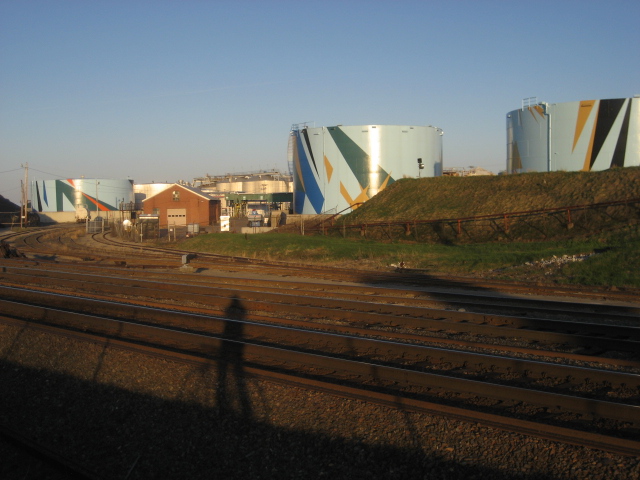
A few years ago, some local philanthropists decided that they needed to beautify the oil tanks with art, and hired a Venezuelan-born artist to design the patterns. I admit I kind of like it, even though I blanch at how much money they spent on it. 


And I'm put off by the a strange impulse to cover the oil tanks in expensive sanctioned art. I'd like to hope that it brings more attention to the oil tanks and makes passing motorists think about their dependence on the global petrochemical industry. But I think most of the wealthy donors are hoping that the paint job will obscure the dirty truth.

On a bike, though, you don't just see the tanks — you smell them, too. A volatile organic bouquet of benzene and sulphates.

A bundle of pipes lead from these tanks to a wharf on the waterfront, where a fuel barge was docked this evening. Similar barges often can be seen refueling tanker ships in the harbor with bunker fuels — the cheapest and filthiest of oil products, so dirty that they generally can only be burned at sea, outside of state and national jurisdictions. A string of oil-containment booms snake out from the wharf's pilings.


For all the fossil fuels on display here, the ability to see them on foot, or on a bike, is a positive development. The new bridge replaces one that had been built in the mid-1950s and designed as a freeway spur. It had one narrow, crumbling sidewalk that dead-ended at a freeway interchange.

Thanks to extensive local activism, the new bridge includes a well-lit bike path, and a lower speed limit and narrower lanes. The freeway interchange on the South Portland side has been  narrowed to a bottleneck where it meets the bridge, in order to force car traffic to yield to bikes and pedestrians.


I like to think how we forced motorists to sacrifice a second or two on their drives across the harbor in order to make the bridge a friendlier place for those of us who prefer not to burn oil. Though I suppose this also means that a few motorists will live longer by not dying in car accidents, only to burn more oil in their old age.

Tuesday, November 27, 2012

Cities & Memory


From Italo Calvino's Invisible Cities:


In Maurilia, the traveler is invited to visit the city and, at the same time, to examine some old post cards that show it as it used to be: the same identical square with a hen in the place of the bus station, a bandstand in the place of the overpass, two young ladies with white parasols in the place of the munitions factory.


Photo courtesy of the Friends of the Eastern Promenade


If the traveler does not wish to disappoint the inhabitants, he must praise the postcard city and prefer it to the present one, though he must be careful to contain his regret at the changes within definite limits: admitting that the magnificence and prosperity of the metropolis Maurilia, when compared to the old, provincial Maurilia, cannot compensate for a certain lost grace,


Photo by Corey Templeton

which, however, can be appreciated only now in the old post cards, whereas before, when that provincial Maurilia was before one's eyes, one saw absolutely nothing graceful and would see it even less today, if Maurilia had remained unchanged; and in any case the metropolis has the added attraction that, through what it has become, one can look back with nostalgia at what it was.


Beware of saying to them that sometimes different cities follow one another on the same site and under the same name, born and dying without knowing one another, without communication among themselves. At times even the names of the inhabitants remain the same, and their voices' accent, and also the features of the faces; but the gods who live beneath names and above places have gone off without a word and outsiders have settled in their place.


It is pointless to ask whether the new ones are better or worse than the old, since there is no connection between them, just as the old post cards do not depict Maurilia as it was, but a different city which, by chance, was called Maurilia, like this one.


Photo credits:
Historic postcards from MaineMemory.net.

Present-day photos courtesy of (from top to bottom): Friends of the Eastern Promenade, Corey Templeton via the archboston.org forums, Corey Templeton via the Portland Maine Daily Photo blog, and Panaramio user sacoo.

Monday, September 10, 2012

The Indian Burial Ground in the Basement

I was walking the dog this weekend along Hammond Street, a quiet residential block squeezed on the hillside between busy Washington Avenue and the industrial district of lower East Bayside here in Portland. They're building two new apartment buildings on a lot at the end of the street, and have started digging out the foundations.

Fascinatingly, the basement excavation has revealed a cross-section of the hillside, which is full of shells. Mostly longneck clams, with a few oysters here and there:


The dense layers of shells are sandwiched between clayey marine soils that are typical of our neighborhood, and they follow the slope of the hillside, such that the same layers are visible twice in the excavation: once against the vertical wall on the uphill side, and once again on the floor:


I'm pretty confident that this is a Native American shell midden — a trash heap from seafood feasts of centuries past. Though it's several blocks and a freeway crossing away from the ocean today, this hillside used to drop straight down into the tidal flats of Back Cove, as you can see in this 1837 map of Portland. The red dot shows the site of this construction site, smack dab on the old shoreline:


Back Cove is a tidal basin — exactly the kind of place where longneck clams thrive, although you wouldn't want to eat them these days. Other parts of the shore around Back Cove were probably marshy and difficult to access from land, but this location, next to a steep hillside, probably offered more direct access to the flats for humans, and for clams, there was relative proximity to the nutrient-rich tidal flows at the Cove's outlet.

I've been kind of stumped by how the shell heaps are interspersed with layers of clayey soil. This photo shows the horizontal cross-section of two layers (on the future basement floor in the foreground) as well as the sloping vertical cross-section (on the street-facing wall, in the center of the photo). At the left edge of the photo is Anderson Street, which was once the shoreline. How did all that clay get in between? 


Stranger still is how some of the shell layers seem to overlap with each other:


My guess is that the steep slopes of the hillside probably set off occasional landslides, which would periodically bury a heap of shells under a thick layer of mud washed down from the higher ground above.

Any archaeologists care to comment?

Related post: Longfellow's Garbage

Update: Howard Reiche e-mailed me this this morning (Sept. 11):
The Knudsen home, which
stood on the site until this
summer. From the City of
Portland's 1924 tax records
.
 Good for you. That was my grandfather’s (Knud Knudsen) house where he raised 13 children after immigrating from Denmark. We have a family photo of my mother, Laura Christine (Knudsen) Reiche, feeding the ducks in the water which came to the foot of their garden which I walked in many times..
    Hammond St. was named after the Hammond rope walk which was originally at that site. Possibly the “layers of clay” mystery had something to do with the construction or changing of the rope walk. 

Thursday, March 01, 2012

High-Rise Forestry

This pair of luxury housing high-rises under construction in Milan includes beefy cantilevered balconies that have been designed to support hundreds of fully-grown trees and shrubs.

Architect Stephano Boeri boasts that the project "is a model of vertical densification of nature within the city." The trees that will be suspended off of its balconies are equivalent to a hectare's worth of flat-land forest, while the homes inside the buildings represent five hectares' worth of single-family homes in the Italian suburbs.

It's called Bosco Verticale, or Vertical Forest.

These construction photos are by Daniel Iodice, and come from the Stephano Boeri Architetti website:

And a close-up of the tree boxes:


Here's the architect's vision of how the buildings will look when complete:

The plantings, which will include holly oak, European wild pear, and a mix of shrubs like Cain Apples and hawthorns, seem to have been chosen for their tolerance for constrained soil conditions and for their ability to improve the environmental quality inside and around the towers — shading the windows on hot summer days, insulating the apartments from city noise and particulate pollution, and filtering the apartments' grey water.

I first saw this project on the Green Futures blog, which included this critique:
Alexander Felson, Director of the Urban Ecology and Design Laboratory at Yale University, agrees that “there will potentially be microclimate and air particulate removal benefits”, but warns that the “overall energy required to construct a building that would support both trees and the wet weight of soil” places some serious question marks over its overall sustainability. He favors a more modest approach focusing on green roofs.
True, all that beefy steel and concrete required to hold up trees on an Italian balcony probably required the environmental sacrifice of a good chunk of China.

Still, I think Dr. Felson is missing the point (maybe he just can't see the forest for the trees?). This is a luxury high-rise, after all. While the architect Boeri is clearly interested in sustainability, he's also interested in creating a nice place to live for wealthy Milanese city-dwellers who can pay his commission. There are lots of luxury high-rises — the vast majority of them, actually — that blow their budgets waste construction material on much more masturbatory design flourishes.

What I find most interesting about these buildings is their approach to re-introducing wild nature into the city. I write about that idea often on this blog, but this project takes it to a new level (literally) by marrying a forest with a skyscraper. It's not merely creating a park that's geographically delineated from the rest of the city: it's integrating a forest with one of our most anthropocentric infrastructures: a high-rise apartment building.

That's pretty cool, not just for the people who live there, but for everyone in Milan who will be able to look at a vertical forest in their city's skyline.

Notwithstanding the technical questions of the construction project's sustainability, the buildings still presents an extremely bold vision of a sustainable city — a city in which nature is prominent and integrated into daily life.

Wednesday, February 15, 2012

A Very Situationist Valentine's Day

The Occupy camps have been dismantled — and yet, none of the motives behind the movement have disappeared. Maybe that's why I've noticed a revival of Situationist thought on city streets in my hometown and elsewhere around the globe.

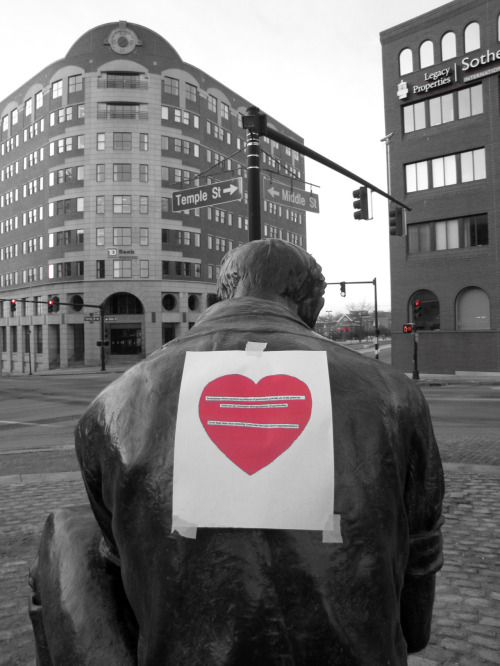
Yesterday, for Valentine's Day, a Good Samaritan posted these flyers around Portland, Maine:

(photo by shannont, via Unseen Portland)

It reads: “In societies where modern conditions of production prevail, all of life presents itself as an immense accumulation of spectacles. Love that was once directly lived has become mere representation.” From Guy Debord's Society of the Spectacle.

Another flyer reads "Young people everywhere have been allowed to choose between love and a garbage disposal unit. Everywhere they have chosen the garbage disposal unit" (another quote from Debord).
And in London, artist Robert Montgomery has appropriated billboards to post his Situationist poetry. This one is probably my favorite (via The Morning News, which has more samples of his work):


Valentine's Day might be the perfect Situationist holiday, especially now, when its hyper-commodified version of love is drawing so much cynicism towards itself in our bailout economy.

And yet, for anyone lucky enough to enjoy real love — not the spectacle, but the genuine article, without the chintzy chocolates or greeting cards or mall-bought lingerie — real love is an act of revolution: a reminder that we can be rich without the fake wealth of the global economy.

Thanks to Jess, I count myself in that number. All the hedge fund managers can go fuck their garbage disposal units (and I'd love to see them try).


Thursday, November 03, 2011

The Bayside Sentinel


The north half of the downtown block bounded by Forest Ave., Cumberland, and Casco is a "telco hotel" owned by Fairpoint - a complex of large buildings filled with telecommunications equipment and servers. I don't think that the microwave tower on top has an official name, but it's a local landmark and deserves to be called something. The Bayside Brainmelter? The Dishrack? Please leave suggestions in the comments.

Inspired by Burrito Justice's animated GIF of the Sutro Tower.

Friday, October 28, 2011

The Ranked Choice Voting Game

This November, voters in Portland, Maine will elect their new mayor using a ranked-choice ballot. Voters will be able to rank as many as 15 candidates in their order of preference.

The ranked choice system will provide a lot of advantages over traditional elections, where you can only choose one candidate. No longer will we have to worry about the "spoiler effect" of third-party candidates: now, we can vote for Ralph Nader AND Al Gore.

Nevertheless, with fifteen candidates (and up to fifteen possible rankings to choose), the novelty of the ranked choice system is causing some confusion for local voters. It's difficult to explain the dynamics of a ranked-choice election in prose, and some attempts have been downright misleading.

So (and I'm puffing my chest out as I write this, because this represents my first substantial foray into practical programming) I've written a Ranked Choice Election simulation game to let people experience firsthand how a ranked choice election will work.


Fill out up to 50 different ballots as though they were coming from different voters. The program will then run through the Instant Runoff counting process, sequentially eliminating last-place contenders and explaining the process of reallocating the ballots along the way, until one winner crosses the crucial 50% threshold.

It may not look like much, but I spent many, many hours working on this over the summer and fall, so please consider leaving a tip if you find it useful (or, click often on our fossil fuel propagandist advertisers). I've tried my best to debug it across various browsers but it'll work best on Chrome, Safari, or Firefox, and don't bother if you're on a phone.

Wednesday, September 28, 2011

Creative Destruction


"The conditions of bourgeois society are too narrow to comprise the wealth created by them. And how does the bourgeoisie get over these crises? On the one hand by enforced destruction of a mass of productive forces; on the other, by the conquest of new markets, and by the more thorough exploitation of the old ones. That is to say, by paving the way for more extensive and more destructive crises..."


"New York, you're perfect
Don't please don't change a thing

Your mild billionaire mayor's
Now convinced he's a king

So the boring collect
I mean all disrespect

In the neighborhood bars
I'd once dreamt I would drink."

- LCD Soundsystem, "New York, I Love You But You're Bringing Me Down"


We live in a nation that no longer makes things, and maybe that's why we're so foggy-headed when it comes to discussions of wealth, class, or even of basic entrepreneurial instinct. How can we hope to understand wealth when "luxury" is pitched to us as a shoddily-built McMansion, and twenty years' worth of retirement savings can disappear in a stock market crash? What does it mean to speak of labor when work is a mind-numbing interval in a cubicle?

Maybe this economic existentialism is also why it's so popular to talk about the "creative economy" these days. Creative industries hold the last vestiges of America's tangible economic output - our last chance to make anything for ourselves.

Like many other cities, my hometown of Portland, Maine is gung-ho about its "creative economy," even though they haven't even finished building the "Biotechnology Park" left over from the last economic development fad.

On the surface, this seems like a positive thing - who wouldn't want more creativity? After chasing smokestacks for decades, City Hall is bringing a long-overdue focus on the small businesses and vibrant neighborhoods that really make our cities welcoming and attractive.

And yet (if the fad comment hasn't already tipped you off) it's beginning to feel like a lot of bullshit to me.

The germ of my ambivalence came from a real estate development proposal in my neighborhood. A billionaire hedge fund manager (and the husband of our congresswoman) owns a pied-à-terre apartment a few blocks away from us, and wants to transform several of the area's working-class tenement buildings that are in his portfolio into a newly renovated cluster of live-work spaces for quote-necessitated-because-I-don't-really-trust-a-billionaire-hedge-fund-manager's-use-of-the-word-unquote "artists".

So. I have some issues with said hedge fund manager's imposition of his aesthetic values on the landscape of our neighborhood, and on the creative output of local artists vis-a-vis the terms of their rental agreements. That's one thing and it might be entirely unjustified.

But I feel more nervous - and more certainly justified in this unease - about how the hedge funded artist colony is going to affect the larger creative environment of the city at large.

His proposed development is located on one of the last working-class neighborhoods of the city. It was part of Portland's Little Italy, and it's one of the few immigrant neighborhoods that wasn't demolished during the urban renewal purges of the 1960s and 1970s.


At one end of the street is the city's friendliest dive bar; at the other end is a day labor agency. It happens to be a pretty great place for artists to live and work right now, as it is. But it's also a great place where teachers, hotel workers, office cleaners, and dozens of other working-class families can still afford to live, within walking distance of downtown's jobs and services. Why would we want to kick those people out?

Simultaneously (and potentially relatedly), a number of the city's economic development professionals and business leaders have recruited ArtSpace, a nonprofit developer of affordable buildings for artists, to investigate the possibility of their developing a project in Portland (possibly on Hampshire Street, and possibly elsewhere).

It may seem counter-intuitive, but even if we did create a walled garden for artists here - and it matters little whether it's built by a hedge fund manager or a nonprofit institution - the experiences of numerous other cities and neighborhoods before us forebodes that the wealth it brings in pursuit of "creative" entertainments will jeopardize the neighborhood's affordability and diversity, and thus undermine the fertile conditions that generate the very creativity we value.

Look at New York City: wealth drove out artists first from SoHo into the Lower East Side, then into Williamsburg, and now deep into Bed-Stuy. If the southeastward exile continues, in thirty more years all the artists will be drowned in the waters of Jamaica Bay.

Forty years ago, Donald Judd tried to escape it by moving from Manhattan to live among ranchers in a miniscule town in west Texas. Today, even that miniscule town is itself losing its identity with the influx of more and more wealth.


The Marfa Prada, a half-joking commentary on "Judd-effect gentrification", on the plains outside of Marfa, Texas. Photo via eartharchitecture.org.

And I saw it happen firsthand in Portland, Oregon, at the turn of this century:
In 1999, I set off to go to college in Portland, Oregon — then known only as a rainy mid-sized city with scenic parks. In the five years I spent out there, I saw the city morph into a self-satisfied model of progressive hedonism. But, as I found after graduation in 2003, and as thousands of other young people have found since then, it’s awfully hard to land a decent job there, and it’s getting harder all the time to find an affordable place to live. (source)
A creative economy requires creative people, and creative people seek out the frisson of affordable, diverse city neighborhoods, where it's easy to discover and interact with new ideas and with people who possess a diversity of cultural and economic backgrounds.

Creative people also require capital: they need affordable places where they can live and create things. But creativity, after all, is fun to be around: it attracts wealth, which ends up competing for the same resources that the creative people need. Thus, to paraphrase Marx, the accumulation of creative capital sows the seeds of its own destruction.

Sure, you can create protected islands of creativity amidst the sterile ruins of luxury condos and fusion restaurants. That's what the hedge fund manager and Artspace want to do, and I suppose that in some circumstances that might be the best option. But how creative can such a place really be, in its isolation? And aren't we declaring defeat prematurely by pursuing that option so soon, while our neighborhoods are still fairly egalitarian and diverse and functional just the way they are?

More importantly, is the exile of creative people from the neighborhoods they make great inevitable? Is the "creative economy" just the post-industrial manifestation of Marx's inevitable creative destruction?

Admittedly, the track record from places like New York isn't great. But I think there are two reasons to be optimistic.

I often think of Houston, where I lived for a year, as one of the most creative places I've lived (it certainly had Portland, Oregon beat). Sure, miles and miles of the city were dead zones of strip malls and cul de sacs. But for every time someone bulldozed a historic edifice to build a Wal Mart, someone else was doing something amazing in a vacant rice factory or shotgun house they bought for dirt cheap. That city thrived on constant change. From the outside, the city might look monstrous, constantly consuming itself and spreading out larger and larger. But on the ground, there was always something new.

If we lose Hampshire Street to a bunch of navel-gazing painters who are condemned to mediocrity because they never meet anyone or anything that challenges their assumptions, then I'll be sad, not least because that's my very own neighborhood that will become a more boring place.

But we live in a city, and cities are meant to change. Creative destruction, after all, is still creative. If one neighborhood becomes boring, another will become interesting. House shows will spring up in unexpected places; empty warehouses or abandoned big-box stores will become artists' squats. If we, as a city, embrace change (and Portland, to own the truth, has some issues with this, a few hang-ups with its nostalgia for the status-quo), then creativity has a way of surviving.

Still, I'd still rather let it thrive. And that brings me to a second reason to have some hope, because here we have a billionaire who wants to do right by downtrodden artists, and it seems churlish to complain about his methods when the impulse carries so much possibility.

If I ever had the chance to meet my billionaire neighbor, this is what I would tell him.

Portland's neighborhoods aren't ruined yet - they're still by and large egalitarian, and affordable, and authentically creative. Even better, a lot of the wealth that might threaten those neighborhoods' creativity is possessed by people who actively want to support a creative environment.

You and the other creative economy boosters want to do the right thing by carving out a refuge for artists - but you haven't yet considered the consequences of how that kind of project could exile dozens of other people who may not make art per se but are nevertheless vital to maintaining the conditions of a creative city.

May I suggest instead diverting your considerable resources toward finding ideas and investments that make the city more equitable and affordable to all people, not just for "artists"? If we can accomplish that, then the entire city stands a better chance of fostering the ideal conditions that generate more and more creative places.

Instead of relying on an institution to build us one Artspace, we could build hundred of Artspaces for ourselves, on our own terms, to our own standards. Sounds good - am I right?


Postscript: I've started writing a biweekly column in a small local paper, the Portland Daily Sun, and I wrote on this subject last week. But 800 words wasn't enough to fit in all the nuances of my mixed feelings about the "creative economy" business, hence this elaboration.

Tuesday, September 13, 2011

A Supposedly Fun Thing Invades Portland

From midsummer until the end of fall foliage season in late October, cruise ships like the one pictured below dock at the Maine State Pier in downtown Portland, Maine. When they're in port, they loom over the small city's skyline and disgorge thousands of well-fed passengers onto our downtown city streets.

The cruise ships that arrive here are taller than most of the city's modest high-rises, and with 2500-3500 passengers, their arrival increases the city's population by about 5%. They have a certain looming effect on the city's landscape, and not just from their striking physical resemblance to the alien mother ships that blot out the sun above human cities in movies like Independence Day and District 9 (see below at right). They flood the city's streets with a certain breed of well-fed, middle-aged idler, toting cameras and stylized cartoon maps of the downtown district.

The effect isn't limited to the infusion of strangers - it also changes the behavior of the city's native residents.

When a ship's in town, improvised kiosks selling lighthouse paintings, secondhand junk, and items marketed as "redneck wallets" proliferate near the ferry terminal. "The Screamer" and other familiar victims of the state's social service cuts become mysteriously absent, while there's a marked increase in downtown police cruisers. Slow, rubber tired omnibuses roam the downtown area behind incongruous teams of draft horses, a bizarre, segregated, and for-profit public transportation system for tourists.

In short, the cruise ships, while they may look innocuous, also seem to beam advanced psychoactive waves into the city's brains to stimulate desperate entrepreneurial pandering. There's money to be made if we behave like a quaint second-world outpost replete with cheap handmade crafts and sweating, shitting modes of transport.

An acquaintance today remarked that the city's transformation reminded him of Heisenberg's Uncertainty Principle, the concept of quantum physics that tells us how the observation of certain properties of a particle limits our knowledge of other physical properties.* Or, to put it another way, that the simple act of observing something, and your choice of what to observe and how to observe it, can change various properties of that thing's essential nature.

This elegantly applies to tourism, especially the mass-market variety of tour buses and cruise ships. An entertaining thought experiment: how would Portland (both the physical landscape of the city and its citizenry) change if the hundreds of thousands of tourists who came here every summer instead arrived as undocumented migrant laborers? How would the city look if those thousands became occupiers of an imperialist army?

And which of those two landscapes - the city of cheap labor, or the occupied city - is more foreign from the city we know today?**

The idea that we occupy a different, parallel universe from the one that our tourists reside in - and that I, as a tourist anywhere, am unlikely to know the true essence of the places I visit - feels as lonely to me as an insomniac night on a cruise ship at sea, "when all the ship's structured fun and reassurances and gaiety-noise ceased."

But then again, shouldn't the possibility of changing the city you know with a shift in perception also offer us new frontiers to explore without leaving at all? And doesn't the uncertainty principle also apply in all sorts of other ways - not just in how we perceive places, but also people and things? We hear rumors of a scandal and a trusted person becomes repulsive to us; make eye contact two or three times across a crowded room, and a stranger becomes an object of fixation.

So even when you live in a small city that's frequently colonized by tourist hordes, there's no need for us to get discouraged when we perceive ourselves in a rut, in an absence of strangeness and possibility.

There's an infinity of alternative cities available to us, all similar to this one and different in significant ways, every time we seek a new way of seeing things.


*Credit for this insight goes to Dan, who's highly versed in the idea of how shifts in our perceptions can affect our lifestyle.

**Personally, I think that our wealthy tourists and our customer-service-oriented culture make us a lot closer to the empire/colony dynamic than we are to being a land of opportunity - then again, that's just the product of my own observations.

Monday, June 20, 2011

Where not to go swimming in Casco Bay

Tonight, Portland's City Council will vote on a 25-year plan to reduce the amount of sewage that gets dumped into Casco Bay during wet weather.


The green warning signs like the one pictured above (located next to the city's cruise ship dock) mark the locations of Portland's combined sewer overflow outlets. During wet weather, when millions of gallons of rainwater flow into storm drains and overwhelm sewer pipes, these outlets keep sewerage from backing up into the streets, by dumping it into local waterways instead (read all the details here).

These combined sewer outlets can be found in surprising places: there are three in the heart of the Old Port, the city's tourism district, including one right next to the outdoor dining area of the Portland Lobster Company, another at the busy ferry terminal, and a third next to the city's cruise ship berth. Along with a few more further down the waterfront, these outlets collectively dump 145 million gallons of sewage into Portland Harbor in a typical year.

Seventeen more outlets ringing Baxter Boulevard, a popular city park, dump over 400 million gallons of mixed sewage into the shallow, stagnant waters of Back Cove. By way of comparison, last year's BP oil spill in the Gulf of Mexico dumped about 210 million gallons of oil into the Gulf.

Nearly twenty years into the city's efforts to separate storm drains from toilet flushings, the city has managed to shut down ten CSO outlets, including the one located nearest to the city's East End Beach, as well as most of the outlets that had dumped into Capisic Brook in the city's western suburbs. But dozens of overflow outlets still remain. The map below shows where they all are (the handful of star icons represent former outlets that have been closed):


As disgusting as this problem is, solving it won't be cheap, quick, or easy. The City is looking at a range of strategies, from building new green infastructure that can absorb rainwater into the ground before it flows into storm drains, to building huge underground storage tanks that can expand the system's capacity to hold sewage without spewing it out into the harbor.

Altogether, the recommended projects will cost the city $170 million - about $2,500 for every individual resident of the city - over the course of 25 years. That would roughly double our sewer bills, and not even then would we have a sewer system that avoids dumping sewage into Casco Bay altogether (the engineers estimate that we'd still dump 87 million gallons a year, an 88% reduction over current levels).

A fair and effective way to pay this bill would ask property owners who contribute the most to the city's sewer overflows to pay a greater share, by charging a fee in proportion to the amount of sewage and stormwater their properties send into the pipes. A one-inch rainstorm on an acre of pavement sends 26,000 gallons of oil-soaked stormwater (the equivalent of 15,000 toilet flushes) down the drains, so the owner of a large parking lot ought to pay substantially more to fix our sewers than an apartment dweller or a homeowner with a rain-absorbing garden.

This wouldn't just be a fairer way to pay for the city's sewer upgrades - it would also encourage property owners to make their own small efforts to help relieve the amount of stormwater flowing into our sewers, whether by tearing up some pavement to install a rain garden, or by fitting in more housing units on smaller lots. Small efforts multiplied thousands of times across the city's watersheds could substantially reduce the impacts of Portland's sewer problems, and the costs of fixing them.

Friday, April 22, 2011

Tea Party Pity Party

Here's an entertaining story in today's Portland Press Herald:

PORTLAND - Eric Cianchette plans to sell the Maine Wharf on the city's central waterfront, saying he's tired of trying to come up with a mixed-use development plan that Portland officials will approve.

"I remember my father telling me, 'You can't just go through life saying what you don't want. At some point, you have to tell people what you do want,"' Cianchette said, and city officials "really don't want anything."
Eric is wrong - just like he was wrong about the inflated real-estate value of the wharf when he was suckered into buying it in 2004.

City officials most certainly do know what they want to have on our waterfront. They want successful marine-oriented businesses. They want a prosperous fishery. They want wharf buildings and businesses that take the fullest advantage of Portland's valuable deep-water harbor.

These kinds of businesses aren't easy to grow. They're challenging. They demand smart entrepreneurs who can think creatively.

By his own self-pitying words in this article, I can come to only one conclusion: Eric Cianchette isn't one of those creative businesspeople.

He bought a wharf. He proposed a formulaic, played-out business model instead of doing something challenging and entrepreneurial. And then he got fleeced when the real estate bubble popped. And now - he's blaming City Hall for his problems?

Give.
Me.
A.
Break.

I'm not a hard-assed business guru, but if I were, I'd probably say that this guy needs to stop looking for sympathy, and start looking for success.

There's a lot in common between Eric Cianchette's super sad story and the whole Tea Party zeitgeist of economic frustration. They're all fond of blaming the government. But when I look at those guys, I see a whole lot of failures who are bitterly trying to pin their shortcomings on politicians, instead of owning up to the pathetic reality of their circumstances.

Take, for instance, T.P. Governor LePage's resigning PR flack, Dan Demeritt, a man who made hay by defending businesses against "government regulation," only to succumb to bigger businesses when banks foreclosed on a number of his rental properties earlier this month.

And the Tea Party isn't just failing in business: it's also failing in governance. Just like Eric Cianchette's luxury hotel, the Governor's proposals are going nowhere fast. And true to form, even though he's the Governor now, the government's chief executive, he is STILL blaming the government: "I went on vacation last week because I had nothing to do," the Governor said last week at a Chamber of Commerce speech reported by the Sun-Journal's Steve Mistler. "Because I'm waiting. I'm waiting for legislation. I cannot do anything until the Legislature acts."

These are your tax dollars at work: a vicious cycle of finger-pointing. Who needs leadership when you've got scapegoats?

These guys act as though they hate government. But they need the government more than anyone. If the government weren't there, whom could they blame for their failures? Nobody but themselves.

The bottom line is this: business in Maine can't thrive until losers like these guys get out of the way. But for the time being, at least Eric Cianchette is getting out of Portland's waterfront.

Thursday, March 03, 2011

Glaciers at risk!

It's that time of year again when hundreds of truck-loads of snow get dumped near the bottom of Chestnut Street to form the Bayside Glacier (documented previously here, here, and here).

In last week's Portland Phoenix, I wrote a short follow-up piece about recent legislation that proposes to dump these icebergs of sewage directly into rivers and harbors.

PS - It's bullshit like this that has kept me from blogging much lately. Elections have consequences.

Monday, January 31, 2011

"The Basement Stacks"

What former library in the land of Stephen King wouldn't be complete without a tentacle of old books creeping out from the basement walls?


Portland's old Romanesque library has recently been rehabbed and reoccupied as the headquarters office for an advertising firm, which commissioned this project from Portland artists/interior designers Wary Meyers. It's called "The Basement Stacks," and you'll find a few more photos on the Wary Meyers blog.


I hope that at least a few of those volumes bursting out of the walls have H. P. Lovecraft's name on their spines.


Wednesday, July 07, 2010

Hot Days Incinerate Oil

If you're an electric utility, you don't take the dog days of summer lying down. No, when it's 95 degrees outside, that's when you want to burn millions of gallons of oil in your oldest, least efficient power plants. Beat the heat by starting a thousand-degree inferno.

That's exactly what's happening across the northeastern United States this week, as record temperatures are also breaking records for electrical consumption. It's the first law of thermodynamics writ large: as millions of office buildings, supermarkets, and houses work their AC units to stay cool, the region's utilities need to put massive amounts of heat into the system, and they fire up every power plant they have at their disposal to meet the demand.
Most utilities keep a handful big power plants in reserve, maintained year-round just to operate a handful of times a year when the grid needs to call in the cavalry. Many of these plants tend to be old and relatively inefficient: they're not economical to run on a daily basis, but they're maintained in running condition for the handful of days each year when they might come in handy, and when spot-prices for electricity rise high enough to justify their high costs of operation.

One such power plant is located right on the edge of scenic Casco Bay, visible from Portland's Eastern Promenade Park and from thousands of other waterfront vistas in greater Portland. Wyman Station, about which I've blogged previously here, is a 1970s-vintage oil-fired power plant capable of generating more electricity (over 800 megawatts) than any other plant in Maine. It's old, it's inefficient, it burns expensive fuel, and it occupies extremely valuable coastal Maine real estate. But it's still there for those few times when a million air conditioners ask the grid to turn the juice up to eleven, and pay for the privilege.

In 2005, the most recent year for which data is available, Wyman Station, in spite of its sporadic use, still managed to produce 2860 tons of sulphur dioxide, 155 tons of carbon monoxide, and 736 tons of nitrogen oxides (source: US EPA). According to the US Energy Information Administration, burning a thousand gallons of heavy oil in a typical boiler yields about 47 pounds of nitrogen oxides, so a little math tells us that Wyman burned somewhere on the order of 30 million gallons of oil in 2005.

In SI units, that is 1.3 shit-tons of filthy fuel. Imagine the Deepwater Horizon oil leak spilling into Casco Bay for 7 days, and you'll have a rough idea of how much oil Wyman burns every year. Go ahead, imagine it.

As I said before, this is for a plant that's only run for a few days each year. So here's the good news: every New Englander who turns off the lights in their office, or shuts down their computers during the hottest mid-afternoon hours to do some old-fashioned analog work, can help save a few gallons of oil from going up in smoke. Many utilities are giving large customers a price break if they do this on the hottest days, since asking your customers to turn off the lights can be cheaper than running expensive diesel backup generators. Right now, this is all done with polite phone calls, but in the near future, appliances will develop a hive mind to communicate with the electric grid, take turns sucking down scarce juice, and keep places from Wyman Station from starting fires on hot days. Others have argued that the situation calls for more solar panels, which tend to generate the most electricity on these hot and sunny summer days.

In the meantime, consider giving your appliances - and your local power plant - a break on these hot afternoons. With or without futuristic "smart grid" technology, if a few thousand New Englanders manage to cut back their consumption on hot days, we could shut places like Wyman Station down for good.

Friday, July 02, 2010

In Seach of Moosey Paradise: A Walk Along Portland's Inner-City Wildlife Corridors


The big news here in Portland yesterday was a young bull moose who had wandered into Deering Oaks Park, a formally-landscaped open space in the central city. Just like the opening credits of Northern Exposure, but with more spectators.

According to reports, the animal took a dip in the park's pond, where it attracted a small crowd of onlookers, as well as the city's police department and a state game warden, who were concerned about how it would cross I-295 on its way out of the city. One of my favorite details of the story is how they were going to shoot the animal with a tranquilizer, but the warden's gun jammed just when she got a clear shot. Apparently Portland's big-game armory has suffered from infrequent use.

It ended up taking the Forest Avenue underpass, crossing one of the city's busiest streets twice, then escaping through the University of Southern Maine campus. It was later spotted at Chevrus High School, located in an inner suburban neighborhood, before it made its way west through the woods in Evergreen Cemetery. The animal was reportedly exhausted, but unscathed.

This isn't the first time a young bull moose has appeared in downtown Portland. A few years ago, police shot one in the middle of the city's Munjoy Hill neighborhood - an even stranger place to see such a huge animal, since it lies at the end of a peninsula, cut off from the mainland by a freeway and the city's central business district. That was also early in the summer, a time of year when juvenile males tend to strike out on their own and take risks in pursuit of their own territory.

These moose that wander into the city obviously have no conception of where it was, just a sense of hope that, on the other side of this neighborhood, it might find a big-enough block of swampy woods with a small surplus of female moose. I'm reminded of how deer and other mammals came to populate islands far from and out of sight of the mainland, swimming for hours on a vague scent, with no way of knowing how much further land would be, or whether they might drown in the crossing. At the risk of anthropomorphizing, I'm impressed at this moose's sense of adventure - its willingness to take big risks to find a great new place.

This kind of exploration is hard to come by for anyone who actually lives in and knows the city. But the moose's path in and out of Portland seems to have gravitated towards the city's remaining blocks of undeveloped land and forested parks - and the places where a moose would feel most at home happen to be the kinds of places I most enjoy exploring myself.

Because there aren't any public reports of the moose before it was sighted in Deering Oaks Park, it's hard to tell how this particular moose got into the city, but I suspect that it either came in the way it left, through Evergreen Cemetery, or it ventured in along the banks of the Stroudwater and Fore Rivers. Here's a map:


Although Portland is on a peninsula, there are two large blocks of wildlands on its fringes that extend towards the central city. To the south, critters like deer and coyotes regularly migrate into the city along the Stroudwater River, which is surrounded by a large block of swampy, undeveloped woods, as well as several farms and golf courses. The Maine Turnpike, probably the biggest barrier for critters trying to get into the city (it's the red-dashed line running across the map above) flies over the Stroudwater on a wide bridge, which makes it easy for critters (and people - this is roughly the path of the Stroudwater Trail) to cross under the highway:


On the other side of the Turnpike, just north of the mouth of the Stroudwater, there's the Fore River Preserve, a former Maine Audubon property that occupies the headwaters of the Fore River along with acres of marsh and forested uplands. From the Preserve, a moose bound for the city could walk through the sparsely-populated neighborhood between the Fore River and the railroad tracks, cross under I-295 at the bridge, and then follow an abandoned railway into Deering Oaks, without seeing a human soul.

Alternatively, a critter could cross the Turnpike at one of two other Turnpike underpasses: one at Warren Avenue, a relatively rural-feeling road that cuts through an industrial area, and one where the Presumpscot River passes under the Turnpike in the city's northernmost reaches. From either of these options, a moose could cut through the thin patches of woods between houses in the city's low-density outer suburbs, before reaching the the Evergreen Cemetery. While the front of the Cemetery, along Stevens Avenue, is highly landscaped, and doesn't offer much cover for critters, the back of the Cemetery is a huge, wild forest that extends almost all the way to the Turnpike. Better still, right across Stevens Avenue from the Cemetery is Baxter Woods, a forested city park, which itself is just a skip across a busy road and railroad tracks to a smaller tract of woods around the new Ocean Avenue School. From there, its just a matter of trespassing through some inner-suburb backyards to get to the parklike University of Southern Maine campus, which is right across the freeway from Deering Oaks Park. The moose yesterday opted to take a detour to the north to visit Chevrus High School, but this roughly describes his escape route.

By coming into Portland, this moose has demonstrated to us an inner-city bushwhacking course through the wildest remaining areas of our city. While I've hiked portions of this itinerary before (such as the Stroudwater Trail, which I described here), I've never tried to do the whole thing in a day, as this moose did. But I think it would be fun to try.