Showing posts with label the built environment. Show all posts

Thursday, March 31, 2016

Public housing for the future

Four years ago I joined the board of commissioners for the Portland Housing Authority with a chip on my shoulder about the fact that it hadn’t built any new apartments for the city since the Reagan administration. So I'm pretty proud about this: we’ve torn out a parking lot on Oxford Street, and in its place we're building 45 new apartments with public housing offices and a Head Start classroom on the ground floor.

This is going to be Maine's greenest building when it's finished. It's aiming for "passive house" certification and we're putting solar panels on the roof. It will have a courtyard that treats runoff under the patio. Most significantly, it’s Portland’s first-ever affordable apartment building that prioritizes housing for car-free households, with no parking on-site, within walking distance of bus routes,  supermarkets, and thousands of jobs. We saved hundreds of thousands of dollars by not building the parking garage that city zoning typically requires, and that's allowed us to build more apartments instead. It’s already won a national competition for innovation in lowering the cost of housing.

Public housing doesn't get the appreciation it deserves. It's facile for liberals to blame it for the tragedies of structural racism in our cities; meanwhile, the right attacks it for its unapologetic Great Society socialism. And as a result we've had decades of bipartisan budget cuts for federal housing programs.

But public housing neighborhoods give millions of people the ability to live amidst the opportunities of our increasingly unaffordable inner cities. Without these neighborhoods, our cities would be even more dramatically segregated and impoverished places.

And if, instead of dismissing it, we can build even more public housing – a lot more, as the Portland Housing Authority hopes to do in the years to come – then the city will be more diverse, more successful and more egalitarian. It will be more like the city we want it to be.

Tuesday, February 24, 2015

The aesthetics of clean energy

My old employer, Maine Audubon, is a fairly conservative and patrician organization. It's not a strong leader on climate issues: its conservation programs are a lot more preoccupied with piping plovers (cute birds that just happen to live on the same beaches as the organization's plutocrat "major donors") than with ending Maine's self-destructive addiction to fossil fuels.

So I was encouraged and a little surprised to see, on a recent visit a few months ago, a large new array of solar panels planted in the meadows of Maine Audubon's headquarters.


Knowing what I know of Maine Audubon's constituency and its neighbors in the blue-blooded suburb of Falmouth,  I presume that this new addition to the meadows of Gilsland Farm didn't come without some controversy. Lots of Maine Audubon's members (and a number of its staff) frankly express opinions that wind farms and solar installations are ugly. They wouldn't disagree that climate change exists, or that we need to do something about it – they'd just prefer that clean energy be built someplace else, where they don't have to look at it.

Maine's community of environmentalists is strongly aligned with the back-to-the-land movement. And in the back-to-the-land narrative, rural Maine was a new frontier where a new, sustainable and allegedly self-sufficient society could be built far away from the problems of the cities.

There's a fatal flaw in this narrative, though. Rural back-to-the-landers were, and still are, cripplingly addicted to oil and private automobiles. As a rule, they don't like to be reminded of this contradiction.

I think that this is the key to what so many rural "environmentalists" find distasteful about wind farms and large-scale solar installations. What upsets them is the reminder, amidst pastoral landscapes, that we are living through a climate catastrophe.

But for those of us who will live with the consequences of that catastrophe, the reminder is overdue – and these small token efforts to avert it are welcome. 


Related: Exporting pollution to Dixie

Tuesday, December 10, 2013

Borderlands

I took a walk this weekend out to Westbrook, the city adjoining Portland to our west. Westbrook's Main Street is less than five miles from downtown Portland, but these are small cities and along the borderlands between them there's a still mostly empty landscape of meadows and depopulated infrastructures.

From the edge of Portland I followed the old Cumberland and Oxford Canal, which for a few years in the mid-nineteenth century used to ferry lumber from 20 miles inland to the ocean. It's mostly silted up now, but its towpath is still in use along the edges of the Fore River marshes as a walking trail.


The canal's on the left; the Fore River's on the right. The high-voltage power lines on the right lead eastward towards a substation near the bus terminal, where the power gets stepped down to lower voltages and fed into local delivery lines along city streets. Westward, the same lines lead to higher-voltage lines on the New England bulk power transmission grid. Not far from the junction is the metropolitan area's largest power plant, which burns fracked natural gas delivered from Pennsylvania and Texas via the state's primary north-south gas pipeline.

Under the power lines are the railroad tracks of the old Portland and Ogdensburg line, which put the canal out of business as an overland connection between Portland and Montreal. Over 150 years later the railroad is still less abandoned than the canal is, but only this short section between Portland and Westbrook is at all active. Give it a few more decades and there might not be much difference any longer.

These days virtually all of the cargo between Portland and Quebec is crude oil that goes through in two underground pipelines. Those pipelines also run through these marshes at the head of the Fore River.

And speaking of abandoned infrastructures: on the other side of the marsh I bushwhacked northwards through the woods for a while and found the city's "technology park" (previously written about here). The city finally wrote a seven-figure check to cut down the woods and build a short cul-de-sac here this past summer. And now, just look at all the jobs:


From there I picked up the right-of-way of the oil pipeline back towards the railroad tracks near the Turnpike. Until the Turnpike, the infrastructural routes I'd encountered all trended east-west, from the coast into the mountains. The Turnpike is oriented north to south. Our 19th-century infrastructure treated Portland as a hub of trade to which rural hinterlands could be connected; our 20th-century infrastructure generally treats Portland as the hinterland that needs to be connected to Boston.

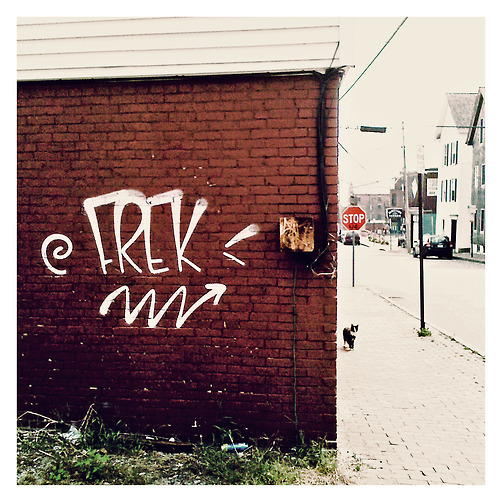
There are some decent and uncluttered tags under the Turnpike overpasses here.


A few yards further and I had crossed over into Westbrook, where the silos of a big quarry and asphalt plant loomed over the tracks. It was there that I found the most impressive of all the day's abandoned earthworks — the Grand Canyon of Westbrook. I'll save it for the next post later this week.

Sunday, November 10, 2013

There it is, take it.

Out in Los Angeles they've been celebrating the centenary of the opening of the Los Angeles Aqueduct, the audacious engineering project that drained the Owens Valley and transformed the San Fernando Valley from a landscape of orchards into a landscape of tract homes and gas stations.


It just so happens that this week I've also been plowing through the final chapters of John McPhee's Annals of the Former World, his consolidated narrative of a lifetime's worth of writing on North American geology. So far, my favorite part of that book has been the section on Wyoming, in which McPhee tails USGS geologist John Love on field excursions across the state. The chapters weave the sixty-million-year history of the Rocky Mountains with the hundred-year timescale of Love's family, from his mother's arrival, via stagecoach, in a gunslinging Old West of the early twentieth century to Love's atomic age discovery of uranium in the Rocky Mountain foothills.
"Love said that a part of his job was to find anything from oil to agates, and then, in effect, say 'Fly at it, folks,' to the people of the United States."
The geologic history of Wyoming spans relatively little time in the grand scheme of Earth's history. In the last sixty million years or so, roughly one percent of Earth's lifetime, the Rocky Mountains rose up, then sank under accumulations of sand and volcanic debris tens of thousands of feet deep, then, relatively recently, rose up again and shook off the sand in freshets of new mountain streams.

And then a new geological force arrives. Ranchers arrive in Wyoming, and their sons help open up its landscapes to strip mines and oil wells. The state digs beneath the ranchers'  thin Holocene topsoil to get at the more lucrative geology of the Mesozoic era. Open-pit uranium mines, oil and gas wells, and mountain-eating coal draglines rearrange the Rocky Mountain landscape and usher in the new Anthropocene era.


Photo: Jim Bridger coal mine, from the Casper Star-Tribune.

"Fly at it, folks." Love was talking about the bounty of Wyoming's mineral resources, but it's exactly the same sentiment expressed by William Mulholland, chief of the Los Angeles Bureau of Water Works, when he opened the sluice gates of the new Aqueduct a hundred years ago and famously said, "there it is. Take it."

In the same momentous twentieth century of human history that rearranged Wyoming, Mulholland's power broker friends find cheap oil under Venice and the Baldwin Hills, and then they give the growing city a reason to burn it by moving the Owens River over mountains and irrigating the massive suburbs of the San Fernando Valley. Gravel erosion from the Santa Monica Mountains, which had washed out into the Pacific for millennia and built the vast coastal plain of the Los Angeles basin, suddenly gets trapped behind foothill dams and begins to bury the mountain canyons. The basin itself acquires new sedimentary layers of asphalt and concrete. The sooty remnants of Carboniferous swamps fly into the troposphere through millions of exhaust pipes.

Geologic time and human history converge here, in the spectacular landscapes of the American west. But remember: geologic history is full of cataclysms.

Tuesday, April 30, 2013

The Social Life of Small Urban Spaces

My hometown of Portland is currently considering a proposal to privatize two-thirds of a downtown park called Congress Square — a not-particularly-successful product of late-1970s urban renewal.


There's a broad consensus that the park's current design is a failure. Surrounded on two sides by the blank walls of adjacent buildings, and with odd proportions that make most of the park inaccessible to the activity of surrounding streets, the only people who linger here tend to be panhandlers and loudmouthed street preachers.

The neighboring hotel's new owners, a real estate investment trust called Rockbridge Capital, are extensively renovating the building and would like to have a better neighbor. Even before they came along, there had been some rumblings about renovating Congress Square, and even of selling off a portion of it. But their real and specific offer has accelerated the debate.

It's hard for me — and for many other Portlanders — to hear out a pitch to turn over public space to a 1% outfit that calls itself "Rockbridge Capital." And it's disappointing that it was the hotel's owners — not citizens — that were allowed to set the terms of this debate about what the park's future should be.

Yet in spite of those handicaps, I find myself receptive to their most recent proposal for the park, which, though smaller, would be more far more welcoming and engaged as a public space than the status quo is.

Opponents will still object to losing publicly-owned real estate, but the quality of a park's design is far more important than the quantity of its square footage. The current Congress Square suffers from the same basic design problem as your typical suburban McMansion: it's too big, for no good reason.

In their pitch to the City Council, the hotel's architect included a number of points from William H. Whyte's book "The Social Life of Small Urban Spaces," a brilliant empirical study of what makes successful city parks work.

There's a great film version of "The Social Life of Small Urban Spaces" that illuminate Whyte's theories with detailed footage of New York's Seagram Plaza circa 1980. It's a lot of fun to watch, and not just because it offers a filmed version of the people-watching that attracts us to good parks. Whyte's photography also brilliantly illuminates how subtle elements of design — things most of us don't consciously notice — can have tremendous impact on how public spaces are used. It's like a Roman Mars podcast from 30 years ago.

If you're anything like me (and especially if you're one of my Portland neighbors thinking of weighing in on Congress Square), it's well worth an hour of your time:

Tuesday, September 18, 2012

How an Icon of Journalism Became a Hollowed-Out Billboard

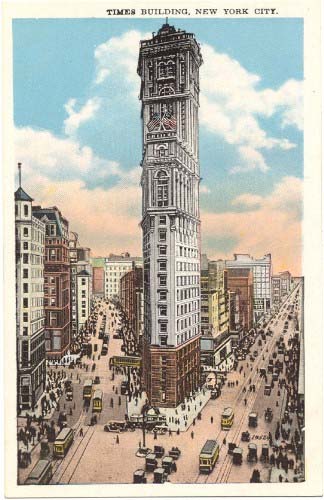
When it was built at the southern end of Longacre Square in 1903, the new headquarters of the New York Times became a landmark of midtown Manhattan, and helped publisher Adolph Ochs convince the city to rename the famous intersection in front of the building as Times Square.

One Times Square in 1904 (source).One Times Square in 2010.
Photo: Bernt Rostad/Flickr
By the mid-20th century, though, the Times had sold the building, and a new owner dismantled the intricate granite and terra-cotta facade to replace the exterior walls with plain concrete panels. In 1996, shortly after the City Council passed new laws that expelled porn theaters from the area, the building got sold again, to Sherwood Outdoor, an advertising firm. By then, the building's signage was covering most of the exterior windows, leaving the offices inside rather dark and dreary.

Rather than spend money to renovate, the new owners decided to simply abandon the building's interior above the 3rd floor, and use the top part of the building exclusively as a billboard (the lower 3 floors are still used, periodically, as retail space — it's currently a Walgreens drug store).

So for the past 15 years, the iconic building that was the namesake of Times Square itself, and a major headquarters of journalism, has become a hollowed-out shell, a mere scaffold for electronic signs.

At the Crossroads of the World, the value of advertising has trumped the value of journalism, and of work in general. 


Postscript: Illustrator Joe Mckendry has made a gorgeous before-and-after elevation drawing of the building's eastern facade in 1904 and in 2010, for his book One Times Square.

Monday, June 18, 2012

Foreclosure Farms

Growing food in abandoned city lots? That's so 2007. In the post-recession landscape, the edgiest agricultural trendsetters are growing cannabis in suburban foreclosures. 

"Houses that sold for $1 million before the crisis have been turned into grow houses, equipped with the high-intensity lights, water and air-filtering systems necessary to produce potent, high-quality marijuana," reported the New York Times in an article this spring.

On the other side of the Atlantic, the BBC reports that local police found over 7,800 cannabis farms in the UK last year.

A foreclosed house in Vallejo, California, where illegal wiring for grow lights caused a fire on the second floor. Photo by Jim Wilson for the New York Times.
It's the logical next step of the "urban farming" fad. Abandoned inner-city lots for growing vegetables are becoming increasingly difficult to find. So what's an aspiring inner-city homesteader to do?

Drive 'till you qualify. There's a bounty of abandonment beyond the city limits. Find a nice quarter-acre lot with a nice lawn and privacy from any nosy neighbors, a good school district where well-to-do students will pay top dollar for your product, and five spacious bedrooms for your grow lights.

Who says the American Dream is dead? It just needs some pharmacological assistance.

Monday, December 12, 2011

Thursday, November 03, 2011

The Bayside Sentinel


The north half of the downtown block bounded by Forest Ave., Cumberland, and Casco is a "telco hotel" owned by Fairpoint - a complex of large buildings filled with telecommunications equipment and servers. I don't think that the microwave tower on top has an official name, but it's a local landmark and deserves to be called something. The Bayside Brainmelter? The Dishrack? Please leave suggestions in the comments.

Inspired by Burrito Justice's animated GIF of the Sutro Tower.

Wednesday, September 28, 2011

Creative Destruction


"The conditions of bourgeois society are too narrow to comprise the wealth created by them. And how does the bourgeoisie get over these crises? On the one hand by enforced destruction of a mass of productive forces; on the other, by the conquest of new markets, and by the more thorough exploitation of the old ones. That is to say, by paving the way for more extensive and more destructive crises..."


"New York, you're perfect
Don't please don't change a thing

Your mild billionaire mayor's
Now convinced he's a king

So the boring collect
I mean all disrespect

In the neighborhood bars
I'd once dreamt I would drink."

- LCD Soundsystem, "New York, I Love You But You're Bringing Me Down"


We live in a nation that no longer makes things, and maybe that's why we're so foggy-headed when it comes to discussions of wealth, class, or even of basic entrepreneurial instinct. How can we hope to understand wealth when "luxury" is pitched to us as a shoddily-built McMansion, and twenty years' worth of retirement savings can disappear in a stock market crash? What does it mean to speak of labor when work is a mind-numbing interval in a cubicle?

Maybe this economic existentialism is also why it's so popular to talk about the "creative economy" these days. Creative industries hold the last vestiges of America's tangible economic output - our last chance to make anything for ourselves.

Like many other cities, my hometown of Portland, Maine is gung-ho about its "creative economy," even though they haven't even finished building the "Biotechnology Park" left over from the last economic development fad.

On the surface, this seems like a positive thing - who wouldn't want more creativity? After chasing smokestacks for decades, City Hall is bringing a long-overdue focus on the small businesses and vibrant neighborhoods that really make our cities welcoming and attractive.

And yet (if the fad comment hasn't already tipped you off) it's beginning to feel like a lot of bullshit to me.

The germ of my ambivalence came from a real estate development proposal in my neighborhood. A billionaire hedge fund manager (and the husband of our congresswoman) owns a pied-à-terre apartment a few blocks away from us, and wants to transform several of the area's working-class tenement buildings that are in his portfolio into a newly renovated cluster of live-work spaces for quote-necessitated-because-I-don't-really-trust-a-billionaire-hedge-fund-manager's-use-of-the-word-unquote "artists".

So. I have some issues with said hedge fund manager's imposition of his aesthetic values on the landscape of our neighborhood, and on the creative output of local artists vis-a-vis the terms of their rental agreements. That's one thing and it might be entirely unjustified.

But I feel more nervous - and more certainly justified in this unease - about how the hedge funded artist colony is going to affect the larger creative environment of the city at large.

His proposed development is located on one of the last working-class neighborhoods of the city. It was part of Portland's Little Italy, and it's one of the few immigrant neighborhoods that wasn't demolished during the urban renewal purges of the 1960s and 1970s.


At one end of the street is the city's friendliest dive bar; at the other end is a day labor agency. It happens to be a pretty great place for artists to live and work right now, as it is. But it's also a great place where teachers, hotel workers, office cleaners, and dozens of other working-class families can still afford to live, within walking distance of downtown's jobs and services. Why would we want to kick those people out?

Simultaneously (and potentially relatedly), a number of the city's economic development professionals and business leaders have recruited ArtSpace, a nonprofit developer of affordable buildings for artists, to investigate the possibility of their developing a project in Portland (possibly on Hampshire Street, and possibly elsewhere).

It may seem counter-intuitive, but even if we did create a walled garden for artists here - and it matters little whether it's built by a hedge fund manager or a nonprofit institution - the experiences of numerous other cities and neighborhoods before us forebodes that the wealth it brings in pursuit of "creative" entertainments will jeopardize the neighborhood's affordability and diversity, and thus undermine the fertile conditions that generate the very creativity we value.

Look at New York City: wealth drove out artists first from SoHo into the Lower East Side, then into Williamsburg, and now deep into Bed-Stuy. If the southeastward exile continues, in thirty more years all the artists will be drowned in the waters of Jamaica Bay.

Forty years ago, Donald Judd tried to escape it by moving from Manhattan to live among ranchers in a miniscule town in west Texas. Today, even that miniscule town is itself losing its identity with the influx of more and more wealth.


The Marfa Prada, a half-joking commentary on "Judd-effect gentrification", on the plains outside of Marfa, Texas. Photo via eartharchitecture.org.

And I saw it happen firsthand in Portland, Oregon, at the turn of this century:
In 1999, I set off to go to college in Portland, Oregon — then known only as a rainy mid-sized city with scenic parks. In the five years I spent out there, I saw the city morph into a self-satisfied model of progressive hedonism. But, as I found after graduation in 2003, and as thousands of other young people have found since then, it’s awfully hard to land a decent job there, and it’s getting harder all the time to find an affordable place to live. (source)
A creative economy requires creative people, and creative people seek out the frisson of affordable, diverse city neighborhoods, where it's easy to discover and interact with new ideas and with people who possess a diversity of cultural and economic backgrounds.

Creative people also require capital: they need affordable places where they can live and create things. But creativity, after all, is fun to be around: it attracts wealth, which ends up competing for the same resources that the creative people need. Thus, to paraphrase Marx, the accumulation of creative capital sows the seeds of its own destruction.

Sure, you can create protected islands of creativity amidst the sterile ruins of luxury condos and fusion restaurants. That's what the hedge fund manager and Artspace want to do, and I suppose that in some circumstances that might be the best option. But how creative can such a place really be, in its isolation? And aren't we declaring defeat prematurely by pursuing that option so soon, while our neighborhoods are still fairly egalitarian and diverse and functional just the way they are?

More importantly, is the exile of creative people from the neighborhoods they make great inevitable? Is the "creative economy" just the post-industrial manifestation of Marx's inevitable creative destruction?

Admittedly, the track record from places like New York isn't great. But I think there are two reasons to be optimistic.

I often think of Houston, where I lived for a year, as one of the most creative places I've lived (it certainly had Portland, Oregon beat). Sure, miles and miles of the city were dead zones of strip malls and cul de sacs. But for every time someone bulldozed a historic edifice to build a Wal Mart, someone else was doing something amazing in a vacant rice factory or shotgun house they bought for dirt cheap. That city thrived on constant change. From the outside, the city might look monstrous, constantly consuming itself and spreading out larger and larger. But on the ground, there was always something new.

If we lose Hampshire Street to a bunch of navel-gazing painters who are condemned to mediocrity because they never meet anyone or anything that challenges their assumptions, then I'll be sad, not least because that's my very own neighborhood that will become a more boring place.

But we live in a city, and cities are meant to change. Creative destruction, after all, is still creative. If one neighborhood becomes boring, another will become interesting. House shows will spring up in unexpected places; empty warehouses or abandoned big-box stores will become artists' squats. If we, as a city, embrace change (and Portland, to own the truth, has some issues with this, a few hang-ups with its nostalgia for the status-quo), then creativity has a way of surviving.

Still, I'd still rather let it thrive. And that brings me to a second reason to have some hope, because here we have a billionaire who wants to do right by downtrodden artists, and it seems churlish to complain about his methods when the impulse carries so much possibility.

If I ever had the chance to meet my billionaire neighbor, this is what I would tell him.

Portland's neighborhoods aren't ruined yet - they're still by and large egalitarian, and affordable, and authentically creative. Even better, a lot of the wealth that might threaten those neighborhoods' creativity is possessed by people who actively want to support a creative environment.

You and the other creative economy boosters want to do the right thing by carving out a refuge for artists - but you haven't yet considered the consequences of how that kind of project could exile dozens of other people who may not make art per se but are nevertheless vital to maintaining the conditions of a creative city.

May I suggest instead diverting your considerable resources toward finding ideas and investments that make the city more equitable and affordable to all people, not just for "artists"? If we can accomplish that, then the entire city stands a better chance of fostering the ideal conditions that generate more and more creative places.

Instead of relying on an institution to build us one Artspace, we could build hundred of Artspaces for ourselves, on our own terms, to our own standards. Sounds good - am I right?


Postscript: I've started writing a biweekly column in a small local paper, the Portland Daily Sun, and I wrote on this subject last week. But 800 words wasn't enough to fit in all the nuances of my mixed feelings about the "creative economy" business, hence this elaboration.

Monday, June 13, 2011

Psychosis and the Suburb

I just finished reading J. G. Ballard's novel Super-Cannes, a scary psychological thriller that runs its gruesome course in the Silicon Valley of the Euro zone, the high-tech suburban office parks in the hills above the French Riviera.


Ballard convincingly asserts that the suburban office park is the architectural manifestation of nihilism. "Thousands of people live and work here without making a single decision about right and wrong," writes Ballard. "The moral order is engineered into their lives along with the speed limits and the security systems."

In Super-Cannes, the absence of moral agency drives executives into bouts of managed psychosis, employed to advance the greater good of executive productivity and shareholder value. As the novel advances, the degree of this executives' violence, sexual predation, and racist xenophobia become more and more intense and unnerving, but Ballard anchors it all in realism by name-dropping familiar corporations (a next-door neighbor who clubs Arabs by night is a Mitsubishi executive by day, a gruesome gunfight takes place on the roof of the Siemens carpark) - and mundane descriptions of the familiar office park landscape.

It's like a right-wing Fight Club, where repressed men band together to enforce corporate power instead of taking it down. And frankly, Ballard's vision - the Man sticking it to us with clubs, a private police force, and a hefty bribery budget to keep other authorities quiet - seems a lot more realistic than any of us sticking it to the Man.

Interestingly, right after I finished reading this, my wife had me listen to a recent This American Life podcast about psychopathy. In Act 2, Jon Ronson (author of the recent The Psychopath Test) interviews a successful business executive and finds that a lot of the traits he considers intrinsic to his success could also be interpreted as indicators of psychosis (actual doctors may find that a stretch, but the guy definitely has antisocial tendencies).

Also interestingly, there's been a flurry of articles this week about the decline of suburban office parks. A special report in Crain's Chicago Business declares that "Like the disco ball, the regional shopping mall and the McMansion, the suburban corporate headquarters campus is losing its charm," and goes on to profile several large corporations that are moving their headquarters offices back downtown.
"The whole corporate campus seems a little dated,” says Joe Mansueto, chairman and CEO of Morningstar... “We've always liked being in Chicago. It helps keep employees on the pulse of what's happening in our society. It keeps them current with cultural trends and possibly technological ones.”
Corporations moved their employees into the highly-controlled landscapes of office parks so that workers would be cloistered from competing job offers and isolated from social distractions for 60-hour work weeks. But maybe killing their workers' social connections and isolating them from creative ideas wasn't so good for profits, after all. Maybe there's still hope for sanity.


Wednesday, February 09, 2011

Hedging for the End of Civilization, Part II

While we're talking about the collapse of the global economy, and civilization in general, I should also mention that there are a lot of people who do expect something along these lines to actually happen. Perhaps not surprisingly, many of them can be found talking about it on the internet.

For instance, there's Wendy, the Surviving the Apocalypse in the Suburbs blogger, who lives and writes from somewhere near me in southern Maine, and is trying to transition her family to a more "self-sufficient" lifestyle.

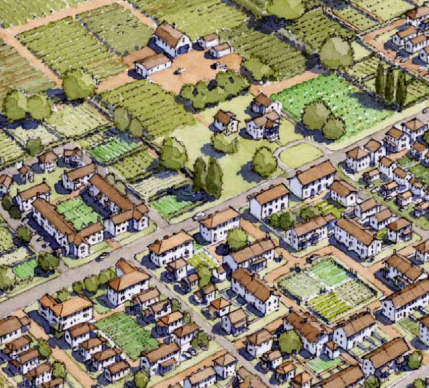
Architect Andres Duany thinks that peak oil and escalating food prices should convince real estate investors to build hobby farm collectives instead of golfing communities. For a million-dollar investment, your post-collapse future can look just like Tuscany! From "New Urbanism for the Apocalypse," by Greg Lindsay for Fast Company.

And I'm especially fond of the Urban Self-Sufficientist in Atlanta. He raises rabbits and grows veggies in the backyard of his in-town bungalow, but the best posts are about practicing falconry in local parks in order to enjoy homemade, free-range squirrel stew.

It's interesting how these different people pursue "self-sufficiency" in different ways. Wendy, for instance, makes much of growing her own food, but she still lives in a suburb where she's forced to pay for two cars and their fuel in order to acquire basic necessities. How's she going to find enough refined oil to fill her cars' tanks after civilization collapses?

Meanwhile, the Urban Self-Sufficientist takes an opposite tack, living in the middle of an urban neighborhood. If gasoline disappears, he won't be too put out - but won't his neighbors start taking an unsavory interest in the fruits of his backyard farm?

And architect Duany talks up economic collapse even while he tries to get real estate investors to build his planned communities, which will presumably be financed by 30-year mortgages. At least he's talking with people who ought to be experts in economic failure.

So even people who are planning for disaster clearly have different expectations of what it's going to be like: different people hedge for the end of civilization in different ways. Some believe that through the wreckage we'll figure out some way to keep our cars; others believe that we'll figure out a way to maintain a financial system.

I have my doubts on these counts - you're going to put more faith in American car culture than in America itself? - but then again, I also don't think it's much worthwhile to plan for any kind of collapse. Even if it does happen, it's going to be unpredictable.

Besides, I'm not much interested in self-sufficiency for its own sake. I'd rather rely on my neighbors for some things - there are plenty of people who are better farmers than I am, for instance, and I'd rather let others do the things they do well rather than try to do everything half-assed by myself. Specialization of labor is one of the innovations that got humanity out of the stone age, and even if civilization did collapse, I would hope that we wouldn't need to leave that idea behind - that we'd still be able to rely on our neighbors, families, and friends to help each other out.

Still, I do enjoy how the idea of self-sufficiency leads people to think about the places and the resources that provide their necessities for living. It's a roundabout way of thinking about our day-to-day relationships and dependencies on the natural resources that sustain us, and for some (like the falconer in Atlanta) it's a way to bring a little wildness home with us, even if we live in the middle of the city.

Self-sufficiency will not be any fun if it's forced on us. But as long as it's an elective activity, these bloggers make it clear that it can be a rewarding pursuit.

Monday, November 29, 2010

The abandoned spaceport

I finally made it to Flushing Meadows Corona Park last weekend to visit the ruins of the 1964 World's Fair. Technically, the abandoned New York State Pavilion is closed to the public, but the fence is poorly maintained and it's easy to sneak in:


And here's how it looked in 1964:


The park is an hour's bike ride from the Queensboro Bridge, or you can ride the 7 train to the Mets-Willets Point station. If you're in NYC, visit soon before the Parks Department fixes the fence, or worse, tears down the historic structure altogether.

Much more to come about Flushing Meadows Corona Park in future posts here...

Saturday, October 02, 2010

Go to Detroit, Young Man, and Grow Up

Bizarrely, a boot company and the guy from "Jackass" have teamed up to debunk the hopeless, epicenter-of-the-recession "ruin porn" that dominates everyone's perception of the Motor City. It's pretty fantastic, so I'll buy into their viral marketing scheme by re-posting and recommending their film here:


Here's the link for the whole 3-part series. It visits some of the famous ruins of Detroit, but only in the context that people are reviving and doing exciting things for those ruins. In this telling, the empty prairies and abandoned buildings don't necessarily represent blight; they represent possibility. Like the frontier in Horace Greeley's day, Detroit offers amazing opportunities for people to reinvent themselves - and reinvent the city.

A lot of what appeals to me in this video reminds me of the things I loved about Houston. Because in spite of its rapid growth and booming economy, Houston (like any other big city) also had a fair share of abandoned buildings, even entire neighborhoods overgrown in weeds, and those were the places I loved to explore.

It was also cheap to live there, partly because Houston has a sprawling geography and very few rules about what people do with their real estate - there is literally no zoning law there.

And so: one man I'd met bought the concrete shell of an old rice mill near the bayou, lived in a bus parked inside its empty walls, and made art cars. Our friends bought an abandoned apartment complex and the old pool hall next door to house a successful after-school program. And the summer we lived there, Art League of Houston commissioned this project for two abandoned houses that had been slated for demolition in the Montrose neighborhood (which is one of the city's most vibrant, by the way):


So in general, the most amazing parts of Houston were the places that had recently been abandoned, and were on the verge of re-creating themselves. I think that the same goes for most cities.

So I guess I disagree, somewhat, with the derogatory term "ruin porn." There are at least a few of us who are ogling Detroit's gorgeous, abandoned architecture and new prairies not out of scorn for the Government Motors bailouts, nor for the sake of wallowing in self-pity about this recession, but out of genuine sense of possibility. We are imagining ourselves making something new there, and being a part of the revival.

Wednesday, July 21, 2010

Dumpster Pools on Streets Without Cars

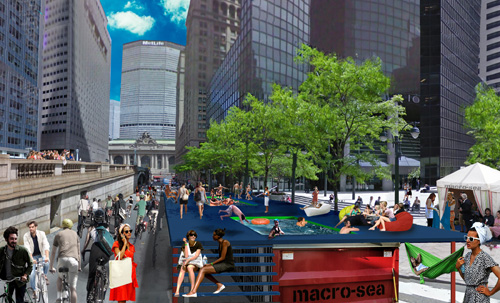
Damn, that last post was a real downer. Sorry, everyone. Why don't we beat the heat by taking a dip in a recycled dumpster parked on a car-free Park Avenue in front of Grand Central Station?


This is roughly what Park Avenue near 42nd Street will look like on three consecutive Saturdays in August, when the city invites pedestrian and cyclists to enjoy major streets without any motor vehicle traffic. It has all the trappings of a futuristic Ecotopia, where fashionable pedestrians have re-conquered the highways from automobiles and dumpsters hold swimming pools instead of garbage. Luckily the image above is just a Photoshop job, so that kid diving into the shallow end isn't really going to break his neck.

The dumpster pools are a new addition for the second annual "Summer Streets" event. This massive prohibition of motor vehicle traffic on one of Manhattan's major avenues to is actually an initiative of the city's Department of Transportation under the leadership of Janette Sadik-Kahn, an avid cyclist and pedestrian. Let this be a lesson to all the other Departments of Transportation: while your pencil-necked bureaucrats are making life more difficult for pedestrians and designing expensive new ways for people to waste their time in traffic, New York City is showing us how transportation planners can actually be lovable.

Tuesday, June 01, 2010

A Park Gained, A Wilderness Lost

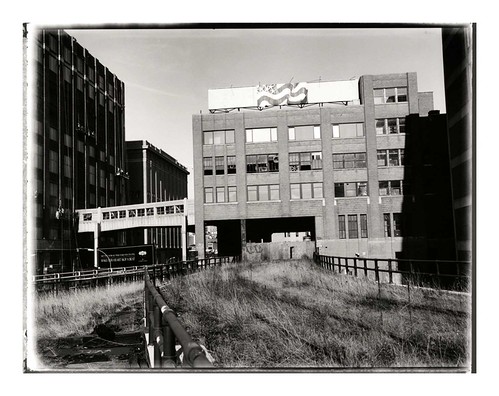
When I was in New York a few weeks ago, I finally made a visit to the High Line, the city's new park on an abandoned elevated rail line on the west side of Manhattan.

The High Line, in 2007 and in 2010 on TwitpicLeft: the High Line in 2007 and in 2010: cultivating native plants and overpriced condo towers. Click to enlarge.

I had been pretty excited about this park for a long time - I first learned about it in 2006, the year I was working for the City as an Urban Park Ranger, when the project first broke ground. For me, the High Line was a vindication of my idea that a city's hidden pockets of wildness - often on the forgotten margins, like the abandoned industrial neighborhood around the High Line - could be celebrated for their unique ecosystems and natural resources, instead of being condemned as "blight."

Since it's opened to the public, there can't be any doubt that this abandoned railroad has been a cause for celebration from residents and tourists alike.

But when I visited last month, I had to wonder if something was lost in the High Line's transition from abandoned railroad to public park. The High Line is stunningly designed, packed with native plantings, and it's opened up new ways for New Yorkers and visitors to experience the city.

But is it wild anymore?


The High Line in 2001, by Jonathan Flaum:And in 2009, via Inhabitat:


The overwhelming impression I got from walking on the High Line this spring was of wealth. The park was clearly expensive to build, with tropical-wood furniture, elaborate fountains (they were under repair while I was there), and meticulously tended foliage. The carefully selected varieties of native plants were evenly, geometrically spaced in mulched planting beds outfitted with an irrigation system. A forest of new condo high rises and hotels, designed by global celebrity architects, loomed over the rehabbed warehouse buildings of the former industrial district.

Great architecture is all well and good. But I found that the High Line, in its "finished" state, was less like the wilderness I'd hoped for, and more like a formal garden for the gentry of Chelsea: a sort of post-industrial Versailles.

I feel like this is a missed opportunity. After all, ostentatious displays of wealth in New York City are not all that compelling or interesting - they're pretty much a dime a dozen.

The High Line, before it was a park, had been a refuge from a landscape obsessed with capitalizing and selling every square foot of space. Here there were acres of land that existed outside of the consciousness of real estate, where weeds, small mammals, birds, and the occasional human adventurer were free to wander in a two-mile meadow, simultaneously above and surrounded by the city. That's where it derived its wildness.

As a landscaped park, though, the High Line is obviously a real estate amenity. When every prospect offers views of shiny condo towers and expensive lofts in expensively rehabbed warehouses, and designer signage implores you to stay on the designer concrete pathway, it's obvious to the visitor that this park was financed and built by developers and neighbors angling to increase their own property values. In the process of becoming a public park, the High Line became co-opted by New York City's real estate juggernaut.

In the process, an essential part of the High Line's promise - its freedom, and isolation from the commodification and control of New York City's landscape - has been lost.*

The new High Line park's design also botches the structure's historical context. Until 1980, the High Line railroad had been used to deliver agricultural raw materials to various food processing plants in the neighborhood. Refrigerated boxcars full of cows, for instance, were delivered to the slaughterhouses of the Meatpacking District. Several spurs curve from the main line into adjacent buildings, and in some places, the High Line actually travels through the middle of buildings, with old loading docks on either side.

Here's a photo from the mid-twentieth century of the High Line where it runs through the National Biscuit Company (a.k.a Nabisco) complex. These are the same buildings pictured at the top of this post:


For decades, then, the High Line (and its surrounding neighborhood) played an important role in feeding New Yorkers, and commodifying the agricultural bounty of the Midwest into value-added processed foods. There's a rich historical narrative here about the industrialization of agriculture, the centralization of food processing, the rise of supermarkets... but there's no trace of any of this in today's High Line Park.

This was the other big thing that unnerved me about walking along the High Line. The structure's wrought-iron railings, steel I-beams, and the handful of high-ceilinged brick warehouses surrounding the old railway clearly hearken back to a lost industrial past. But everything about the park itself, and the expensive architecture that surrounds it, drives home the fact that that industrial past is entirely gone. This used to be a neighborhood that made things and trafficked in the heavy, bulky products that required massive railroads to move. The High Line itself used to be a vital connection between the City and the natural resources that fed it.

But today, the neighborhood traffics in abstractions: there's tremendous wealth here, but it's anyone's guess where it comes from.

Back in 2007 I wrote about how the abandoned High Line illustrated the ecological succession of urban vacant lots
:
Over the years, more dust, leaves, and soot blew in. Each fall, the topsoil gained another layer of dead grass and leaves from pioneer weeds like goldenrod, Queen Anne's lace, and Ailanthus Altissima... the new High Line park will have benches, new concrete paths, easy access from the street level, and drought-tolerant landscaping that mimics the wild weeds that inspired the park.

It might seem like an interruption and commodification of the wild successional process, but New York is nothing if not habitat for homo sapiens, and the new High Line fits in perfectly with New York's typical neighborhood succession: places once run-down and diverse inexorably become unaffordable and boring. At least until the next large disturbance, anyhow.
When the new park opened in 2009, we were in the middle of a huge financial crisis that seemed to hold out the promise of being that "next large disturbance." Here's an excerpt of the post I wrote at the park's grand opening:
In the new economy, the High Line feels a lot weirder. It was meant to be a futuristic preserve for New York's past - especially its overgrown lots and abandoned industrial infrastructure. Now that the park is open, though, the ultra-slick High Line feels a bit out of place. Instead of evoking New York City's past, the High Line looks more like an expensive simulation of conditions in inner-city Detroit, or of a foreclosed backyard, or of any of the thousands of newly-defunct car dealerships nationwide. Those conditions were rare in New York City two years ago, but now that they're fairly commonplace in society's consciousness, the High Line seems more artificial and contrived.
Now that I've been there, though, I realize that the High Line doesn't feel anything like Detroit or an abandoned car dealership. That's its problem: it lacks any relationship to the economic or environmental conditions of the city. Instead, it sits aloof from the street, a walled garden guarded against the weeds and the history that used to reside there.

But the views are nice, I'll grant it that.


*Footnote: This is related to the age-old debate about whether we can open up "wilderness" areas to the public without ruining the essential qualities that make these areas feel wild - namely, their isolation and freedom. I'm typically inclined to believe that this is not a real trade-off, especially if we can help people appreciate the relative abundance of places like the (old) High Line that exist right under our noses, in our cities and neighborhoods. Cultivating a sense of stewardship for these places, whether they're in an abandoned downtown area or in a national park, will let more people enjoy them without necessarily "ruining" them.

Unfortunately, in the case of the High Line, we (the public) have surrendered our responsibilities of stewardship to profit-motivated architects and developers.


Saturday, April 24, 2010

Safari 7: a wilderness tour of Queens


During a few days spent in New York, I had a chance to briefly visit the Safari 7 Base Camp, set up in Grand Central for Earth Week.

Safari 7 is pretty much exactly what I have been thinking about doing ever since I worked as an Urban Park Ranger a few years ago in Inwood Hill Park: a guided tour that highlights nature and ecology in the places we typically overlook those things. I'm glad that someone actually had the initiative to make it happen. From the project's description:

“The 7 line is a physical, urban transect through New York City's most diverse range of ecosystems. Affectionately called the International Express, the 7 line runs from Manhattan's dense core, under the East River, and through a dispersed mixture of residences and parklands before terminating in downtown Flushing. Safari 7 circulates an ongoing series of podcasts and maps that explore the complexity, biodiversity, conflicts, and potentials of New York City's ecosystems. Tours are available online and can be experienced independently, or in group expeditions and workshops organized by the Safari 7 team.”


The "Base Camp" at Grand Central included an array of gorgeous banners that highlighted things like the aquatic wildlife of the East River, the ecosystems of decomposition at work in the city's huge “cemetery belt,” and the dual role of urban chickens, as food sources and as illegal fighters. The centerpiece of the project is a series of podcasts, short enough to listen to between stops, that describe various ecological phenomena at work at each stop along the line.

Thus, as you ride under the East River, you can listen to a podcast about the tiny island formed from that tunnel's excavation, and learn about the cormorants that nest there. Or hear about the ecology of courtyard gardens in Queens, while you try to get a glimpse of one from the elevated portion of the line.

Over the next few weeks, I plan to write more about those individual podcasts and some of the issues they discuss in more detail. Much of the subject matter isn't unique to Queens - no matter what city or backwoods internet-enabled cabin you live in, there's something for you to learn about your own human habitat. Visit safari7.org to download your own safari audio tour.

Friday, January 29, 2010

Ski Your City!

Last week, most of Maine got a soaking 3 inches of rain, which washed away most of the season's snow. It was a sad day.

But as I write this, an unlikely alliance of scaffolders, public works employees, and snowmaking crews from the Sunday River ski resort in western Maine are converging in Monument Square, the center of downtown Portland, to put together an artificial ski hill and cover it in snow. Tonight, hotshot skiers and snowboarders will spend the evening running dozens of loops up the scaffold's stairs, down the short hill and its stunt-rails, and up the stairs again. Here's a video of last year's event:


Admittedly, the main intention of this is to get the kids to drink more Red Bull and surrender $60 for a day's lift ticket at the big ski resorts that are sponsoring this. Still: a temporary ski-slope installation in the central public space of your city's downtown is pretty cool. They've brought the mountains to the people.

It also reminds me of a proposal to redevelop Berlin's Templehof airfield as a giant mountain, girdled at its base by the Nazi-era terminal building. It wasn't a serious proposal, but it was meant to inspire more creative and interesting ideas for redevelopment beyond the typical mix of apartments, parks, and office buildings:


Templehof Mountain, by Jakob Tigges and Malte Kloes, via Der Spiegel

And it also reminds me of the mid-century craze for winter carnivals, with the massive ski-jump constructions they brought to the nation's big stadia. Pruned posted a good compendium of those historic photos last year - my favorite might be this one from Dodger Stadium:


Ski jump in Dodger Stadium, 1963. Photo by Tom Courtney, via Pruned.
Note the palm trees in the photo. Skiing in Los Angeles required both architectural and meteorological interventions.

Historically, skiing has always served to open up new ways of crossing the landscape in the winter. Before it became a "sport," it was a mode of transportation for Swedish postal carriers, soldiers in Italy, and Ernest Hemingway. It wasn't until the sport was commercialized and commodified after World War Two that skiing became limited to something that you primarily did downhill, on mountains with elaborate and expensive cable lifts.

Why should it be that way, though? The ski slope in Monument Square doesn't particularly make me want to drive 2 hours to the ski resorts. Instead, I look up at the even taller buildings that surround the Square and think about what it would take to ski down the four-story terraces on the office building at One City Center.

Two or three times a year, there are snowstorms big enough to overwhelm plowing crews downtown, and it actually is possible to ski through the streets. And in back alleys, snowdrifts pile up and open up new, otherwise inaccessible shortcuts between buildings.

Skiing in the city can be, like skateboading or parkour, a radical act to rearrange our understanding of and relationships with the urban environment. As such, we should probably expect these attempts to commercialize and control it, but that doesn't mean we have to buy it. Skiing in the city is free - and fun.


Sunday, January 17, 2010

Fort Gorges, Portland, Maine

Here's a post to remind us of the halcyon days of summer.

Fort Gorges (pronounced "gorgeous") is a military installation that dates to the Civil War era, when Portland's harbor was still a strategic military target. It was built more or less in the ocean on top of Hog Island Ledge. Its thick granite walls were built to withstand cannon blasts, which means that they're still in good condition to withstand the constant waves of Casco Bay.


Its construction continued during wartime, but by the time of its completion in 1865, wartime advances in artillery had already made its walls obsolete against the largest cannons. According to this history, "a modernization plan was begun in 1869, but funding was cut off in 1876, with the third level of the fort still unfinished." That third level was instead covered over in a mound of sand, to insulate the interior of the fort and its stores of gunpowder against attack. Today, that mound of sod grows wild with small trees and shrubs.

Inside the fort's walls is a large open parade ground, which is remarkably calm and quiet:


Granite staircases are still in good condition and lead up to the second and third levels, where there are dark tunnels that lead into the pitch-black powder magazines. The northern side of the fort, facing the city, houses the remnant woodwork of the officers' quarters. Walk on the rotted-out floors at your own risk.


During World War Two, the Fort was basically used as a military storage unit, and there's a concrete pad in the central field where sea-mines were allegedly stored. In 1960, the military finally decided that it had no further use for it, and they donated it to the City of Portland, which has maintained it as a public park ever since. The military cleaned out everything that wasn't nailed down or made of granite, with one exception: a large, Civil War cannon on the eastern side of the third level, which was apparently too large to move out and melt for scrap. It's still there, pointing towards the harbor, half-overgrown in grass and daisies:


The Fort is wide open to the public, but you need a boat to get there - some water taxis will take you there at high tide, or you can rent a kayak (as we did) and paddle there from the East End boat launch. It is a pretty excellent adventure.


Wednesday, December 16, 2009

The Boom: Portland's Spoils of the Naughts

The naughts are almost over. This was the decade of the real estate bubble, but it would be easy to assume that the bubble passed by Portland, Maine. After all, the city's skyline, as viewed from Falmouth or across the harbor in South Portland, hasn't changed much in the past 10 years.

But take a closer look, by walking along the city's main streets and through its neighborhoods, and it's clear that Portland is substantially newer and more vibrant than it was in 1999, when I graduated from Bonny Eagle High School and left for college in that other Portland. Many of the buildings are the same, but they've been refurbished and re-inhabited with households and businesses that care more about them. And elsewhere, abandoned lots and under-utilized parking spaces have given way to new housing and businesses.

The Portland peninsula has sprouted dozens of new buildings in the past decade. Here are five of my picks for the best, in no particular order (I'll post five more in a follow-up post next week):

  • Bayside East. Corner of Smith and Oxford Streets, East Bayside. Designed by Scott Teas, TFH Architects. Completed 2008.

    While prosperity arrived in most of Portland's neighborhoods during the 2000s, East Bayside was largely left out. The neighborhood is centrally-located geographically, but it remains isolated thanks to the lousy ideas of 1960s urban renewal: a monopoly of government-owned housing and dead-end streets cut off by the wretched Franklin Arterial. It's Portland's most Detroit-like neighborhood.

    Bayside East is a another affordable housing project, but unlike its older neighbors, it doesn't look like one. The south-facing patio works well as a pleasant public space for the building's residents, and the solar hot water heaters take a prominent place as a sort of awning on the top floor.

    It's not at all flashy, but of all of Portland's new buildings, this one might be the most successful at integrating itself into the scale and context of Portland's central-city neighborhoods. It goes a long way towards healing East Bayside's tattered urban fabric.

  • 280 Fore Street, by SMRT Architects. Completed 2004.

    There was a time when banks invested in good, quality buildings to establish a public trust in the solidity of their institutions.

    During the 2000s, though, most banks were content to put up cheap offices ringed with drive-thrus. Banks literally sought to emulate fast-food joints, both in the facile idiocy of their products and in the shittiness of their architecture. And then they collapsed.

    Bangor Savings Bank wasn't immune from this impulse - they built Burger Bank franchises out on Brighton Ave. and over the bridge in South Portland's Mill Creek Strip Mall - but at least they put some effort into their downtown Portland branch and corporate offices. It's a quality building, and the curved acute angle of its northern corner adds a dynamic presence to the corner of Franklin and Fore Streets. I don't mind admitting that my admiration for the building led me to choose this bank over its competition.

  • 490 Congress St., by Jim Sterling. Completed 2007.

    Like the W.L. Blake Building addition below, this is an attractive modernist structure that fits in well with its historic surroundings on Congress Street. It's even more striking in the context of what it replaced, a pair of half-abandoned 2-story hovels that stuck out like a missing incisor in Congress Street's smile.

    The wide glass windows and striking metal siding probably make this building the city's most stereotypical example of naughts architecture. It's clearly making a hard sales pitch for "loft living" - you can even buy Eames chairs and contemporary art from the ground-floor retail tenants. Still, it's a damned attractive sales pitch, and even if it's a bit cliched I much prefer this to the urban abandonment that prevailed in the latter half of the last century.

  • W.L. Blake Building Addition, 79 Commercial St. By David Lloyd of Archetype Architects. Completed 2001.

    This was one of the first new buildings of the naughts, and it set a good precedent. The new building respects its historic neighbors on either side by adopting the same scale and massing. But it stops short of imitating their brick cladding and granite sills and lintels (unlike most other new buildings in the city, regrettably) with fine-looking building materials of our own era.

    The view from inside the offices must be incredible. But the view from the street ain't bad, either.

  • Unity Village, Stone, Oxford, and Cumberland Streets. By Winton Scott Architects. Completed 2001.

    At the beginning of this decade, the city was in the midst of a severe housing shortage, thanks to decades of pointlessly-restrictive zoning and a resulting lack of investment.

    Unity Village was one of the city's first proactive efforts to turn things around. City Hall offered up three city-owned parking lots behind city hall to developer Richard Berman (disclosure: I helped build his company's website) for a new, mixed-income housing complex. Today, it's a place where the newly-homeless can live comfortably and unassumingly next to white-collar downtown office workers and immigrant families. The homes have abundant porches that mesh the private life of the households with the vibrant public life of the narrow street and a nearby playground.

    If Unity Village hadn't been as successful as it is, the City could easily have slid back into the old habit of Not-In-My-Backyard zoning, which would have effectively stymied most of the other projects listed here. Instead, it helped spark the broader revitalization of Bayside. Unity Village demonstrated to Portlanders that new development - even if it brought poor people into the neighborhood - could be an improving asset for the community.