Friday, April 14, 2006

Agiocochook!

The winter caretaking season is over, and Jess and I have started working for the AMC's construction crew. These past two weeks, that's meant a lot of hanging around at Pinkham Notch Visitors' Center, painting the lodge and repairing the cargo nets we use for the annual springtime helicopter trips. Not quite as glamorous as caretaking, but it does let us spend more time with friends at work and elsewhere in the valley.

Last Friday we received a tip that there were several cancellations for the Mount Washington Observatory's weekend "Edutrip," and that we were welcomed to join buddy Tom (2005 Carter winter caretaker and currently a scientist in the Observatory's valley office) on a snowcat ride to and overnight stay at the summit.

We have several buddies working for the observatory right now, and we'd intended to pay a visit all winter. The chance to ride in a snowcat, along with all of our winter gear (including skis!) was not one that we would pass up. Plus, now that it was April, we could experience a slightly milder version of Agiocochook's winter weather, with long daylit evenings and temperatures up in the positive single digits of the Fahrenheit scale.

We spent a strange and wonderful evening in the cavernous, well-heated summit building with the summit crew, two Observatory volunteers, and the other Edutrip people. I stepped outside a couple of times that night to take in a brilliant moonlit view from the lights of Portland to the pale outline of Mount Mansfield. Close by on the other side of Pinkham Notch, Carter Dome, that big mountain that had loomed over me all winter, was over one thousand feet beneath us. The low temperatures and steady north winds kept me from spending much time outside, though, and between our isolated and beautiful surroundings and the lively company indoors, I had to agree with our volunteer chef Anthony when he compared living at the Observatory to living on a big ship at sea.

I made several excursions with Tom and weather observer Neil to enjoy the skiing on the east snowfields, a 700 foot drop from the summit complex to the Alpine Garden in the Observatory's backyard. We made four laps our first evening there, skiing until the sun dipped underneath the overcast clouds and shone on everything horizontally. It was spectacular light, and one of the photographs I took wound up next to Neil's weather column in the local "Mountain Ear" newspaper. My first published photograph - and in the Mount Washington Valley's second-finest newspaper!

The next morning, Tom and I skied down the snowfields and Tuckerman's Ravine while Jess, still recovering from a knee injury, slid down in a series of long, controlled self-arrests. Sunday was a paragon of spring days, with sunshine and mild temperatures, and a beach party scene at the lunch rocks on the bottom of the ravine. A fine descent from a fine weekend. We're looking forward to returning to the rockpile when the construction crew begins renovations at Lakes of the Clouds Hut next week. Stay tuned for more ski pictures and (hopefully) a chronicle of our helicopter rides.

Wednesday, March 29, 2006

Critters of Carter Notch

Now that I've finally gotten around to uploading my pictures, here's a field guide to the critters resident in and around Carter Notch Hut.

Here's the female half of a mating pair of foxes that has been hanging around the Notch. I saw both of them "flirting" with each other - roughhousing, really - around the hut building right before I took this picture. A moment later, she peed on the sign. A few nights later, one of them begged to come inside out of the cold (the wildlife remains wild, however). I haven't seen them for a couple of weeks, but I do see lots of tracks and will occasionally smell their skunk-like urine.

I woke up at 2 am Friday morning to frantic rodent scratching noises. I've so far been lucky not to have any rodents except for a harmless shrew (see below) that hung around for a couple of weeks, but as the warmer weather returns, they're becoming more active. I got out of bed so that I could set some traps and sleep in peace.

Here's the shelf where we store the rodent traps, and, in the corner, you can see the vole that got itself stranded there, unable to climb up or jump down to escape. It took me a couple of seconds as I fiddled with the mousetraps and bait before I realized that I was looking straight at my quarry. I herded the little guy into an empty grey-water bucket from under the sinks, and left him out in the kitchen until the morning, when I hoped to provide him as live bait to one of the local predators. The plan fell through when I found him dead of hypothermia five hours later.

The next afternoon, I trapped a second vole in a mousetrap. Hoping that I could attract predators and watch them dine through the big window next to my bed, I tossed this one into the same outdoor buffet as the hypothermia victim. The stirring chorus of Elton John's "The Circle of Life" played in my head as I shook the second corpse from the trap.

And this is a shrew, a very tiny rodent that has to eat almost constantly to sustain its frenzied metabolism. I had one in January that kept the floors exceptionally clean until it climbed into a full bucket of grey water and drowned. This one here lasted only three days before it, too, perished in a mousetrap.

And a local predator (I suspect the pine marten, whose tracks I found before and after the massacres) did snack on these treats, albeit in the privacy of darkness.

Tuesday, March 14, 2006

Ski Carter Notch!


March 2006 on Carter Dome: Enough snow to confound navigation.


So far, rain has fallen during every ten-day stint I've worked at Carter Notch this winter (most recently during the hike down to the valley for a backcountry meeting on Sunday afternoon). But, even if all of the major storms have accompanied tepid southern winds, a number of runt "systems" have persisted in keeping the mountains pretty with fresh snow in between the monsoons.

This year, those of us who would like to consider ourselves vigorous northerners have been grasping at every meteorological suggestion of winter. Two or three of these scanty snowfalls piled on top of each other at least gave me the opportunity to recall the idea of "powder" on the top section of the Nineteen Mile Brook Trail, just as they've offered New Hampshire snowplow drivers the opportunity to resurface Route 16 with rock salt. In spite of the rain, the snowpack gradually got deeper, all the way to 24 inches this past week at the hut. Windblown cornices on top of the Dome were over my head. And so, if there was going to be a week for skiing Carter Notch this year, this last week was likely to be my best opportunity.

I spent Monday on the Dome. I carried my skis to the summit on a brilliantly clear, calm, and cold day, then descended the Rainbow Trail on skis to the bald eastern ridge a mile east of the summit. Because few people ever travel on the Rainbow Trail, I enjoyed fresh, deep, and untracked powder the whole way, and the descent through was only steep and narrow enough to make me concerned about major trauma in an abstract (as opposed to concrete) sort of way. Actually, though the Rainbow Trail is ridiculously narrow, much of the spruce-fir woods around it are open enough to allow some degree of tree skiing. From the scrubby knob I had a fantastic view of Agiocochook rising over Wildcat, and I basked in the sunshine for about half an hour before heading back up to the summit and back down to the hut, on skis until Pulpit Rock, then on foot for the rocky last half mile.

Wednesday was a similarly beautiful day and, though I was tempted to enjoy the greenhouse effect of the large window next to the caretaker's bed, I got an early start to do a long loop of a ski tour via the Wildcat Valley/River trails. The Wildcat Valley Trail, which is maintained by the Jackson Ski Touring Foundation, descends over 3000 vertical feet from the top of the Wildcat ski area to the town of Jackson. It is a long, meandering trail, not especially steep - it is meant for cross-country skiers, after all - but it can be fast if you want it to be, and the ride goes on for a long time. In my case, it took over half an hour, and I didn't even follow the trail to its end in Jackson Village.

In the valley, I was in the somewhat unfamiliar territory of Jackson's cross-country ski trail network. I needed to find the Wildcat River Trail to get back up to the hut, and after some skiing on a groomed track, I found a yellow blaze and a rough trail in the woods to the west of what I believed to be Jackson's Carter Notch Road. I followed this for over a mile before I began to second-guess my sense of direction and suspect that I might be climbing Doublehead Mountain on the other side of the valley. This idea, troublesome because it would have put me nearer to Maine than to the hut, turned out not to be so. In hindsight, an interstate tale of nocturnal navigations and neglected hut guests would have been better blog material than this account of a merely satisfactory day. For my next excursion, I will keep this in mind.

Monday, March 13, 2006

Dr. Almond takes a hike

On Saturday I learned that Dr. Almonds are a new superhero food. Filled with almond butter, honey and crushed graham crackers and dipped in dark chocolate, they are a tasty fuel and hearken the graham craze of the late 1890s. Let me know if you'd like the recipe.

It was Satuday that I hutchecked Madison Springs and Lakes of the Clouds Huts with Chris Dufreese, a regular hutchecking companion. The hike across the ridge is my favorite hike anywhere in the White Mountains. It changes every time. Leaving Madison and ascending Adams' shoulder, we were buffeted by 70 mph winds, with higher gusts. The air, however, was warm enough to need little more than long underwear and a windbreaker. By the time we reached Edmonds Col, the winds had died a bit, and the clouds had lifted (or we had desceded below them). We could see the hem of a thick cloud curtain hanging over the Great Gulf and shrouding the summit of Mount Washington. Then my crampon broke.

I hike in L.L.Bean boots with strap-on crampons and have since learned this is a mistake. My boots flex too much for the crampon, stressing the dinky clip that holds the back and front halves together. Fortunately, at the last moment, I packed some Dermatone which comes on what I had always thought was a useless carabeener keychain. Not so. The key ring worked perfectly to reconnect my crampon, so Chris and MacGuyver ate some Dr. Almonds, and carried on.

The crampons (and Dr. Almonds) proved necessary for the hike around Jefferson. Its flanks were covered with chenille-like stretches of snow and ice. The clouds lifted, and by the time we reached Clay, the sun had peeked out from behind its curtain. Following more Dr. Almonds, we skirted Washington in the sun. Lakes hosted a quick snack and an illegal quinzee, and we warned a loitering hiker against camping next to the hut. The buttslide down the Ammonoosuc Ravine Trail was just an added bonus to a beautiful, brisk, ridge walk.

Hutchecking both huts in one day allowed me to visit C.Neal at Carter that evening. I motored up in the moonlight to be welcomed by the Maine AMC chapter, led by C.Neal's high school chemistry teacher, and some delicious peach pie. It was a perfect day, and I can only attribute my endurance to a certain Doctor, and the coming of Spring.

In other news, I saw the pine marten at Zealand this week. He spent much time sunning just below the front porch and nosing around in its ice scrapings. I was so excited about my visitor that I shot an entire roll of film, and I will be sure to share them here as soon as they are developed.

This week in books:

Cruddy, by Linda Barry
The Corrections, by Johnathan Franzen
The Wild Sheep Chase, by Haruki Murakami.

Friday, March 03, 2006

New York City

It's Friday, which means that I hike back into Carter Notch this evening with a 10 day stint in front of me. But March is my favorite month of the year, with lots of snow and lengthening days and warming temperatures in which to enjoy it. There's enough white stuff in the Notch that it's feasible for me to bring up my skis for the first time in a month. I plan to attempt ski descents of Carter Dome and the Wildcat Valley Trail this week.

This last set of days off were spent on the road, visiting friends in Vermont and New York City. We enjoyed good company and fresh vegetables, but New York was further away than I had thought, and I was also reminded of my extreme distaste for driving. What a relief it is, after a long day in the car, to arrive someplace where one gets around on foot, whether in the White Mountains or in Brooklyn. Jess and I also replenished our supplies of novels from the city's rich supplies of used books.

My buddy Paul from Reed joins me on the hike up today. He's visiting from Oregon and it's his first time in New Hampshire. I hope that Carter Notch raises his regard for the Granite State enough that he can turn a blind eye to that lower intestinal tract of White Mountain tourism, the North Conway strip, when he drives back to Boston tomorrow.

And before I head off to the hills, a shout-out to the crowd from Views From the Top website. They visited me over Presidents' Day weekend and shared two tremendous (in both the qualitative and quantitative meanings of the word) dinners of authentic Asian cuisine.

Sunday, February 26, 2006

A beaver gets busy

After so many hikes, in and out, the beaver pond is the reason I still enjoy the Zealand Trail. I love the way the trail changes--winding around the ponds, through birches and over bridges. I think it best in new snow just as the sun peeks over the ridge and this week, in the early morning snow, I met a new obstacle, a delightful surprise.

December 27, on my very first hike into Zealand as caretaker, I was new and nervous, filling my head with expectations for the new position, bold projects I would, in three months time, accomplish. Rounding the curve after Z-bridge, I met the signs of a beaver, and was reminded that I was no longer in Houston. He had gnawed a 12 -inch patch into a tree of even greater diameter. Did he really think he would fell it, and if so, how would he put it to use?

Hiking out, a week later, I noticed more signs, as he'd begun a number of new projects (and I had yet to begin any of mine). He'd scoped out a few trees more proportional to the one felled by the beaver in Lady and the Tramp, and I marveled at how he'd move the trees without the Tramp's converted muzzle. They were on the uphill side of the trail, a good ways from the water.

Fellow hikers have helped charting his progress, and I've thought of taking bets on which tree he'll fell first. One group of visitors in January spotted him swimming lazy circles in an ice hole in the middle of the pond. Another lucky pair must have startled him at work. No sooner had they noticed his ambitious projects, than they saw the go-getter crouching below near the water. I've not been so lucky, but the stories have made me take time to look up from my commute in the hopes of seeing my erstwhile companion.

This week, coming upon what I now think of as his section of trail, I eagerly looked up and about. It was a good thing, too, because even though I didn't see beaver, I was just in time to stop before an enormous birch, thigh height, blocking my path. He fell first a birch, more than a foot in diameter, uphill from the trail. He's well on his way in Phase I of construction, and how far have I come in my novice ambitions?


This week in books:

The Plot Against America, by Philip Roth
Persepolis: The story of a childhood, by Marjane Satrapi
The Sot Weed Factor, by John Barth
Prodigal Summer, by Barabara Kingsolver
The New Transit Town; Best Practices in Transit-Oriented Development, edited by Hank Dittmar and Gloria Ohland

Tuesday, February 14, 2006

You can dance if you want to

"Project CLIMB," an outing club from Kearsarge Regional High School, stayed at Carter Notch this past weekend with about 35 students and 5 teachers/chaperones. Since they've been making trips to the huts in the winter for several years now, there was little need for me to supervise them as a caretaker: I was most helpful when I just stayed out of their way. The kitchen and dining room were considerably messier than usual this past weekend, to be sure, but when they left on Sunday morning, the place was spotless.

Besides being an easy group to host, they were also a lot of fun. One of the women had brought a fiddle, and on Saturday night, the students organized a contradance inside the hut. This past week was the coldest so far this winter, and temperatures in the Notch that night hovered around 0 degrees F, but between the woodstove and the dancing, we were wearing t-shirts indoors.

Every winter, caretakers hear the promise from certain guests who, huddled cold and sedentary by the woodstove on a winter night, promise that they'll pack up their own firewood to supplement our wood supply the next time they visit. After a year to think about it, they invariably opt to carry extra warm clothes instead. But future guests who dream of a 60 degree hut should forget about the woodstove and heed instead the example of Kearsarge RHS: a fiddle, skillfully used, will produce as much heat as a dozen stout logs.

This week's reading:
  • The Sot-Weed Factor by John Barth
  • Harper's, January 2006 issue, which I found in the box of games (?) on Friday and had read almost entirely by the next evening.

    Wildlife sightings this week
  • A pair of red foxes (vulpes vulpes) were flirting with each other around the hut on Monday afternoon. I watched them through the windows of the hut and had the chance to snap a few photos, which I will post here soon.
  • Our resident masked shrew (sorex sinereus), which has been a frequent sight inside the hut for the past few weeks, was only identified as such after it drowned in the dishwater buckets and was found frozen to the gray water screens on Saturday morning. It was a little bit sad to lose such a cute critter, especially since it never invaded my food supply but was always content to clean up crumbs on the floor, but hopefully the corpus will make a good snack for one of the local predators.

  • Tuesday, January 31, 2006

    Solitude and Red Mac


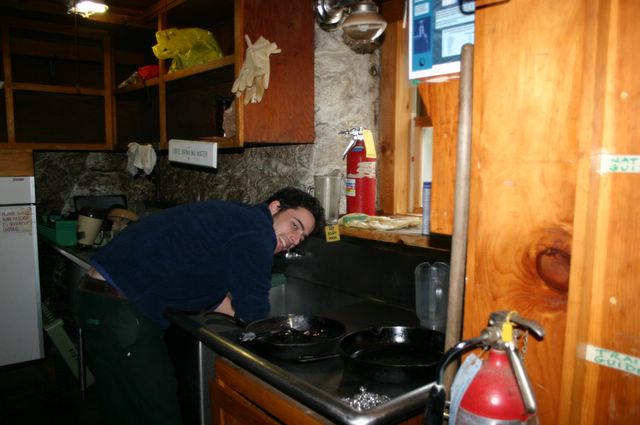
    Thanks to Carrie, one of my guests this weekend, for taking this caretaking action photo. Reaming the sinks, without running water, is just one of the glamorous activities of the caretaking lifestyle.

    In between two nearly-full houses on the last two Saturday nights, I spent a lot of quality time with nobody but me and the staticky voices of Terry Gross and other NPR personalities. By the time the weekend gives leave to the inmates of the global economy to keep me company in the mountains, my typically reserved personality becomes downright outgoing. It helped that my guests these past two weekends were funny, genial, and helpful as well.

    This last Saturday was also a perfect winter day, sunny and mild, and the first day so far that I was able to recognize the daylight lingering after the 5 pm radio call. With the clear skies, I promised that night's guests a program on the winter constellations later on when everyone had finished dinner. But that took longer than expected, and by the time the kitchen was clean, Auriga, Orion and the rest were hidden behind clouds, the front lines of an approaching low-pressure system.

    The approaching storm also brought winds that were gusting to 60 MPH that night, and so, while the wind generator howled periodically on the roof, I decided to substitute the star program with the tale of Red Mac McGregor.

    Red Mac was one the first manager of the White Mountain huts system, probably best known as the man who hired Joe Dodge to work as the Pinkham Notch hutmaster in the 1920s. Red Mac started his AMC career as the hutmaster of Carter Notch Hut during some of the first summers of its existence. Carter Notch was his favorite hut, and he allegedly joked that when he died, his heaven would be on the shores of the Lakes of the Winds.

    Years later, in the late 1970s, the AMC began to leave Carter Notch Hut open year-round. Whereas the winter season is currently split into two shifts (late fall caretakers work from October until Christmas, and winter caretakers work from Christmas until April), the first Carter winter caretakers worked, with biweekly days off, straight through from October until April. Furthermore, in those first few years, there were far fewer winter hikers, and caretakers could work for an entire ten-day stint without seeing anyone at the hut.

    Joe Gill looked after Carter Notch during the third winter it was open, in 1978. On one evening late in March, near the end of his seasonal tenure, Joe woke up late in the night with a flashlight shining in his eyes. There had been no guests in the hut when he had gone to sleep, but late arrivals aren't uncommon, and someone had apparently wandered into the crew room to let him know that they had arrived.

    "Can I help you?" said Joe as he squinted into the light. There was no answer, and the flashlight didn't move. He found another light that he kept near his bed and shone it across the room, and there he saw his own flashlight, switched on and pointed directly at him. He couldn't remember putting it there, and it would later strike him as strange that he would have been able to fall asleep in the first place with it shining in his face. But anxious to get back to sleep, and assuming that he had just forgotten to turn it off, Joe got up, crossed the room to turn off the light, and went back to sleep.

    Later on in the same night, Joe woke up again, this time shivering and extremely cold. Anyone who has been camping in the winter will recognize the condition of being half asleep, too tired to get up and put more clothes on, but too cold to sleep soundly. Joe struggled with the problem for a while before the cold overpowered his torpor and he sat up to find an extra blanket. When he did, he noticed that the door to the crew room had blown open. When he got up to close it, he saw that the front door to the hut, which is directly opposite the crew room door, had also blown open, with the north winds blowing straight through both. He closed and latched them securely, found an extra blanket, and slept soundly until the morning.

    Just as they do today, the front door and the crew room door open into the dining room of the hut. When he thought about his strange night, it occurred to Joe that it would be very difficult for the wind, from any direction, to blow open both doors in opposite directions at the same time.

    A few days later, Joe hiked down to Pinkham Notch for his days off. In an offhand conversation with someone working at the visitors' center, he mentioned the unusual events that had kept him up a few nights before.

    "What night did you say this all happened?" asked the visitors' center employee.

    Joe told them the date.

    "Well, that was the night that Red Mac McGregor died."

    Since then, Carter Notch caretakers have reported various "Red Mac" sightings, or soundings: footsteps on the roof of the hut, clanking pots and pans in the kitchen before any guests are up for the morning, flashing lights in the thick spruce forests around the hut, etc. When I worked here in the spring of 2004, my co-caretaker Tiana reported hearing footsteps in the dining room early one guestless morning, and she attributed the noises to Red Mac. For my part, I have had better luck sighting the marten. When I hear strange noises, I have learned that it is better for a solitary caretaker to ignore them than to speculate on what supernatural sources they may have. But I have two more months at Carter, and it may be that the approaching springtime will make our resident haunt restless for another summer in the Notch.