Thursday, December 07, 2006

Chain stores downtown: another perspective

In the brouhaha over "formula businesses" in downtown Portland, an article in the latest issue of The Atlantic brings some important arguments to the debate.

Unfortunately, the links above don't quote the entire article, but the Houston Strategies blog (highly recommended reading, whether or not you live in Texas) quotes extensively from the article, and adds some Space City perspective.

Particularly applicable to the debate in Portland are these arguments: that chains "increase local variety, even as they reduce the differences from place to place," and that "Chains let people in a city of 250,000 enjoy retail amenities once available only in a huge metropolitan center."

There are times when author Virginia Postrel seems to be writing specifically about Portland: "Contrary to the rhetoric of bored cosmopolites, most cities don’t exist primarily to please tourists." Zing!

And there are some choice quotes from planning consultant Robert Gibbs, who works with cities to help revive moribund downtown areas:
To his frustration, he finds that many cities actually turn away national chains, preferring a moribund downtown that seems authentically local. But, he says, the same local activists who oppose chains “want specialty retail that sells exactly what the chains sell—the same price, the same fit, the same qualities, the same sizes, the same brands, even.” You can show people pictures of a Pottery Barn with nothing but the name changed, he says, and they’ll love the store. So downtown stores stay empty, or sell low-value tourist items like candles and kites, while the chains open on the edge of town. In the name of urbanism, officials and activists in cities like Ann Arbor and Fort Collins, Colorado, are driving business to the suburbs. “If people like shopping at the Banana Republic or the Gap, if that’s your market—or Payless Shoes—why not?” says an exasperated Gibbs. “Why not sell the goods and services people want?”

Candles and kites? She's got to be writing about Portland. Or maybe she's talking about any one of thousands of quaint tourist trap communities. It's hard to tell - kind of like driving through a strip of chain stores.

Related post: Buy Local, While You Still Can (November 20)

Welcome, Press Herald readers!

Today the Press Herald printed an op-ed column I wrote, as well as the first printed reference to The Vigorous North (identified as my "e-mail" address). So, for those of you visiting from the realm of analog news, welcome! This here blog is updated almost daily with news of the Maine environment and economy. Here's a sample of what you can find here, which will hopefully entice you to stay a while and come back often:

  • The Central Park S'more Inferno

  • Bald eagles of Manhattan Island

  • What's wrong with the property tax

  • The aesthetics of clean air
  • Wednesday, December 06, 2006

    The local psychogeography


    Charlie Poole's map of Portland harbor.

    Today at the Coastal Enterprises office I noticed an old poster for an art project that solicited individals' maps of the Maine coast. The artists, a group called Spurse, look like they were based in Maine until recently, and have since moved on to bigger scenes. Wish I'd been around to see their gallery shows, but the web site's the next best thing, and worth a look.

  • Spurse: mapping Maine coasts
  • Boston's Institute for Infinitely Small Things
  • Monday, December 04, 2006

    Up Plum Creek without a paddle

    Thanks to Maine Environmental News for the tip on this one.

    The Oregonian reported on Saturday that the same Plum Creek we're dealing with in the Moosehead region of Maine is looking to make an end run around Oregon's strict land-use laws in order to develop 32,000 acres of coastal forestland.

    For decades, Oregon's laws have dictated that working farms and forests are strictly off-limits to housing development. These laws allowed foresters and farmers to work in natural resource industries without pressure to sell out to the latest real estate boom, and as a result, Oregon has gained a reputation as the state that does the best job of protecting its natural landscapes from the forces of suburban sprawl.

    Then, a few years ago, Oregon voters passed Measure 37, a proposal from a right-wing property rights advocacy group. Few voters understood what the consequences of Measure 37 would be at the time of the election, but in effect, the initiative allows landowners to either ignore land use laws or demand compensation from the government if they can demonstrate that the regulations have adversely affected the value of their land. Never mind that Oregon's laws have increased state land values tremendously by making the entire place a more attractive place to live, but that's a whole other topic, because this particular blog entry is about Plum Creek.

    Plum Creek, a corporation whose timber interests have benefited tremendously from Oregon's timber-protective laws, is now saying that the rules that have kept them from turning their forests into houselots have cost their company $95 million.

    Which means, that under the auspices of Measure 37, Plum Creek is holding 32,000 acres of Oregon's coast - which is certainly a state treasure, if not a national one - hostage for $95 million.

    The fact that Plum Creek filed their claims with little fanfare at the last minute before a regulatory deadline speaks to their shame in the matter, since they are clearly trying to avoid criticism. The difference between the time zones may only be three hours, but what passes as good timing for Plum Creek in Oregon amounts to horrible timing in Maine. Hearings on Plum Creek's designs on the Moosehead region begin in just a few weeks. The news from Oregon hardly inspires faith in the corporation that would transform Maine's north woods.

  • Measure 37 explained
  • More Measure 37 wackiness, from Sightline
  • Sunday, December 03, 2006

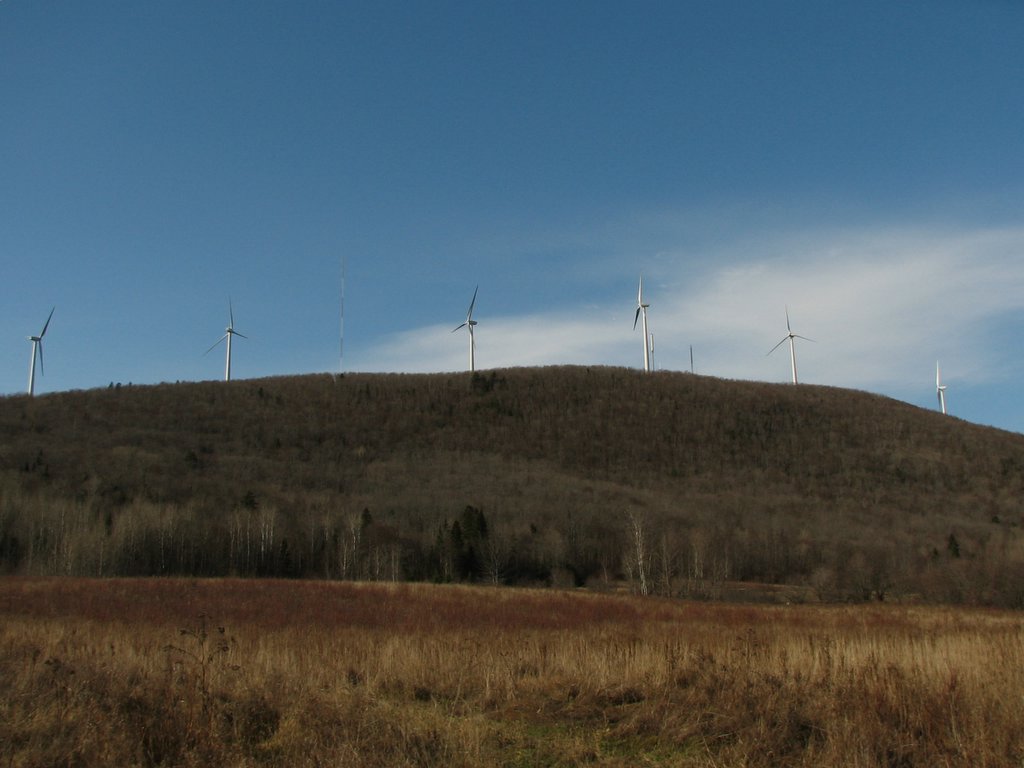
    Just look at that ugly clean air!

    This photo links from The Thing of the Moment, where there are many excellent photos of Mars Hill and other Maine places.


    A pretty good article in today's Press Herald reported on locals' reactions to the Mars Hill wind power project, scheduled to start generating electricity this month.

    Althouth the article's headlines in the front page of the printed edition make much of a supposed "controversy" over an "eyesore," the text of the article only reveals a few objections, which come off sounding relatively petty.

    The Bangor Daily News, in its reports, has focused more on the town's tax benefits. Since Bangor's newspaper is a lot closer, geographically and politically, to Mars Hill, I'm inclined to believe that there's really less controversy than the Portland paper's headlines warrant.

    Still, the Press Herald article brings up the point that the Mars Hill windmills will be a test case for other wind power proposals pending elsewhere in the state. One of those proposals, for Redington Mountain, does face some more serious opposition, due to its proximity to the Appalachian Trail. The Maine Appalachian Trail Club, Audubon Society, and Appalachian Mountain Club have all expressed their opposition to that proposal, not only because of visual impacts, but also because of the project's potential impacts to alpine zone habitats.

    Considering that global warming is a certain way to eliminate all alpine habitats from the state within the next fifty years, these objections, while they have some merit, amount to an attempt to rearrange deck chairs on the Titanic.

    Links to other wind-power projects and news:

  • Redington Mountain
  • A compromise proposal for Redington
  • A three-turbine proposal in Freedom, east of Waterville
  • Cape Wind, an offshore project near Cape Cod.
  • Thursday, November 30, 2006

    Plum Creek

    Perhaps you've heard about what Plum Creek, the stockholder-owned real estate and timber company, has planned in Northern Maine. In a landscape that today stands as a largely undeveloped working forest, with pristine lakes and a remarkable wealth of renewable forest resources, Plum Creek has proposed building 975 houses and two large resorts.

    By way of comparison, North Conway, New Hampshire has 1,602 housing units in all (2000 Census), and Bar Harbor has 1,558 (2000 Census).

    Plum Creek has also tried to sweeten the deal by including a proposed "conservation framework" that would put 368,000 acres under easements or conservation ownership. The possibility for conservation is indeed impressive: the framework would connect a million acres of conserved lands stretching from Baxter State Park to the Canadian border. The only hitch is that the company demands approval of their development plans, then expects state taxpayers and conservation nonprofits to pony up millions of dollars for the framework to take effect.

    I'll be writing about this business in greater depth in the weeks to come, until and during the time when the state conducts public hearings on the plan. In the meantime, a few links:

    -Natural Resources Council of Maine (who are shaping up as the main opposition group)

    -Plum Creek Moosehead Plan site

    And this is the big plan: Plum Creek's own documents (these are huge files):

    Vol. 1: Petition for rezoning (PDF, 90 mb)

    Vol. 2: Plan description (PDF, 165 mb)

    Vols. 3 and 4: Appendices (PDF, 110 mb)

    The Maine Land Use Regulation Commission (LURC) has a whole web page devoted to the concept plan and its path through the regulatory process here, as well as a calendar of updates and upcoming events.

    Monday, November 20, 2006

    Buy local... while you still can.

    I spent last Saturday evening at Stacy Mitchell's book reading in the old Center for Cultural Exchange space. The event was sponsored by the Portland Buy Local campaign, a new organization that's gaining lots of steam as a sort of chamber of commerce for homegrown businesses.

    Mitchell was an excellent speaker, and her concerns with big box retailing are well founded and well researched. I should say that I generally agreed with her from the outset: big box retailers exploit structural inefficiencies in our economy (cheap suburban land and cheap gas, chief among them) at tremendous expense to workers, communities, and even to the consumers they are supposed to serve.

    But I was also troubled by another aspect of Saturday's gathering: the expensive snacks donated by local caterers. Not that they weren't tasty - I certainly sampled the offerings - but the fact that fancy foods like these are typically beyond the means of most Portlanders, myself included. What value is there in local businesses that produce and sell things that most locals don't really need, or can't afford?

    Indeed, the proliferation of upscale boutiques (call it retail gentrification) in downtown Portland seems, in some ways, to be the other side of the big box coin: consumers seeking bargains head for the burbs, while well-heeled consumers rebel against big box tastelessness by patronizing rarefied shops downtown. Where does that leave someone who can't afford to drive out to the fringes - do we expect them to eat cake, or a ten dollar block of cheese?

    I asked a question in to this effect in the Q and A session that followed Mitchell's lecture, and in her excellent response (I hope that the wine and cheese retailers in attendance were listening) she noted that local shops had better serve local residents, or else face rebellion when the big boxes come courting with low prices for practical goods. She also noted that Portland's retail scene, while changing, is far from completely gentrified: we still have Maine Hardware, Paul's Grocery, as well as the empty storefronts and porn stores on Congress Street.

    Still, the old Surplus Store has been replaced by three tony food merchants. As one other guy asked me after the event, "where's a guy to get socks and underwear around here?"

    Saturday, November 18, 2006

    What's wrong with the property tax

    Taxes aren't just for raising money: they also serve to discourage activities that are undesirable to the public by raising their prices. A government subsidy, on the other hand, can be thought of as a "negative tax", something that encourages certain purchases and investments for the public good. Thus we have high taxes on things like cigarettes and booze, and low taxes and subsidies for things like affordable housing and some types of health care.

    So what about property taxes? The property tax is almost always thought of exclusively as a fundraising tool for local municipalities. But a tax of its magnitude will inevitably have a big economic effect, by effectively increasing the costs of landownership. Thus, the property tax acts as an incentive for big landowners (say, farmers and woodlot proprietors) to subdivide and sell off their land in smaller parcels.

    The property tax made a certain amount of sense in colonial times, when the amount of land a family owned was a good measure of how rich they were. And in some cases, the value of a property might still be a good indicator of wealth (if, for example, an appraiser values a big McMansion on five acres as worth more than a working farm on a hundred). But other taxes - like an income tax, gasoline tax on commuting, or - best of all - a progressive consumption tax would be more effective and fair.

    In more ways than one, property taxes are too expensive for New England.