Wednesday, August 19, 2009

Why I Lately Haven't Been Blogging As Much As Usual

In a couple short months, when it's 36 degrees and freezing-raining and you leave work in the dark at 4:30, are you going to be saying to yourself, "I can't believe I didn't go to the beach after work that day while the water in the ocean was twice as warm as it is outside right now."

OR would you rather say to yourself, "Look at this tan I still have, even in November!"

Carpe diem, buddies.

Sunday, August 02, 2009

Beneath the corn, the husks of ancient Venice

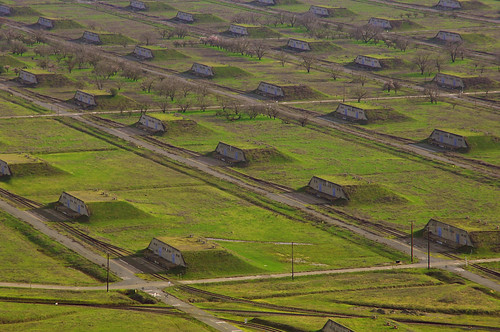
This is a farm field near the small village of Altino, Italy, about two miles northeast of the Venice airport, and a mile from the northern edge of the Venetian lagoon:


Look carefully at this aerial view and you can see lines of darker and lighter vegetation slicing across the crop rows. This week's issue of Science magazine features an article by Paolo Mozzi, an Italian geomorphologist who surveyed this same field with infrared cameras during the severe drought of 2007 to analyze subtle variations in plant hydration.

He was looking for crop marks, an archaeological technique that looks at variations in plant health on the surface as a way to discover ancient walls and building foundations that have since been buried beneath three feet of soil. At right is a sketch from Wikipedia that shows how it works: a stone wall just below the surface (on the left side of this sketch) limits the amount of topsoil and stunts the growth of the plants growing above, while an old ditch (on the right) helps the plants above it grow taller with extra topsoil.

Here's what Mozzi's infrared survey found:


This is the ancient Roman city of Altinum, a place that became an important strategic and commercial center thanks to its position at the edge of the Venetian lagoon and at the crossroads of the empire's Via Annia and Via Claudia Augusta. In the fifth century C.E., it and several other Roman cities nearby were conquered and burned by Attilla the Hun, and subsequent barbarian invasions from the north forced the Romans to retreat from the mainland cities to the marshy islands of the lagoon.

Altinum was abandoned completely by the 11th century, but its island refugee settlements grew in size and prosperity to eventually become the city of Venice.

The Roman historian Strabo wrote that "Altinum too is in a marsh... and hence subject to inundations"(see note below). The engineering behind the canals of Venice was pioneered in Altinum, where the Romans built a network of canals to drain the marshes and carry the water away from their buildings. One of the canals is clearly visible in the infrared image above, and, if you know where to look, it's also visible as a slightly darker band of green in the aerial view at the top of this post. When the Romans left, the canals filled in and the marshes took over once again, until the nineteenth century, when the land was reclaimed for farms.

This makes Altinum one of the few Roman cities that wasn't subsequently buried underneath more modern settlements. Instead, it sank into the marshes, only to be re-discovered a thousand years later as a shadow cast over an unwitting farmer's agricultural yield.


Note: Here's the translated source text from "The Geography of Strabo." Strabo calls Altinum similar to the nearby city of Ravenna, which sounds even more like modern Venice: he calls it "a city built entirely of wood [another possible translation is "built on piles"] and coursed by rivers, and it is provided with thoroughfares by means of bridges and ferries. At the tides the city receives no small portion of the sea, so that, since the filth is all washed out by these as well as the rivers, the city is relieved of foul air."

Wednesday, July 15, 2009

Picket Lines and Prairies

Above: An unmown pedestrian bridge in Windsor, Ontario.
Photo courtesy of
wreckingball.org

In Windsor, Ontario (the city directly across the river from Detroit), 1,800 municipal workers have been on strike for several months now. Among other things, this means that no one is mowing the lawns in the city's parks, which are transforming from riverfront esplanades and soccer fields into wild prairies as the summer wears on.

The re-wilding of Windsor's parks has inspired some nice nature writing from Anne Jarvis, a columnist from the Windsor Star, and her readers:

At first, the flood of comments and letters on the strike by 1,800 city workers, including those who cut the grass in the usually manicured parks, expressed anger about the unsightly overgrowth.

Then the grass matured, the wildflowers began blooming and wildlife returned. And the letters began to change.

This one is almost poetic in its description:

"The long grass is now home to so many singing birds and insects and there is such a wide variety of colourful native plants in bloom. The wind can be heard as it blows through the grass ... Such a difference from the plain, flat and empty space it was before."

The park? The soccer pitches at the Ford Test Track [which is exactly what it sounds like: a former proving ground for Detroit's dying manufacturers] in the heart of the city.

"Today was the first time that I have ever considered that park to be beautiful," wrote the woman.

A colony of bobolinks and some eastern meadowlarks, declining species known and loved for their beautiful song, were discovered there last month. They surprised and delighted birdwatchers. A grassland species, they're rarely seen in the city because there isn't much grassland.

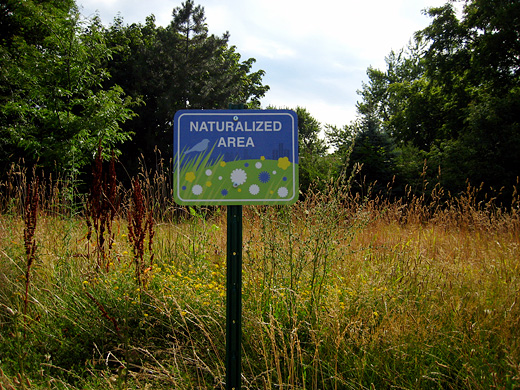
I found out about Windsor's strike and unintentional re-wilding project via the Broken City Lab, whose latest project has been to unofficially recognize the city's overgrown meadows with these signs, which they designed and installed themselves:

Above: Strike commentary from Windsor's Broken City Lab.

I love how these signs tweak peoples' perceptions of these places: suddenly, it's not an overgrown lawn or a symbol of municipal neglect: it's a wildlife refuge!

As the Summer Without Lawnmowers wears on, people in Windsor are growing fond of the new wildflower meadows and flocks of bobolinks. In the same Windsor Star column, Jarvis reports that the City has resolved to leave a couple hundred acres of parkland unmown, even after the strike eventually ends.

Wednesday, July 08, 2009

Oil Companies Get Weird

Climate change is doing strange things in Texas.

In the panhandle town of Sunray, Valero Energy Corporation operates an oil refinery that dates to the 1930s and is capable of processing up to 170,000 barrels of oil a day into gasoline, asphalt, and other petroleum products. The refinery is a large industrial operation that uses a lot of electricity: a typical monthly bill runs to about $1.4 million.


Strange neighbors: photo by Michael Schumacher of the Amarillo Globe News.

So Valero recently decided to upgrade the refinery with a $115 million investment that will cut its energy costs dramatically. This month, Valero began operating six wind turbines on the site, which is now also the company's first wind farm. Unlike other wind farms that sell their power into the regional power grid, this one will be primarily devoted to powering the large refinery right next door. By the end of next year, Valero plans to add another 27 turbines, which would make the wind farm capable of powering the entire refinery whenever the wind is strong (the company expects this to be the case 40-45 percent of the time).

Unlike prior efforts from Big Oil (remember the "green" gas station?), this one seems to be a legitimate business effort, not a greenwashing public relations stunt. The company's publicity for the project amounts to a no-frills corporate press release buried in the depths of Valero's web site, and little else. In a recent Wall Street Journal article, the refinery's manager dismisses warm and fuzzy motives for the project: "We didn't build the wind farm so we could get into the wind-energy business. We built the wind farm so we could support the refinery and run it more economically."

Of course, the wind farm is still being used to produce gasoline, and the combustion of refined oil for transportation accounts for nearly a third of the nation's greenhouse gas emissions. But the wind farm replaces energy that Valero had previously bought from Wyoming coal-fired power plants and had delivered over hundreds of miles of transmission lines (along with significant energy loss along the way). So, even though Valero is still manufacturing atmospheric poisons, at least they'll be burning a lot fewer atmospheric poisons in the process.

And here's another story of weird behavior from an oil company: ExxonMobil, the fossil fuel giant that's historically been the most outspoken denier of global warming (the company continues to fund global-warming-is-a-hoax conspiracy theorists at places like the Heritage Foundation) last month announced a partnership with an electric car company to make a fleet of rent-by-the-hour battery-powered cars available to the public in Baltimore.

ExxonMobil has invested $500,000 in the project, which is roughly how much money the company takes in every 45 seconds. Still, it's strange to see them investing in technology and a business model (carsharing) that are designed to reduce demand in their primary product. ExxonMobil is making a very small hedge against the risk that they'll turn into the next Chrysler or Kodak.

It's probably too soon to say for certain, but all of this seems to me to be another indicator of an unsteady climate: when even corporate oilmen from Texas start taking renewable energy technology seriously, could it mean that Hell is freezing over?

Tuesday, June 30, 2009

The Big Box Aviary

The Christian Science Monitor reports that house sparrows love home improvement warehouse stores:

These birds have set up housekeeping in Home Depots, Lowe's, and other big-box stores around the industrialized world. But here's the really amazing thing: from Maine to Virginia, England to Australia, and points in between, house sparrow populations everywhere have learned the motion detector trick [fluttering in front of automatic door sensors] to let themselves in and out of their cavernous homes. In other words, it appears that all these far-flung flocks have independently discovered how to use technology to their advantage.
Home improvement stores offer near-ideal habitat for sparrows: there are none of the housecats that decimate bird populations elsewhere in the suburbs, no hawks, no weather, and there's an abundance of birdseed.

The Monitor article reports that one Home Depot employee in Maine put up a decoy owl to scare away the birds from turding on the kitchen and bath display. Other stores have installed fine-meshed nets around the ceiling rafters to prevent the birds from nesting.

Friday, June 26, 2009

ACES: American Clean Energy and Security Act

There's a climate change and renewable energy bill being debated right now in DC, and it might even have a fighting chance.

Do yourself a favor and call your representatives to help it win. Think of it as a sort of retirement plan: a small insurance policy against famine, drought, and failed states to go along with your 401(k).

1Sky has the phone numbers.

Wednesday, June 24, 2009

Heavy rains and the fecal ocean

A public health advisory:

In the past week, most of the northeastern Atlantic seaboard has received several inches of rain. The storm drains and sewers of the region's cities have been overwhelmed by millions of gallons of runoff, carrying whatever garbage was lying in the gutters and frequently discharging a mix of raw sewage and street runoff in older cities' combined sewer systems.

So (and I'm sorry to be such a bummer), even though it's finally sunny and warm, it would be kind of gross to take a dip in the ocean right now.

Here in Portland, for instance, the East End Beach has been under a pollution advisory for most of the past week, and was closed completely over the weekend. In New York, several beaches in the Bronx and North Queens are under advisory or closed, and a number of beaches around Boston in Massachusetts Bay are either closed or nearing the health limit.

Beach water quality is determined by the number of enterococci bacteria found in a 100 milliliter sample, which is highly correlated with the number of other pathogenic bacteria that are often found in sewage, including fecal coliform. The federal limit defined by the EPA is 35 colonies per 100 mL, but keep in mind that the federal standard has been influenced by lobbyists: Hawaii, the state with the strictest water-quality standards, posts warnings on its beaches if its testing samples find any more than 7 bacteria in 100 ml of water.

So, for instance, you might not want to swim at Boston's Carson Beach, even though its open, since the sample taken yesterday found 31 colony-forming units of enterococci. Scarborough Beach State Park found 20 colony-forming bacteria in its sample on Tuesday. And even in relatively isolated areas of the coast, weird stuff is washing up on beaches - for instance, dozens of used hypodermic needles on a beach in Harpswell, in midcoast Maine.

So, as tempting as it is, I will not be visiting a beach this afternoon. If I were you, I'd lay off the bottom-feeding bivalves and crustaceans for a week or two as well. Luckily, the ocean is good at washing itself out with several tides every day, and if the dry weather continues I might take a dip this weekend.

Here are the public health websites where you can read up on bacteria counts and beach advisories for the Northeast's major cities:

Maine Healthy Beaches
Massachusetts Bureau of Environmental Health
New York City Beach Quality Reports
New Jersey Ocean Beach Information - NJbeaches.org

Tuesday, June 23, 2009

Alpha Site: the Navy's nuclear Grand Central, in the suburbs of San Francisco

Here's a ground-level photo of yesterday's mystery site on the eastern fringes of Concord, California, from flickr user topherus:


Looking at the map, I noticed that these rails all led to the US Naval Station Port Chicago, about three miles away on the shore of Suisun Bay (the Sacramento-San Joaquin River Delta). A quick search uncovered this globalsecurity.org blurb about the base:
The Detachment’s primary purpose is the loading and unloading of large quantities of weapons and equipment from cargo and pre-positioning ships. This differs substantially from most other naval weapons stations and detachments, where weapons are loaded aboard combatants, amphibious vessels or replenishment ships one at a time or in very small groups. Base infrastructure is uniquely suited for bulk quantity operations with one floating crane, seven shore cranes, 1 superstacker, one Rough Terrain Container Handler, 342 forklifts, 101 miles of railroad track, and 79 miles of roadway. During wartime conditions, Detachment Concord has the capability to load 4,500 tons of munitions per day.
This is how frightened we used to be of the Communists: imagine building all this in order to send hundreds of bomb-packed boxcars to explode over Siberia on a daily basis, because the Russians were also planning to send hundreds of bomb-packed boxcars to explode over California on a daily basis. Stuff like this gives me some comfort in knowing that our global society isn't quite as batshit crazy as we were during the Cold War.

The base's inland portions, including those pictured above and in yesterday's post, are massive weapons bunkers, designed to transfer boxcars full of explosives into storage, and then onto waiting Navy ships. The area is currently in the process of being decommissioned, and in the course of planning for redevelopment, newly-declassified details are emerging. One "community representative" at a recent meeting learned from the Navy’s “Historic Radiological Assessment” team that nuclear missiles were stored in these bunkers, and moved through these railyards on a fairly regular basis. The "Halfway to Concord" blogger reports:

The area of these bunkers can be seen from Willow Pass Road as your approach Highway 4 looking South East, there is a set of bunkers set aside surrounded by a double wire fence with telephone poles surrounding it with floodlights on them. It was called in various documents: the Alpha Site or in RAB records as Site 22 Bunker Group 2...

The period of atomic weapon storage was ended “long ago”, but the implication elsewhere is that they removed more than 25 years ago and maybe into the late 70’s...

In the main ‘Bunker City’ area [pictured above] opposite the Dana Estates there were 6 bunkers that housed ammunition for the Phalanx Weapon System that used depleted Uranium bullets. This material is about 1/3 denser than lead, which is why it makes for a better bullet for this weapon system.
The author also notes that, in the city's redevelopment plan, much of the base would be sold off to housing developers to house 33,000 new residents. The area of these bunkers, the Grand Central station of Cold War naval warheads, would become the site of "low density ‘Estate’ style housing," which is Californian for "McMansions."

Other than the fact that Contra Costa County has averaged about 100 foreclosures a day for the past year, building new, radioactive trophy houses is probably a fantastic idea! Hey, Californians: here's some inspiration from ye olde East Coast.


PS- Kudos for commenter Jake D. in the previous post for guessing correctly what these were.