Wednesday, February 09, 2011

Hedging for the End of Civilization, Part II

While we're talking about the collapse of the global economy, and civilization in general, I should also mention that there are a lot of people who do expect something along these lines to actually happen. Perhaps not surprisingly, many of them can be found talking about it on the internet.

For instance, there's Wendy, the Surviving the Apocalypse in the Suburbs blogger, who lives and writes from somewhere near me in southern Maine, and is trying to transition her family to a more "self-sufficient" lifestyle.
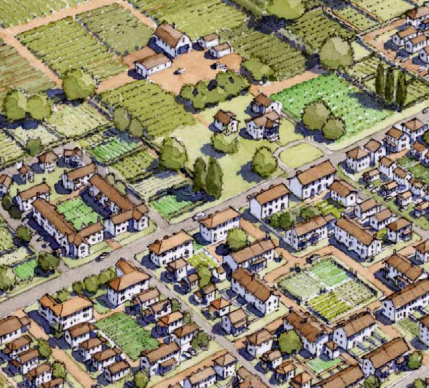
Architect Andres Duany thinks that peak oil and escalating food prices should convince real estate investors to build hobby farm collectives instead of golfing communities. For a million-dollar investment, your post-collapse future can look just like Tuscany! From "New Urbanism for the Apocalypse," by Greg Lindsay for Fast Company.

And I'm especially fond of the Urban Self-Sufficientist in Atlanta. He raises rabbits and grows veggies in the backyard of his in-town bungalow, but the best posts are about practicing falconry in local parks in order to enjoy homemade, free-range squirrel stew.

It's interesting how these different people pursue "self-sufficiency" in different ways. Wendy, for instance, makes much of growing her own food, but she still lives in a suburb where she's forced to pay for two cars and their fuel in order to acquire basic necessities. How's she going to find enough refined oil to fill her cars' tanks after civilization collapses?

Meanwhile, the Urban Self-Sufficientist takes an opposite tack, living in the middle of an urban neighborhood. If gasoline disappears, he won't be too put out - but won't his neighbors start taking an unsavory interest in the fruits of his backyard farm?

And architect Duany talks up economic collapse even while he tries to get real estate investors to build his planned communities, which will presumably be financed by 30-year mortgages. At least he's talking with people who ought to be experts in economic failure.

So even people who are planning for disaster clearly have different expectations of what it's going to be like: different people hedge for the end of civilization in different ways. Some believe that through the wreckage we'll figure out some way to keep our cars; others believe that we'll figure out a way to maintain a financial system.

I have my doubts on these counts - you're going to put more faith in American car culture than in America itself? - but then again, I also don't think it's much worthwhile to plan for any kind of collapse. Even if it does happen, it's going to be unpredictable.

Besides, I'm not much interested in self-sufficiency for its own sake. I'd rather rely on my neighbors for some things - there are plenty of people who are better farmers than I am, for instance, and I'd rather let others do the things they do well rather than try to do everything half-assed by myself. Specialization of labor is one of the innovations that got humanity out of the stone age, and even if civilization did collapse, I would hope that we wouldn't need to leave that idea behind - that we'd still be able to rely on our neighbors, families, and friends to help each other out.

Still, I do enjoy how the idea of self-sufficiency leads people to think about the places and the resources that provide their necessities for living. It's a roundabout way of thinking about our day-to-day relationships and dependencies on the natural resources that sustain us, and for some (like the falconer in Atlanta) it's a way to bring a little wildness home with us, even if we live in the middle of the city.

Self-sufficiency will not be any fun if it's forced on us. But as long as it's an elective activity, these bloggers make it clear that it can be a rewarding pursuit.


Monday, February 07, 2011

Hedging for the End of Civilization, Part I

Tell me, would you trade 22 pounds of gold for this shoddily-built suburban confinement unit?

(creative Commons-licenced photo by David Shankbone, via his Flickr page).
Ever since the global financial crisis of 2008, when our mirage of real estate wealth dissolved faster than a mold-infested McMansion, and thousands of major employers looked into their bank accounts and realized that they wouldn't meet the weekend payroll without a bailout, it's become apparent to most people that "money" is only as valuable as everyone else thinks it is.

The paper bills we carry in our wallets are ultimately just paper. But they're valuable to us as a convenience of modern society: a means of exchange whose value we all agree on by consensus.

A few weeks ago, This American Life broadcast another great show from the economist-reporters at Planet Money all about the fiction of money. It made the point that money's value is a collective act of faith: we all trust that every store, bank, and employer will be more or less in agreement about the value of our dollar bills.

But societies have lost faith in the value of their currencies before - many, many times. When it happens, people are forced to rely on theft and barter in order to feed themselves. Faith in money is closely bound with the cohesion of civilization itself. If people can't trust their neighbors to value their currency, then they are less likely to trust their neighbors in general.

So far, because money is convenient and civilization is important to people, societies have invariably come back to trust money once again - no matter how badly it burned them before. It helps that, for the last century, the United States Dollar has lorded over everything as the world's papal currency. It's been the one kind of money that everyone could have faith in and rely on. Even when pesos and rubles collapsed, Argentines and Russians could still use tattered U. S. dollar bills as a trusted means of exchange.

But recently, the world has been questioning even its faith in the dollar. Which is not to say that anyone is losing faith in money: they're just looking for a new idol. And guess what it's made of?

In the past five years, the price of gold has more than doubled. Right-wing radio propagandists are making "money" hand over fist by sowing doubt in their followers' faith in dollars, and selling them overpriced gold as a "safe" alternative.

Gold has always been used as currency. It's compact, relatively rare, and impossible to counterfeit. It's still widely used as a reserve for the world's national treasuries - here's a great field report on Manhattan's Federal Reserve Bank gold vault, where 7,000 tons of gold are stored under the streets of the financial district in order to shore up our faith in the financial stability of national governments.

But if we're questioning our faith in the value of dollars, shouldn't we also question our faith in the value of gold? At the end of the day, it's just a shiny metal. Gold can't feed anyone, or generate energy. Just like paper bills, it's only valuable if lots of other people think that it's valuable. And if we really come to a circumstance where the dollar collapses and the world's economy comes crashing down, I can't see how a gold brick is going to do anyone a damned bit of good, unless you're using it to smash windows in a looting spree.

I don't consider that a realistic possiblity by any means, but it's an interesting thought experiment to consider what kinds of currencies would actually be valuable in that kind of situation. How about solar panels? If the dollar collapses, then utilities would lose the means to buy up supplies of natural gas and other fuels from overseas. Blackouts could become widespread. Homegrown electricity would be more valuable than gold in such a situation.

So if there's a real risk of that happening, then solar panels should be very, very valuable for anyone who's hedging their investments against the end of civilization, right?

Well, that's not happening: solar panels are actually getting less expensive, largely thanks to improved technology.

This tells us two things:
  1. The market doesn't seriously expect civilization and the dollar to collapse. And, as a corollary: the price of gold, which has more than doubled in four years, is an asset bubble just like McMansions and stock in Pets.com. Instead of a real estate craze or an internet craze, we're going through an Apocalypse craze.
  2. Glenn Beck's listeners would be much better off if they started buying bought renewable energy while it's still cheap, instead of overpriced gold coins.


Monday, January 31, 2011

"The Basement Stacks"

What former library in the land of Stephen King wouldn't be complete without a tentacle of old books creeping out from the basement walls?


Portland's old Romanesque library has recently been rehabbed and reoccupied as the headquarters office for an advertising firm, which commissioned this project from Portland artists/interior designers Wary Meyers. It's called "The Basement Stacks," and you'll find a few more photos on the Wary Meyers blog.


I hope that at least a few of those volumes bursting out of the walls have H. P. Lovecraft's name on their spines.


Wednesday, January 19, 2011

"This Is Not A Place of Honor"

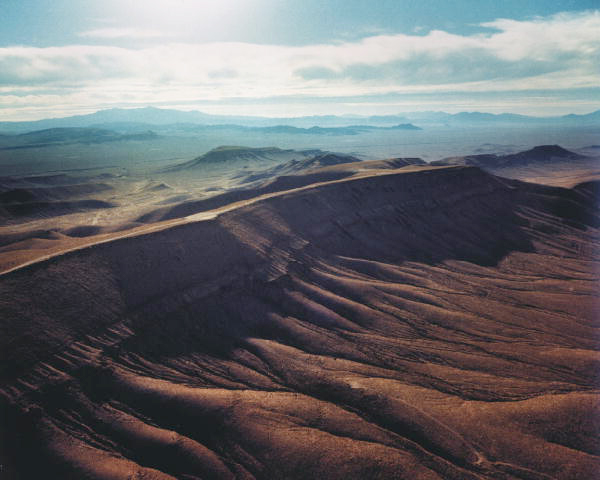
This week I'm reading About a Mountain by John D'Agata, a long-form essay about Las Vegas, suicide, and the proposed Yucca Mountain nuclear waste repository.

One of the fascinating paradoxes that the book delves into is the idea that the radioactive waste stored in Yucca Mountain is going to be deadly for tens of thousands of years - and so, if the species that has made itself capable of destroying itself actually manages to survive for ten millennia or more, into a future where the United States and the English language will both have been long forgotten and Yucca Mountain itself could be oceanfront property, how should we warn our distant descendants not to explore inside?

Yucca Mountain (source: Wikipedia)

The government convened a team of materials scientists, linguists, anthropologists, graphic artists, and others to come up with a warning sign or message that civilizations 10,000 years from now would still be able to understand in order to stay away from the mountain and its deadly tunnels. This is their rough draft for the ideas that that message should convey:
"This is not a place of honor. No esteemed deed is commemorated here. Nothing of value is buried here. This place is a message, and part of a system of messages. Pay attention. We are serious. Sending this message was significant for us. Ours was considered an important culture."
Even in the doubtful scenario that this message could last, and there's anyone around able to understand it in ten thousand years, I doubt this message would serve its purpose.

If there's any human characteristic will last for 10,000 years, it will be the capacity to identify bullshit. If you can imagine a future in which, even though your "important" culture has been long forgotten, some vestigial scrap of humanity that has anything in common with your own still exists - and if your own civilization has the hubris to believe that it can communicate across those millennia, that your message will last and be remembered - well, the assertion that that message is hiding "nothing of value" and "no esteemed deed" kind of rings hollow.

It's like if Homer decided to write the Illiad not as a parable of honor and duty, but as a long poem about how, while Homer considered the idea of the Illiad to be very serious and important, the actual historical details of the Trojan War are not worth knowing or investigating at all - and in fact, if you read between the lines, trying to learn the details of the plot will actually give you a nasty case of thyroid cancer.

Would that poem last? And if by some miracle it did, would anyone take it seriously?

John D'Agata is a great essayist. But his book and its themes also remind me of another favorite author of mine, the novelist Cormac McCarthy. Yucca Mountain, both as a stark desert landscape and as the repository for the waste of civilization's self-destructive technologies, seems like an ideal subject for one of McCarthy's novels. I'm reminded of the interview he did with the Wall Street Journal last year, and this brief discussion of the end-of-the-world scenario in his novel The Road:
But it could be anything—volcanic activity or it could be nuclear war. It is not really important. The whole thing now is, what do you do? The last time the caldera in Yellowstone blew, the entire North American continent was under about a foot of ash. People who've gone diving in Yellowstone Lake say that there is a bulge in the floor that is now about 100 feet high and the whole thing is just sort of pulsing. From different people you get different answers, but it could go in another three to four thousand years or it could go on Thursday. No one knows.

WSJ: What kind of things make you worry?

CM: If you think about some of the things that are being talked about by thoughtful, intelligent scientists, you realize that in 100 years the human race won't even be recognizable. We may indeed be part machine and we may have computers implanted. It's more than theoretically possible to implant a chip in the brain that would contain all the information in all the libraries in the world. As people who have talked about this say, it's just a matter of figuring out the wiring. Now there's a problem you can take to bed with you at night.

Personally, I'll not be taking that problem to bed with me tonight. But maybe Yucca Mountain's sign makers should take it up - communicating with the cyborgs of the 22nd century should be a manageable first step towards communicating with whatever alien descendants might still be around in the 121st century.

Thursday, January 13, 2011

The Colors of Abandonment


Greenfields: former agricultural lands laying in fallow. Greenfields proliferated during the early 20th century, as agribusiness consolidated and small farms were abandoned.


Brownfields: former industrial lands, frequently with pollution hazards. Brownfields proliferated during the late 20th century, as manufacturing businesses moved overseas and firms abandoned domestic factories.


Redfields: former middle-class neighborhoods, frequently characterized by strip malls, tract housing, and other properties that are now "in the red" and owned by absentee financial institutions. Redfields have proliferated in the first decade of the 21st century, in the wake of the real estate bubble, as the suburban middle class succumbs to crushing debt and poor access to economic opportunity.


Photo credits (from top): GeoFX on Flickr, Das_A on Flickr, and The Bollard.

Friday, January 07, 2011

Detroit Princess

An enterprising use of an ice flow, on the Detroit River on a bright winter's day:


Catching Sun from Kinga Osz-Kemp on Vimeo.

Wednesday, January 05, 2011

The Braindead Megaphone and the Plague of Dead Critters

There's been a spike in worried reports over hundreds of dead blackbirds that fell from the sky in Arkansas on New Year's Eve, and hundreds more that fell from the skies over Louisiana a few days later.

Today, the internet is panicking over dead fish that are washing up by the thousands in Chesapeake Bay and Brazil. Some of the internet's more tabloid-inclined "news" sites are consolidating these local reports in fearsome stories that seem to imply a global pattern.

Not quite. The Arkansas blackbirds were probably done in by New Year's Eve fireworks. The other die-offs probably had more quotidian causes, like cold weather.

Mass wildlife deaths are nothing unusual. A cursory Google News search from 2010 locates similar stories about manatees (early last month in Florida), freshwater fish (in Vermont this past summer), and pelicans (in California last February).

So yes, it's a global pattern - one that's been going on for MILLIONS OF YEARS.

Unlike those other wildlife die-offs, though, this flock of Arkansas blackbirds had the misfortune of dying on New Year's Eve in the middle of the Bible Belt - a circumstance that destined them for celebrity among the merchants of end-times infotainment.

So when other wildlife die-offs occurred in Louisiana and Brazil and elsewhere in the following days, our global media culture didn't treat these relatively ordinary local phenomena as ordinary local phenomena - they treated them as pieces of a narrative from the book of Revelations.

Such is the pathetic state of environmental journalism, and environmental literacy, in the 21st century: instead of a nuanced discussion of our ecosystem's real threats and complex functions, CNN, the Huffington Post, and other braindead megaphone broadcasters prefer to give us a horror-movie plot that invents a fictional environmental disaster from insinuation (because, you know, real environmental disasters are so hard to come by these days).


Occupy Heathrow

I've been meaning to write here about how the Occupy movement has brought an element of wilderness survivalism into the downtown districts of out largest cities. How corporate plazas in financial districts have transformed into undeveloped campsites.


Before I do, though, I'd like to show you how they're doing it in England. Earlier this fall, the New York Times ran an article about England's remarkable squatters' laws:
Currently, it is a crime to occupy a house where someone is living or plans to move in imminently. But squatting in an empty commercial property is a civil offense, and such squatters can be removed only by court order.

Homeowners are allowed to use “reasonable force” to get rid of squatters, though it is unclear what that means. Giles Peaker, a housing lawyer, said no one wanted to do anything that might provoke counterclaims of assault. Violence is out. No baseball bats, no pepper spray, no household weapons...

As for commercial owners, they cannot use any force, not even to break into their own property or muscle their way past the occupiers. Property owners say that the police are loath to intervene, except in the most blatant cases, without formal court orders.
Notwithstanding lurid tales told in the sensationalist British tabloids, having responsible tenants to take care of abandoned and foreclosed properties has generally been a good thing for England during these years of financial crisis. Without the squatting law, England would have more homeless, and more abandoned neighborhoods in terminal decline.

Think of it as an Occupy movement for the dross of the collapsed real estate market.

One prominent squatters' community mentioned in the Times piece is the Grow Heathrow encampment in the village of Sipson, just north of London's massive Heathrow Airport and in the path of a proposed runway expansion.


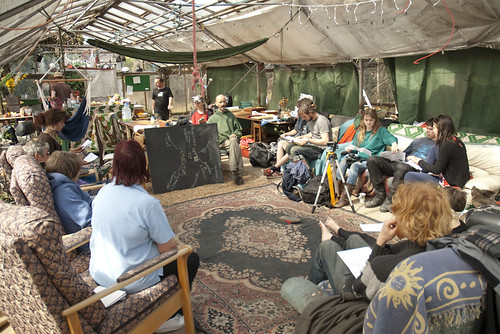
Citing British squatter laws, the community has successfully cleaned up an abandoned nursery, and turned its broken greenhouses back into functional (and beautiful) spaces for living, growing produce, and organizing activists against the airport expansion.

The proposed third runway at Heathrow has become a national issue in British politics. Ousted Labour leader Gordon Brown had been a supporter of expansion, but environmental activists - many of whom live at Grow Heathrow - have successfully delayed the proposal to the point where even airport executives acknowledge its unlikelihood.

One reason Brown and other political leaders had been pressing for a third runway is because the expansion had been seen as a necessity to preserving London's status as a global financial center.


In this light, Grow Heathrow and other opponents of airport expansion are not just fighting against airplane pollution. They're making a vital contribution to the Occupy movement, by inconveniencing Britain's bankers and hedge fund managers in their pursuit of global commercial domination.

All photos courtesy of Transition Heathrow's Flickr.