Tuesday, May 31, 2011

Walden

While in Boston over the weekend, we took our first swim of the summer in Walden Pond, the famous suburban retreat where Henry David Thoreau lived for two years.

Walden was never a wilderness - even when he lived there 150 years ago, it was still within a 30 minute walk of Concord's busy downtown, where Thoreau managed the family's pencil-manufacturing factory. The commuter rail line that skirts the western edge of the pond today was still there in Thoreau's time (he'd often walk along it as a shortcut from his cabin to the town).

But, inspired in part by Thoreau's writings, people have changed the woods around Walden tremendously in the past century and a half. Americans following Henry David's suburban impulse ("I have, as it were, my own sun and moon and stars, and a little world all to myself," Thoreau bragged in a chapter of Walden titled "Solitude") have transformed Concord from a small agricultural and manufacturing center into a convenient bedroom community halfway between Worcester and Boston.

Three miles east of Walden Pond, modernist cubicle farms for software and pharmaceutical companies crowd along the Route 128 corridor, surrounded by greenery designed to be enjoyed at 55 miles per hour.

From there, a four-lane expressway, the Concord Turnpike, runs within a hundred yards of Thoreau's homestead site. In the time it took him to make his daily 2-mile walk to Concord, modern Thoreauvians can drive themselves all the way to Logan Airport (albeit with less self-reliance).

The road goes two ways, of course, which means that Walden Pond has also become an extremely popular destination for anyone in the metro Boston region who wants to live deliberately and front only the essential facts of life for a few hours after a rough day of shopping at the nearby Burlington Mall.

The state has gradually tried to buy up the land around Walden Pond to turn it into a state reservation. Still, in doing so, the remaining privately-owned parcels nearby have become increasingly valuable as tourist traps and highway rest stops, making additional land conservation asymptotically difficult.

And as a public park, several acres of Walden's former Woods have been cleared to make way for parking lots, a replica of Thoreau's cabin, and the "Thoreau Society Shop" (Thoreau's famous quotation on poverty - "Do not trouble yourself to get new things, whether clothes or friends... Sell your clothes and keep your thoughts. God will see that you do want society" - graces the shop's best-selling t-shirts).

A large bathhouse overlooks a tiny beach on the eastern end of the pond near the parking lots and souvenir shop. The spring-fed pond itself is facing serious erosion problems in the face of all the foot traffic and bootleg sunbathing clearings on every shore, and the state has built a long concrete wall to keep the land nearest the beach from sliding into the pond:

The pond's circumferential footpath in many places runs within inches of the water, compacting the forest soils and making it difficult for plants to take hold and establish their natural filtration functions.

Thankfully, the agency in charge is taking a more aggressive stand against erosion, and erecting fences that keep people from treading on every inch of shoreline. The conserved forestlands that surround Walden Pond do a good job of filtering out the oil- and pesticide-soaked runoff pollution from surrounding freeways, parking lots, and McMansion developments, and so Walden Pond itself is remarkably clean, in spite of its metropolitan surroundings. It's one of my favorite swimming holes anywhere - and I say this as a connoisseur who lives in a place with a bounty of swimming holes.

In a follow-up post tomorrow, I'll write about one of my favorite Boston bike rides: downtown to Walden Pond in about 2 hours, which makes for an ideal summer day trip.

Monday, May 02, 2011

Terrorism Survives

I'd had a nice weekend. A great weekend, even - one that made me feel grateful to live in Portland, Maine, with spring weather, sunny skies, and the company of good friends on my 30th birthday.

And then, on my bike ride to work this morning, I passed by our neighborhood mosque, just a few blocks from my house, and I saw this.


And, in addition to this, more graffiti that said "Long live the west" and "Go home."

I've been in a funk all day. The mosque is a nondescript building; there's nothing on the outside to indicate that it's a place of worship, which leads me to suspect that it was someone from our own neighborhood who did this. Somewhere in this city I love there is at least one cowardly neo-Nazi who has the disgusting gall to believe that religious persecution is somehow an American value.

Seeing this provided a visceral demonstration of how rage can beget more rage. I found myself wishing I'd had the presence of mind to head outside and check on our neighbors last night when I'd heard the news. With a baseball bat.

But what good would that really have done? This is just graffiti, and it's already been painted over. American Muslims, unfortunately, have suffered much worse. The real damage is the toxic, self-consuming hatred that still persists, not only in the bitter minds of those who did this, but even in the dim intellects of presumably "upstanding" members of our community. Let's not forget our daily newspaper's publisher, Richard Connor, the dimwit who apologized for running a front-page story about local Ramadan celebrations last September 11, and then humiliated himself and his city by broadcasting his racist cowardice on national radio.

Make no mistake: the fact that Americans among us could behave this way is much more of a threat to the American republic than Osama bin Laden ever was.

If Osama Bin Laden's death spurs cowardly, Klan-like hate crimes like this one, then there is nothing to celebrate today. The terrorists are still among us.

Friday, April 22, 2011

Tea Party Pity Party

Here's an entertaining story in today's Portland Press Herald:

PORTLAND - Eric Cianchette plans to sell the Maine Wharf on the city's central waterfront, saying he's tired of trying to come up with a mixed-use development plan that Portland officials will approve.

"I remember my father telling me, 'You can't just go through life saying what you don't want. At some point, you have to tell people what you do want,"' Cianchette said, and city officials "really don't want anything."
Eric is wrong - just like he was wrong about the inflated real-estate value of the wharf when he was suckered into buying it in 2004.

City officials most certainly do know what they want to have on our waterfront. They want successful marine-oriented businesses. They want a prosperous fishery. They want wharf buildings and businesses that take the fullest advantage of Portland's valuable deep-water harbor.

These kinds of businesses aren't easy to grow. They're challenging. They demand smart entrepreneurs who can think creatively.

By his own self-pitying words in this article, I can come to only one conclusion: Eric Cianchette isn't one of those creative businesspeople.

He bought a wharf. He proposed a formulaic, played-out business model instead of doing something challenging and entrepreneurial. And then he got fleeced when the real estate bubble popped. And now - he's blaming City Hall for his problems?

Give.
Me.
A.
Break.

I'm not a hard-assed business guru, but if I were, I'd probably say that this guy needs to stop looking for sympathy, and start looking for success.

There's a lot in common between Eric Cianchette's super sad story and the whole Tea Party zeitgeist of economic frustration. They're all fond of blaming the government. But when I look at those guys, I see a whole lot of failures who are bitterly trying to pin their shortcomings on politicians, instead of owning up to the pathetic reality of their circumstances.

Take, for instance, T.P. Governor LePage's resigning PR flack, Dan Demeritt, a man who made hay by defending businesses against "government regulation," only to succumb to bigger businesses when banks foreclosed on a number of his rental properties earlier this month.

And the Tea Party isn't just failing in business: it's also failing in governance. Just like Eric Cianchette's luxury hotel, the Governor's proposals are going nowhere fast. And true to form, even though he's the Governor now, the government's chief executive, he is STILL blaming the government: "I went on vacation last week because I had nothing to do," the Governor said last week at a Chamber of Commerce speech reported by the Sun-Journal's Steve Mistler. "Because I'm waiting. I'm waiting for legislation. I cannot do anything until the Legislature acts."

These are your tax dollars at work: a vicious cycle of finger-pointing. Who needs leadership when you've got scapegoats?

These guys act as though they hate government. But they need the government more than anyone. If the government weren't there, whom could they blame for their failures? Nobody but themselves.

The bottom line is this: business in Maine can't thrive until losers like these guys get out of the way. But for the time being, at least Eric Cianchette is getting out of Portland's waterfront.

Wednesday, April 20, 2011

Factory Nostalgia

Photo courtesy of tabism.com

Near the turn of the last century, Frederick Jackson Turner wrote his famous "frontier thesis": the idea that the frontier was what made Americans exceptional and unique - "the advance of the frontier has meant a steady movement away from the influence of Europe, a steady growth of independence on American lines. And to study this advance, the men who grew up under these conditions, and the political, economic, and social results of it, is to study the really American part of our history."

As many colonialist and racist problems as there are with Turner's frontier fetish, the idea still resonated. And that's probably because so many ordinary people behaved as though they agreed with Turner, whether or not they'd actually heard of him. For the entire subsequent century, Americans flooded into new frontiers of their own making: into suburban communities, into "ranch" homes on half-acre lots, into the nation's newly-dedicated national parks and forests.

America didn't start celebrating the wild frontier in earnest until it was already gone.

And now, at the turn of another century, we finally have something new - and newly lost - about which we can wax nostalgic: our industries.

Photo by flickr user Kyota.

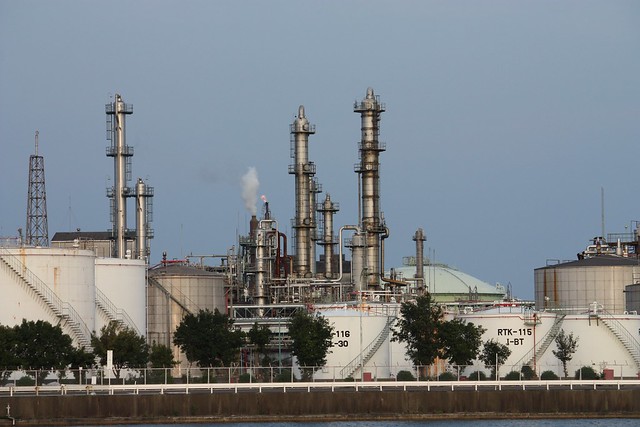
In Japan, an increasing number of charter bus tours and cruises are taking tourists on “kojo-moe” (工場萌え), or "factory love" tours of the country's remaining industrial areas. At a time when an intransigent recession and cheaper competition from developing nations are taking their inevitable toll on Japanese industry, tourist groups are kindling their nostalgia for the country's mid-century industrial boom, and getting sentimental over the steel and concrete landscapes that built their nation.

Yokkaichi oil refinery. Photo by flickr user Kyota.

And why should kojo-moe be limited to the Japanese? Isn't our cultural fascination with Detroit and all of its magnificent industrial ruins essentially the same thing? All the Japanese have done is come up with a name for it. "Factory love," the nostalgia that the 21st century feels for the 20th.


You can find many, many more "factory love" photos tagged on Flickr, here.


Monday, April 18, 2011

Vernal Pools of Portland

This evening I'll be giving a short talk about forest ecology at the Maine College of Art, as part of their FOREST show at the ICA. If you're in Portland, please come and save me from talking to an empty room.

To get ready, Jess and I took a bike ride on Sunday to explore the woods near the abandoned city dump, where there are several vernal pools at this time of year.

Above: a small vernal pool in the right-of-way of an unbuilt city street - that's a manhole in the background.

Vernal pools are temporary wetlands that fill up with snowmelt and spring rains and typically dry out by the midsummer. That important distinction keeps fish out and allows niche species - mostly amphibians - to breed and develop without competition from other wetland species.

This is another vernal pool closer to Ray Street. It's been a cold spring and so there wasn't much sign of life, but we did find what looked like some salamander jelly:


When a big rainstorm coincides with the first warmish evening of the spring, salamanders will come out of hibernation and venture down to breed in the same pools where they themselves had been born. Here in Portland, that probably happened last week or during Saturday night's drenching rains.

Male salamanders will deposit gelatinous packets of sperm on submerged sticks (like the one above), and later, females will deposit their eggs on top to fertilize them. Within the next few weeks, these will develop into tapioca-like sacs of salamander eggs.

Near "Stepping Stone Lane," a street name that tells you all you need to know about this neighborhood. You can actually make out some of the foreclosure boxes through the trees in the background here.

As the pools dry out in the summer, the amphibians they've nursed venture out into the surrounding woods as adults. These pools literally nurse the species near the bottom of the forest's food chain, providing food for critters in a wide radius.

These pools near Ray Street are just a 20 minute bike ride from downtown Portland - and there are similar pools located in the woods behind Evergreen Cemetery and in the uplands of the Fore River Sanctuary. No matter where you live in the northeastern U.S., there's probably a vernal pool not too far away. Finding them is half the fun.

At this time of year, they're neat places to visit: it's as though the entire forest's fecundity is concentrated here in these big puddles of water. It's also nice to take off your shoes and socks and wade into the water (which is still cool, but not cold) for the first time in months.

Monday, April 04, 2011

The Utopia Over the Freeway

The Bridge Apartments in Washington Heights. Photo used by permission from photographer Mario Burger,
Burger International, Inc.
.

Last fall, the Cooper Union hosted a show dedicated to Paul Rudolph's Lower Manhattan Expressway (or LOMEX) proposal - a design study intended to enamor New York City's modernist architectural elites with Robert Moses's freeway-building ambitions.

Rudolph was a genius draftsman, and he produced stunning drawings that manage to generate a sense of futuristic optimism and excitement around the idea of living above thousands of exhaust pipes stuck in traffic:


One of Paul Rudolph's LOMEX studies.


From at least the 1930s, when Moses was in charge of the Parks Department, New York's "Master Builder" wanted to build a freeway through lower Manhattan, connecting New Jersey to Brooklyn by way of the Holland Tunnel and the Williamsburg and Manhattan Bridges. Interestingly, Paul Rudolph's proposal came only during the Lower Manhattan Expressway's dying days, and only at the sponsorship of the Ford Foundation.*


Jane Jacobs had published The Death and Life of Great American Cities seven years previously, in 1961; a year after Rudolph began his study of the Expressway, in 1968, Governor Rockefeller would freeze Moses out of the city's transportation agencies. By the time Rudolph stopped working on this proposal in 1972, the city was on the verge of bankruptcy and grand building schemes like this one were relegated to the realm of fantasy. In a review on the Design Observer blogs, Mark Lamster wrote that Rudolph's was "an extraordinary vision, if not a practical one."


Rudolph's drawings are indeed amazing, especially the ones that compare the hugeness of his vision to existing landmarks (the red drawing above frames the towers of the Williamsburg Bridge, which is huge in its own right, in the center).

The show is powerful not just for its audacity, but for what we know now, forty years later, when the historic neighborhoods that Rudolph and Moses would have liked to have bulldozed are worth hundreds of billions of dollars. In hindsight, it's easy for us to say, "something like that could never actually happen."

Except for one thing: something like Rudolph's vision actually did happen. A few miles away, on the same island of Manhattan, urban renewalists and highway builders had actually finished a massive cross-island expressway, topped with apartment towers and a major transit hub, several years before Paul Rudolph started designing the LOMEX.


The new Trans-Manhattan Expressway seen from a tower of the George Washington Bridge. Photo from the LIFE Magazine archives.


This is the Trans-Manhattan Expressway, also known as I-95, the only Interstate highway that crosses Manhattan Island. It was opened in 1963, when a second deck was added to the George Washington Bridge to New Jersey. It crosses the island in Washington Heights, where the island is only one mile wide, but its construction still required the demolition and clearance of dozens of buildings on eight dense city blocks.
When the Expressway opened in 1963, Robert Moses, the freeway's champion, foreshadowed Paul Rudolph's work to come later in the decade:

"This is the first expressway to be built across Manhattan, and we hope that the Lower Manhattan and Mid-Manhattan expressways, both of which have been the victims of inordinate and inexcusable delays caused by intemperate opposition and consequent official hesitation, will follow. These crosstown facilities are indispensable to be effectiveness of the entire metropolitan arterial objective of removing traffic through congested city streets."

Of course, the scorn for opposition that Moses has on display in this quote was even then sowing the seeds of his downfall. And with the benefit of hindsight, it's easy for us to chuckle at the notion that building a fast and convenient route for cars and trucks to enter Manhattan would do anything to remove any traffic from New York's streets:

Photo by Zach K.


The Trans-Manhattan Expressway wasn't merely a freeway, though. It was a linear megastructure that stacked a complex of modernist transportation hubs and huge apartment blocks overhead. On the western end, Moses built a winged bus terminal that squatted over the freeway's entrance ramps:

Looking west towards New Jersey over the new Trans-Manhattan Expressway and the George Washington Bridge bus terminal. Photo courtesy of the Port Authority of NY-NJ.


George Washington Bridge bus terminal. Photo by gezellig-girl.com.


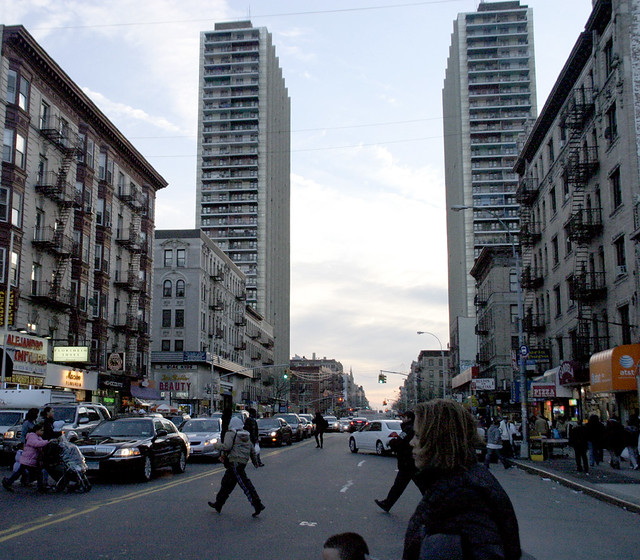
On the eastern end, the city sold development rights to private developers who built four enormous apartment towers, known today as the "Bridge Apartments." The New York Times did a story a few years ago called "Life on the Road," a chronicle of the apartments' history and what it's like to live there. "If the windows are open, the noise is most deafening on the middle floors, and people inside find that they need to raise their voices to hold a conversation or talk on the phone," writes reporter David Chen. "The winds carry vehicle exhaust upward, which is especially noticeable on the terraces. And on most floors, the vibrations of trucks can clearly be felt, along with those of any construction equipment."


Two of the four Bridge Apartment towers, which mark the path of the Trans-Manhattan Expressway beneath. Photo by Zach K.


The Bridge Apartments loom over Washington Heights like mother ships from a sci-fi movie. I remember catching sight of them from time to time when I worked as a park ranger in Inwood Hill Park, two miles away, and being startled by their incongruous appearance on the skyline. This in a city known for its tall buildings - but the four towers, lined up in a row and hulking over a major freeway, have an otherworldly quality to them (Mario Burger's photo at the top of this post is the best illustration of this feeling that I was able to find online).

In all the reviews I've seen of Rudolph's show, I'm surprised no one has mentioned the Trans-Manhattan Expressway. It was obviously a major precedent in Rudolph's mind and in his designs - when he began working on LOMEX, the Trans-Manhattan Expressway would have still felt new and futuristic, not yet dated and dingy with soot and exhaust as it is now.

And for those modernist romantics who wonder at the ambitions of people like Robert Moses and Paul Rudolph, and yearn for a future that might have been: the gritty reality is on plain view to all in Washington Heights.


*The Ford Foundation's involvement in promoting LOMEX was probably not a self-serving effort to get more New Yorkers into Fords, as I'd initially suspected. By the late 1960s, the Ford Foundation, most famous for sponsoring the Corporation for Public Broadcasting, was separating itself from the Ford Motor Company through stock divestiture and new members of its Board of Directors (source). Instead, the Foundation seems to have hired Rudolph in a well-meaning - if misguided - effort to promote "urban renewal" in what were then some of the city's most impoverished neighborhoods.

Monday, March 21, 2011

Your Spouse is Radioactive: Radiation Risk in Perspective

Randall Munroe of XKCD has published an awesome visualization of radiation levels from various sources - view it here. Some points of interest:
  • People are radioactive: sleeping next to someone exposes you to 0.05 microsieverts, or 1/20th the dose you'd receive from an arm x-ray, thanks to trace amounts of radioactive isotopes we have in our bones and bodies - things like potassium-40 and carbon-14.

  • Bananas are surprisingly radioactive (thanks to all their potassium, a vital nutrient that also contains radioactive isotopes). Eating one single banana exposes you to a higher dose than living within 50 miles of a nuclear power plant for a year.

  • Coal power plants hit us with more radiation than nuclear plants do. This is because coal contains uranium and thorium, elements which are condensed and concentrated during the coal-burning process. And while nuclear waste is carefully confined, radioactive coal emissions go up the smokestacks and into our lungs, our cropland, and our fisheries. Living 50 miles from a coal plant will dose you with 0.3 microsieverts every year - that's like eating three bananas, for Christ's sake!

  • The Three Mile Island meltdown produced doses of up to 1 millisievert - about 1/6th the dose you'd receive from a chest CT scan. The Fukashima meltdown in Japan is producing doses of roughly 3.6 millisieverts per day at some sites within 50 km of the plant.

  • The lowest one-year dose clearly linked to increased cancer risk is 100 millisieverts. That would be equivalent to eating 2 million bananas, or spending a month in the neighborhood of the damaged Fukashima reactors. So avoid doing those things, and you should be fine.
I was also tickled to note that Munroe's chart was produced in association with "Ellen," the senior reactor operator at the Reed College Research Reactor. I spent a few months of my freshman year training (unsuccessfully) to become an NRC-licensed reactor operator, and even though I didn't follow through with it, I did learn a lot of excellent trivia about subatomic particles, nuclear history, and chemistry, which has been good material for party conversations these last few days.

Thursday, March 03, 2011

Glaciers at risk!

It's that time of year again when hundreds of truck-loads of snow get dumped near the bottom of Chestnut Street to form the Bayside Glacier (documented previously here, here, and here).

In last week's Portland Phoenix, I wrote a short follow-up piece about recent legislation that proposes to dump these icebergs of sewage directly into rivers and harbors.

PS - It's bullshit like this that has kept me from blogging much lately. Elections have consequences.