Saturday, October 03, 2009

Out of the Office

I'm headed out this weekend on a trip through northern Maine's "100 mile wilderness," the northernmost section of the Appalachian Trail between Monson and Katahdin.

I'll be incommunicado for the next 8 days but hope to return with lots of new blogging material about nineteenth-century logging artifacts, remote hunting camps, and moose in rut.

Thursday, October 01, 2009

The Future Portland, Oregon, as Envisioned by Robert Moses

The other Portland's weekly Mercury published a great article last week about that city's planned-but-unbuilt freeways. The west-coast Portland is very much in love with itself in general, but the fact that it had the foresight in the 1970s to reject millions of dollars in freeway funds, and re-appropriate the money for the first line in its growing light rail network, is something that it should legitimately be proud of. In the decades since, a number of conventional-wisdom-bucking decisions like this one have made the city what it is today, a leader in urban planning and design.

Before the city abandoned its plans for the Mount Hood Freeway or tore out its waterfront Harbor Drive expressway, though, it was gleefully subscribing to the same happy-motoring, urban-renewal fads that poisoned so many other American cities in the second half of the twentieth century. During World War II, the city commissioned an infrastructure plan from Robert Moses, the same "master builder" who bulldozed hundreds of New York City blocks in order to build new freeways to the suburbs of Connecticut and Long Island.

In a follow-up blog post, Mercury writers posted a PDF copy of the Moses report, which calls for an inner-city loop of grade-separated freeways around Portland's downtown. This loop actually did get built in a slightly modified form, as Interstates 5 and 405.

It's striking to see how the city developed in the neighborhoods where actual freeway construction deviated from Moses's plans. Moses's proposal for an East Side freeway probably would be more appealing to Portlanders than what actually got built: while Moses suggested a route through the industrial neighborhood a few blocks away from the river, the city built the freeway right on the Willamette's eastern bank instead.

Moses also proposed a "Foothill Thruway" that would hug the base of Portland's West Hills, through the neighborhoods of Goose Hollow and cutting diagonally through the city's tony NW 23rd Avenue neighborhood. Here's an illustration from the report:

The caption is vague, but by reading the report's description of the proposed route ("a crossing of Burnside Street near the intersection of King Street... crossing Jefferson Street between Eighteenth and Nineteenth Avenues") and looking at maps, this seems to be a westward-looking view of the Goose Hollow neighborhood. I think that the stadium visible at the lower edge of this drawing is today's PGE Park, next door to the Multnomah Athletic Club, a country-clubbish place where I worked through college as a lifeguard. Here's what the neighborhood looks like today:

High-rise condos and apartment buildings occupy the land that Moses had envisioned for freeway on-ramps, and the neighborhoods of Northwest Portland that would have been bulldozed now host some of the city's most valuable retail and residential properties.

Not to say that the city avoided the destruction altogether; the foothills freeway became I-405, which required the demolition and excavation of about 50 city blocks along the western edge of downtown in the mid-1960s.

In a failed bid for the 1968 Olympics, city boosters/saboteurs published a much more ambitious freeway-development plan, which included the infamous Mount Hood Freeway and many others. Oregon's Cafe Unknown blog has a history of the Olympic bid and a few images from the city's Olympic plans, which mostly consist of suburban stadia surrounded by huge parking lots. A map of the ambitious plans for the freeway network is about 2/3rds of the way down the post.

Moses's report was published in 1943, about a decade before the freeway construction binge caused by Eisenhower's interstate highway development bill. In addition to the freeway plans, Moses included a lot more mundane and uncontroversial advice for improving parks, playgrounds, and sewers.

Still, as commenter "atomic" notes in the Mercury's blog post, it's "strange to think that something so apocalyptic was going on in Europe and Asia, and dudes over here were planning how we were going to manage traffic jams when we were done with it."

Thursday, September 24, 2009

Cryptozoology

I've just learned that THE International Cryptozoology Museum will be opening a permanent exhibit space just two blocks away from my apartment in downtown Portland, Maine.

(logo courtesy of Loren Coleman, www.cryptomundo.com)

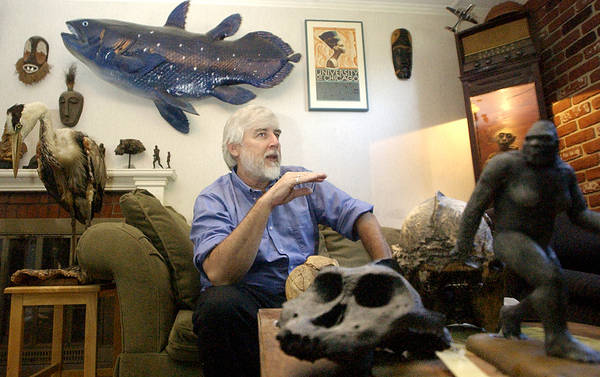
Local cryptozoologist Loren Coleman has an impressive collection that includes life-sized Bigfoot replicas, lake monster models, and a Coelacanth, among many other curiosities. These objects had been crowding his living room (BoingBoing wrote about a visit to his home two years ago), where he'd offered private tours of the collection by appointment. The new museum space on Congress Street, in the middle of the city, will give his exhibits a more prominent, public display.

Coleman, the museum's founder, also blogs about cryptozoology at the website www.cryptomundo.com. A blog post announcing the new museum was published two weeks ago:
The mission of the museum is to share the many items I have collected during the last half a century, with tourists, teachers, researchers, scholars, colleagues, students, documentary filmmakers, news people and the general public...

[the collection includes] hundreds of cryptids toys and souvenirs from around the world, one-of-a-kind artifacts, a life-size 8 feet tall Bigfoot representation, a full-scale six-foot-long coelacanth model, over a hundred Bigfoot-Yeti-Yowie footcasts, jackalopes, furred trout, along with such Hollywood cryptid-related props as The Mothman Prophecies’ Point Pleasant “police” outfit, the movie P. T. Barnum’s authentic 3.5 feet tall Feejee Mermaid, the TV series Freakylinks‘ 11 ft long “Mystery Civil War Pterodactyl,” and some of the movie Magnolia’s falling frogs.
The museum is also looking for donors: "For any patron who wishes to send in a donation of $1000 (one thousand dollars) or more, I shall be sending to you ~ anywhere in the world ~ a first generation copy of an Orang Pendek footcast," writes Coleman. If you're interested, follow this link.

Coleman at his home, which he had been sharing with the museum's collections. Photo by Amber Waterman of the Lewiston Sun-Journal.

Coleman seems aware that his field is substantially influenced by pop-culture silliness, and to his credit he seems OK with that.

But cryptozoology is really interested in making new zoological discoveries, and there's still plenty we don't know about the world's biological diversity. A recent post on Coleman's blog heralds the official scientific description of a new deepwater species of ghostshark, and the museum's logo (above) features a Coelacanth, a species known only from prehistoric fossils, and believed to be extinct, until fishermen caught a live specimen off the South African coast.

If modern science can discover a living fossil, who's to say it won't someday discover the real Abominable Snowman?

Wednesday, September 16, 2009

The Recession Armada and Air Force

A fascinating article in Britain's Daily Mail describes the enormous armada of cargo ships that have been idled off the coast of Signapore for the summer (thanks for the tip, Jim).

Above: idle cargo ships off the coast of Signapore.

"Their numbers are equivalent to the entire British and American navies combined; their tonnage is far greater," writes reporter Simon Parry. "Container ships, bulk carriers, oil tankers - all should be steaming fully laden between China, Britain, Europe and the US, stocking camera shops, PC Worlds and Argos depots ahead of the retail pandemonium of 2009."

Of course, the pandemonium of 2009 turned out not to be the sort where frenzied shoppers mobbed shopping malls. Asia won't underwrite our credit card debt and lousy mortgages anymore, which means we can't afford to by container-loads of their manufactured goods.

The Daily Mail article also notes that these ships are being manned by skeleton crews, doing basic maintenance and guarding against piracy. What an incredibly lonely job that must be - it must be kind of like working as a salesperson at Sears (right: inside the Schuylkill Mall, courtesy of DeadMalls.com).

The cargo armada off of Signapore isn't the only idled fleet of the recession, though. Seeing all those ships reminded me of Don Delilo's Underworld, a novel in which there's a character who re-paints and arranges abandoned airliners as huge landscape art pieces in the Mojave desert. Such aircraft boneyards really do exist in the desert southwest, and sure enough, they're filling with new arrivals during this recession. Via an April CBS News report:
The number of planes in storage has jumped 29 percent in the past year to 2,302, according to aerospace data firm Ascend Worldwide. That includes 930 parked by U.S. operators alone....

That makes for busy times at facilities like Evergreen Maintenance Center near Marana. Its super-sized hangar fits a 747, and there are plenty of active planes on hand, including one 747 used to test Pratt & Whitney engines and another converted to fight forest fires.

But outside there's a ghost fleet of 204 parked planes. Some of Northwest's retired 747s are here. Planes from defunct ATA Airlines, 767s from Air Sahara and MaxJet, and a hodgepodge of other airlines from around the world are here, too.
Here's a glimpse through the fence from Flickr user DannyMcL:

And here's another particularly good photo of the Mojave airliner storage lot. Enjoy!

Tuesday, September 15, 2009

Cities, Buried by Signs

"Your gaze scans the streets as if they were written pages: the city says everything you must think, makes you repeat her discourse, and while you believe you're visiting Tamara you are only recording the names with which she defines herself and all her parts. However the city may really be, beneath this thick coating of signs, whatever it may contain or conceal, you leave Tamara without having discovered it. Outside, the land stretches, empty, to the horizon; the sky opens, with speeding clouds."
-Italo Calvino, Invisible Cities
They say that if you take someone who has never been to New York City, but has watched plenty of American movies - a Korean shopowner, for instance, or a Greek hotel clerk- and dropped them in the middle of midtown Manhattan, they would not feel completely lost, because American movies have created a global, subconscious familiarity with the city and its landmarks.

It's possible to wander through Harlem and navigate by landmarks like the university from Ghostbusters and the diner from Seinfeld, for instance, or to navigate through Central Park by recognizing the places where Harry Met Sally or where Macaulay Culkin feeds the pigeons in Home Alone 2.

In most movies, though, the city is only a backdrop. In my experience, books can have a bigger impact on how a city feels, especially with authors who create a strong sense of place in their writing - as though the city itself becomes a character.

Via the Strange Maps blog, I've come across two "literary maps" of cities with strong presences in literature. Here's one of San Francisco, originally published in the Chronicle earlier this summer:

The quotes in this map roughly match the neighborhoods they reflect: Joan Didion's passage about Janis Joplin singing in the Panhandle spans the southern edge of Golden Gate Park near Haight-Ashbury, and a Kerouac quote spans the Russian Hill neighborhood where the beat poets lived.

Today, of course, both Haight-Ashbury and Russian Hill are the opposite of bohemian, full of franchise stores and yuppies with expensive cars. And yet the song lyrics and sentences we've read about these places still somehow imbue them with a bohemian aura, contrary to all reality: aging hippies still come to Haight-Ashbury, wander among the high-end restaurants and boutiques, and manage to keep a few holdout head shops in business.

So where is the real Haight-Ashbury - the neighborhood that exists independently of the writers and musicians who wrote about it? Are the hippies and head shops merely the ghosts of the neighborhood that Joan Didion and Hunter S. Thompson wrote about? Or are the fancy boutiques the impostors, there only because the Haight has become a cultural icon and hence a desirable neighborhood?

Thinking about it, I've concluded that both of these are true: Haight-Ashbury has become a product of our cultural expectations of it. The "real" neighborhood isn't so much concealed by the "thick coating of signs" by which we know it, as defined by it. It's no wonder that these kinds of places in our cities - Times Square, The Alamo, the Las Vegas Strip, and all the other places we think we know from books, movies, or songs about them - can simultaneously feel very familiar and very strange when we finally experience them in person.

Here's another literary map of Saint Petersburg, a city with a much richer literary tradition than San Francisco's. Unfortunately, I've never been there - my understanding of St. Petersburg is completely defined by what I've read by Pushkin, Gogol, and Dostoyevsky. I studied Russian in college, but a part of me is actually afraid to visit the real St. Petersburg, lest I ruin the glorious nineteenth-century city of my imagination.

The St. Petersburg map is a limited-edition print, and if you really love this blog and want to give the author a great surprise, feel free to send a copy to 64 Winter Street, Portland, ME 04102.

Thursday, August 27, 2009

The Aral Sea Is Gone

Via NASA's Earth Observatory, an image of the (former) Aral Sea, this August:


Near the dry harbor of Aral, Kazakhstan. Via Wikipedia.
The Aral Sea used to straddle the border between Uzbekistan and Kakakhstan as the world's fourth-largest saltwater lake. A Soviet industrialization program in the 1940s diverted most of its source water to irrigation projects for thirsty cotton farms in the desert. By the 1960s, most of the sea's water supplies had been diverted, and it began to shrink.

As the sea evaporated, a new desert, known locally as the Aralkum, took its place. The desert's soils consist of fine marine deposits mixed with highly polluted runoff from the former industrial cotton farms that used to surround it. Massive dust storms have blown this soil and its pollutants all over the world. The disappearance of the Sea has also removed a tempering influence on the regional climate: winters are now colder, summers are hotter, and there's less rainfall. Ironically, these problems haven't helped the industrial cotton farms that continue to divert water from the former sea's source rivers.


The Aral Sea seen from space in 1985. Via Wikipedia.
At the same time, as the lake shrank, its waters became increasingly saline. The water that remains in the disappearing southern lagoon is now three times saltier than typical ocean water.

The Kazakh government has undertaken a number of projects to restore the northern part of the sea, where water levels have recently stabilized and a fishing industry has even been able to re-establish itself. But the much larger southern portion has been written off as a lost cause, and continues to shrink at rapid rates.

Pretty amazing: in roughly half a century, a sea that was once the size of Missouri has essentially disappeared.

So long, Aral Sea.
We hardly knew ye.

Monday, August 24, 2009

A Field Guide to North American Seafood Menus


The Monterey Bay Aquarium has put together a consumers' guide to sustainable seafoods. The idea is to encourage grocery shoppers and restaurant patrons to support responsible fisheries, like wild Alaskan salmon, and to avoid fisheries that are environmentally harmful or near collapse, like farm-raised Atlantic salmon.

Snapper, Red

Rating: Avoid


Red snapper is in decline worldwide, and fishing pressure on this species remains excessive. Red snapper should therefore be avoided.

Market Names:
Mule Sow, Rat, Tai, American Red Snapper
The guides started as printable pocket versions that you could fold into your wallet and consult at the supermarket. But now there's an even better, more discreet version for mobile phones, accessible at mobile.seafoodwatch.org (part of the mobile-phone webpage about Red Snapper, a species that's in serious decline, is shown at right). Or, if you prefer, get the iPhone app. There's even a guide tailored for sushi restaurants that translates common Japanese fish names.

These guides are meant to accompany your menu at the restaurant, but I find them pretty fascinating in their own right. For instance, the Aquarium's guide for the Northeast region endorses Pacific halibut as "best choices," but we're advised to "avoid" Atlantic halibut and flounder caught here in the Gulf of Maine.

Clams (both farmed clams and wild steamers) are also endorsed as a "best choice." Which is good news, as long there's no red tide.

And Monterey is lukewarm about Maine lobster, a fishery that's long been hailed for its socially-driven sustainable management techniques. Maine lobster ranks as merely as a "good alternative," not as one of the "best choices," since the "current population status is considered weak or unknown" and there are concerns about right whales getting trapped in the buoys and lines attached to traps. Haddock also falls into the middling "good alternatives" category, with the caveat that "the majority of U.S. Atlantic haddock is caught using bottom trawl gear [which causes] considerable habitat damage to seafloor habitats."

So maybe I'll switch my preferred clam-shack order from fried haddock with tartar sauce to fried clams, and just opt for salad during red tides or after big rainstorms.

If you're a chef looking for sustainable-fisheries cred, Monterey Bay and a number of other marine research institutions also recently launched fishchoice.com, a tool for restaurants and other commercial seafood buyers.

Wednesday, August 19, 2009

Why I Lately Haven't Been Blogging As Much As Usual

In a couple short months, when it's 36 degrees and freezing-raining and you leave work in the dark at 4:30, are you going to be saying to yourself, "I can't believe I didn't go to the beach after work that day while the water in the ocean was twice as warm as it is outside right now."

OR would you rather say to yourself, "Look at this tan I still have, even in November!"

Carpe diem, buddies.