Monday, January 31, 2011
Wednesday, January 19, 2011
"This Is Not A Place of Honor"
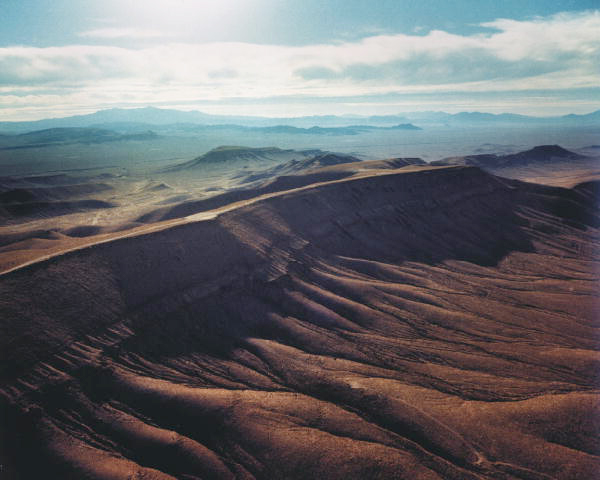
One of the fascinating paradoxes that the book delves into is the idea that the radioactive waste stored in Yucca Mountain is going to be deadly for tens of thousands of years - and so, if the species that has made itself capable of destroying itself actually manages to survive for ten millennia or more, into a future where the United States and the English language will both have been long forgotten and Yucca Mountain itself could be oceanfront property, how should we warn our distant descendants not to explore inside?
The government convened a team of materials scientists, linguists, anthropologists, graphic artists, and others to come up with a warning sign or message that civilizations 10,000 years from now would still be able to understand in order to stay away from the mountain and its deadly tunnels. This is their rough draft for the ideas that that message should convey:
"This is not a place of honor. No esteemed deed is commemorated here. Nothing of value is buried here. This place is a message, and part of a system of messages. Pay attention. We are serious. Sending this message was significant for us. Ours was considered an important culture."Even in the doubtful scenario that this message could last, and there's anyone around able to understand it in ten thousand years, I doubt this message would serve its purpose.
If there's any human characteristic will last for 10,000 years, it will be the capacity to identify bullshit. If you can imagine a future in which, even though your "important" culture has been long forgotten, some vestigial scrap of humanity that has anything in common with your own still exists - and if your own civilization has the hubris to believe that it can communicate across those millennia, that your message will last and be remembered - well, the assertion that that message is hiding "nothing of value" and "no esteemed deed" kind of rings hollow.
It's like if Homer decided to write the Illiad not as a parable of honor and duty, but as a long poem about how, while Homer considered the idea of the Illiad to be very serious and important, the actual historical details of the Trojan War are not worth knowing or investigating at all - and in fact, if you read between the lines, trying to learn the details of the plot will actually give you a nasty case of thyroid cancer.
Would that poem last? And if by some miracle it did, would anyone take it seriously?
John D'Agata is a great essayist. But his book and its themes also remind me of another favorite author of mine, the novelist Cormac McCarthy. Yucca Mountain, both as a stark desert landscape and as the repository for the waste of civilization's self-destructive technologies, seems like an ideal subject for one of McCarthy's novels. I'm reminded of the interview he did with the Wall Street Journal last year, and this brief discussion of the end-of-the-world scenario in his novel The Road:
But it could be anything—volcanic activity or it could be nuclear war. It is not really important. The whole thing now is, what do you do? The last time the caldera in Yellowstone blew, the entire North American continent was under about a foot of ash. People who've gone diving in Yellowstone Lake say that there is a bulge in the floor that is now about 100 feet high and the whole thing is just sort of pulsing. From different people you get different answers, but it could go in another three to four thousand years or it could go on Thursday. No one knows.Personally, I'll not be taking that problem to bed with me tonight. But maybe Yucca Mountain's sign makers should take it up - communicating with the cyborgs of the 22nd century should be a manageable first step towards communicating with whatever alien descendants might still be around in the 121st century.WSJ: What kind of things make you worry?
CM: If you think about some of the things that are being talked about by thoughtful, intelligent scientists, you realize that in 100 years the human race won't even be recognizable. We may indeed be part machine and we may have computers implanted. It's more than theoretically possible to implant a chip in the brain that would contain all the information in all the libraries in the world. As people who have talked about this say, it's just a matter of figuring out the wiring. Now there's a problem you can take to bed with you at night.
Posted by
C Neal
at
9:53 PM
5
comments
file under: geology
Thursday, January 13, 2011
The Colors of Abandonment
Greenfields: former agricultural lands laying in fallow. Greenfields proliferated during the early 20th century, as agribusiness consolidated and small farms were abandoned.
Brownfields: former industrial lands, frequently with pollution hazards. Brownfields proliferated during the late 20th century, as manufacturing businesses moved overseas and firms abandoned domestic factories.
Redfields: former middle-class neighborhoods, frequently characterized by strip malls, tract housing, and other properties that are now "in the red" and owned by absentee financial institutions. Redfields have proliferated in the first decade of the 21st century, in the wake of the real estate bubble, as the suburban middle class succumbs to crushing debt and poor access to economic opportunity.
Posted by
C Neal
at
2:07 PM
1 comments
file under: economics, succession
Friday, January 07, 2011
Detroit Princess
Catching Sun from Kinga Osz-Kemp on Vimeo.
Posted by
C Neal
at
7:34 PM
0
comments
file under: Detroit
Wednesday, January 05, 2011
The Braindead Megaphone and the Plague of Dead Critters
Today, the internet is panicking over dead fish that are washing up by the thousands in Chesapeake Bay and Brazil. Some of the internet's more tabloid-inclined "news" sites are consolidating these local reports in fearsome stories that seem to imply a global pattern.
Posted by
C Neal
at
1:17 PM
0
comments
file under: jackass environmentalism
Occupy Heathrow
Before I do, though, I'd like to show you how they're doing it in England. Earlier this fall, the New York Times ran an article about England's remarkable squatters' laws:
Currently, it is a crime to occupy a house where someone is living or plans to move in imminently. But squatting in an empty commercial property is a civil offense, and such squatters can be removed only by court order.Notwithstanding lurid tales told in the sensationalist British tabloids, having responsible tenants to take care of abandoned and foreclosed properties has generally been a good thing for England during these years of financial crisis. Without the squatting law, England would have more homeless, and more abandoned neighborhoods in terminal decline.
Homeowners are allowed to use “reasonable force” to get rid of squatters, though it is unclear what that means. Giles Peaker, a housing lawyer, said no one wanted to do anything that might provoke counterclaims of assault. Violence is out. No baseball bats, no pepper spray, no household weapons...
As for commercial owners, they cannot use any force, not even to break into their own property or muscle their way past the occupiers. Property owners say that the police are loath to intervene, except in the most blatant cases, without formal court orders.
Think of it as an Occupy movement for the dross of the collapsed real estate market.
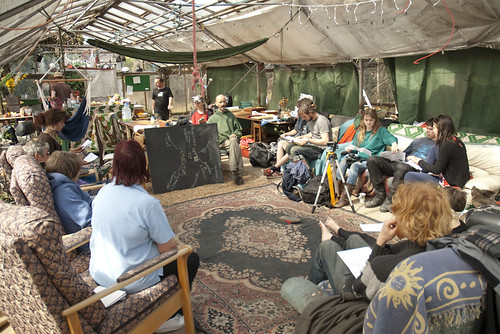
One prominent squatters' community mentioned in the Times piece is the Grow Heathrow encampment in the village of Sipson, just north of London's massive Heathrow Airport and in the path of a proposed runway expansion.
Citing British squatter laws, the community has successfully cleaned up an abandoned nursery, and turned its broken greenhouses back into functional (and beautiful) spaces for living, growing produce, and organizing activists against the airport expansion.
The proposed third runway at Heathrow has become a national issue in British politics. Ousted Labour leader Gordon Brown had been a supporter of expansion, but environmental activists - many of whom live at Grow Heathrow - have successfully delayed the proposal to the point where even airport executives acknowledge its unlikelihood.
One reason Brown and other political leaders had been pressing for a third runway is because the expansion had been seen as a necessity to preserving London's status as a global financial center.
In this light, Grow Heathrow and other opponents of airport expansion are not just fighting against airplane pollution. They're making a vital contribution to the Occupy movement, by inconveniencing Britain's bankers and hedge fund managers in their pursuit of global commercial domination.
All photos courtesy of Transition Heathrow's Flickr.
Posted by
C Neal
at
1:08 PM
0
comments
file under: citizenship, economics, London
Tuesday, December 28, 2010
Books I enjoyed in 2010
So I figure that it's time to return the favor. If you enjoy reading this blog, here are a few other printed materials that you might look for at your library or bookstore (if you click the links to buy them from Powell's website, you'll help finance my own book habit with a small commission).
Chronic City by Jonathan Lethem.
This has been described as a novel about an "alternate-reality" Manhattan, in which a giant tiger prowls the upper east side, stranded space station astronauts play out a survival drama on the nightly news, and a conceptual artist erases entire neighborhoods to build bottomless pits.
But the main characters spend the entire book struggling to determine what's real and what's fake about their city and their lives in it. And as they do, Lethem elegantly brings you to the inevitable conclusion: that on this island that's obsessed with real estate, terrorism, meaningless wealth, and celebrity diversions, "reality" of any kind, alternate or not, is a scarce commodity. The upside is that Manhattan's a rich source for a smart novelist like Lethem, since fiction is everything. I think this is the best novel about New York City since Don Delilo's Underworld, and it deserves to go down in history as the definitive chronicle of New York City in the first decade of the 21st century.
The Blue Flowers by Raymond Queneau.
At a wedding in Texas this spring, an Italian translator whom I'd just met somehow intuited that I liked Italo Calvino, and then she recommended this book, which Calvino had himself translated from French into Italian in the mid-1960s.
This novel switches back and forth between two plot lines: one of a Duke who advances through time through the history of France from the middle ages towards the present day, and one of a 1965 French pensioner, each of whom is having dreams of the other's life. As soon as one of them falls asleep in one plot line, the story switches to the other. It's a very funny book, even though I got the sense that half of the puns were lost in translation.
It turned out to be the most serendipitous book recommendation of my year, and led me to read other works by Queneau, including Zazie on the Metro and Exercises in Style.
The Complete Stories of J. G. Ballard
I decided to read Ballard after seeing repeated references to his fictional landscapes on BLDGBLOG and elsewhere. I actually started by reading Empire of the Sun, his semi-autobiographical chronicle of his experiences as a boy in China during World War II. That book, with its gloomy descriptions of sickened prisoners living in squalid conditions, deserted neighborhoods, and the machinery of war, gives a lot of insight into his later stories, where similar themes reappear in futuristic dystopias.
In a lot of these stories, the abandoned hotels and lost colonies of Ballard's imagined sci-fi future bear an uncanny resemblance to the foreclosure-ravaged suburbs of our present day - good reading for the Great Recession.
Wild Urban Plants of the Northeast, by Peter del Tredici
This is a great field guide to the wild-growing weeds, shrubs, and other plants that proliferate in empty lots and broken sidewalks. It goes above and beyond basic identification techniques, and delves into each species' natural history and ecological function - which plants fix nitrogen, which plants thrive in high-traffic, compacted soil, and which plants can tolerate or even treat various kinds of urban pollution.
Thanks go to Mitch Rasor for recommending this one on his twitter feed.
The Baron in the Trees, by Italo Calvino
It will be a great disappointment when I finish reading all of Italo Calvino's novels. This one is about an Italian aristocrat who takes to the trees to escape his family in an act of adolescent rebellion, and then spends the rest of his life up there, travelling from branch to branch, never touching the ground. It's enjoyable enough as a fable, but Calvino enriches the story by involving the adult Baron in the Enlightenment, in revolutionary politics, and in the Napoleonic Wars, as well as in a bittersweet romance.
The Rings of Saturn by W. G. Sebald.
It occurs to me that this book bears some resemblance to Ballard's - it's a fictional travelogue of various sites on the coast of Britain, including a number of abandoned military installations and struggling blue-collar villages. For Sebald, these sites serve as pretexts for a sweeping digressions on world history: for instance, a visit to Norwich, a former center for British silk manufacture, leads to a discussion of silk's strategic importance to various empires of history, and of the brutal rule of the dowager empress Tzu Hsi.
The narrative returns, again and again, from these sweeping discussions of historical titans to the lonely and seemingly mundane landscapes of contemporary coastal England. The effect is jarring, simultaneously demonstrating us how the passing years obscure the great crimes of history, while also demanding that we not forget that history. Sebald's books have the rare quality of physically affecting my mood as I read them - the mark of a truly engrossing book.
Two other things worth reading, although not yet in books:
"Victory Lap" and "Escape from Spiderhead" by George Saunders (published in the New Yorker)
George Saunders is a national treasure.
Posted by
C Neal
at
5:12 PM
0
comments
Sunday, December 19, 2010
Some coastlines are more infinite than others
Every coastline infinitely long. Not only that, but every state gains and loses an infinitely long length of coastline every time the tide goes out, or every time a wave washes ashore.
I thought of this problematic state trivia because Mandelbrot's first academic paper, "How Long Is the Coast of Britain? Statistical Self-Similarity and Fractional Dimension," tried to tackle this paradox. It observed that how long a coastline looks depends on how much detail you care to look for - whether you're measuring on a classroom map of the contiguous states, or on individual grains of sand under a microscope. For instance, if we use a 50-mile yardstick, Maine's coast looks about 230 miles long:

But try using a 5-mile yardstick, and you'll find that there are at least 200 miles of coastline in Casco Bay alone:
And we're still missing so much detail! Who wants to try measuring Casco Bay with a mile-long ruler? Or an actual yardstick?*If Maine's coastline were smooth, like Florida's, the 40-odd 5-mile rulers in the bottom map would have covered roughly as much territory as four 50-mile rulers.
Mandelbrot's insight was this: you could measure the "crookedness" of a coastline by calculating the relationship between how carefully you measure something (the scale of your ruler) and the total length you get.
This relationship is similar to the fractal dimension, a mathematical concept useful for calculating how some infinite sets are "more infinite" than others. It's also a way of describing things that are neither one-dimensional lines, nor two-dimensional planes, but fuzzy and in between - like the infinite coastlines that emerge and sink away under every one of the ocean's infinite ripples.
For what it's worth, these guys say that the coast of Maine's fractal dimension is 1.27 - slightly more infinite than the coast of Britain (at 1.25), but not nearly as infinite as the coast of Norway (1.52).
* Please don't.
Posted by
C Neal
at
9:27 PM
2
comments
file under: math, yankee nativism