Thursday, June 07, 2007

Love this place.

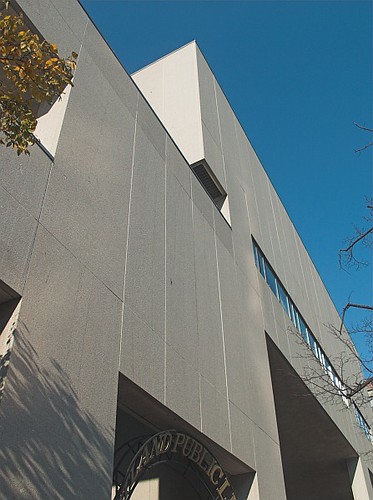
One of the characteristics that makes Portland such a walkable city is how its greatest public buildings are framed at the end of our streets: look up Temple Street, and there's the stately Unitarian Church. Winding along Fore Street, the streetscape suddenly opens up at Boothby Square to frame the old Custom House. And at the top end of the former Middle Street, we have this, our Public Library, bookending the great public square in the heart of downtown Portland.

Seeing buildings at the end of streets makes our city feel smaller and adds to our street life: if you can see it, you can walk there, and most people do. So all the better if the architectural artwork that our streets frame happens to be a public building like a church or a library. Who wants to stroll down a street that dead-ends at a monstrous concrete parking garage?


This photo comes courtesy of selfnoise, who has many excellent pictures of Portland on his flickr page.
When I was a kid, this building was usually the destination when my family came to visit downtown Portland from Steep Falls, Maine. The building and its surroundings - the Square, the old gothic skyscapers next door - made Portland seem more exciting than it actually was in an era when several Congress Street buildings had been abandoned. When it was built in 1979, downtown Portland was losing its life to the Maine Mall, but the Library gave families like mine a reason to come downtown again. It was, and still is, a great public building that enjoys a mutually beneficial relationship with a great public space, Monument Square.

It saddens me that the Library's trustees are in such a rush to sell this public space short, to abandon a great building to move into a smaller space around the corner, in the shadow of Bayside's white elephant parking garage.

Luckily, it's not a done deal yet. Portland voters will have a chance to save the Library on June 12, during a special election to decide on a bond that would finance the move. We can preserve the library and save a million bucks. Let's all turn out to the polls next Tuesday and vote no on question one.

Tuesday, June 05, 2007

Put this in your cap and trade it.

I just received a press release from the NRCM's Sara Lovitz, who helped organize the New Coast Parade:
"Today, the Maine Senate voted 35-0 for final passage of “An Act To Authorize the State's participation in the Regional Greenhouse Gas Initiative” (LD 1851, known as RGGI [that's the Regional Greenhouse Gas Initiative]).

"Today’s vote makes Maine the third northeast state to pass a law that requires power plants to reduce their emissions of global warming pollutants as part of a region-wide "cap-and-trade" system. Vermont and Connecticut have already passed RGGI legislation -- altogether ten northeast states are in the process of adopting similar policies, and five western states are not far behind...

"The bill would reduce global warming pollution from power plants by nearly 20% by the year 2019, and would enable Maine businesses to participate in a regional marketplace for emission reductions. RGGI can save electricity customers 5 to 15% on electricity bills, help protect against rate increases, generate an "energy savings fund" worth up to $25 million per year to help both residential and commercial energy consumers save money and invest in energy efficiency, and create a new "carbon market" in the Northeast, with opportunities for everyone from dairy farmers to high-tech companies."
This is great news for Maine's environment and its economy. Legions of capitalist agents - from multinational reinsurance companies and Big Oil to independent farmers and fishermen - have asked our government to assign rights and responsibilities to account for the costs of greenhouse gases.

The Yankee states fighting for the Union and emancipation true cost accounting for global warming pollutants.
In terms of allocating financial capital where it properly belongs, these new cap-and-trade markets will be to the age of global warming what Wall Street was to the twentieth century (and incidentally, I find it interesting how the extremist conservatives who would deny global warming's existence do so at the expense of their faith in American capitalism). Instead of sending billions overseas to fossil fuel-exporting kleptocracies, a price on carbon will divert more capital to foster innovative green technologies here.

Besides gaining greater efficiency in its whole economy, Maine will also benefit in the short term because our utilities generate relatively few greenhouse gases: because we produce more electricity from small hydro projects (and because wind power is our main source of growth in electrical generation for the foreseeable future), Maine ratepayers will reap the benefits as local power companies export carbon credits to other states.

Meanwhile, a string of five western states bookended by Washington and New Mexico are starting their own cap-and-trade scheme, and the proliferation of multiple regulatory frameworks is sure to incur big costs for Big Oil and interstate utilities. Some of them are even begging the crew they bought for the White House to enact a strong nationwide cap-and-trade system to save them the hassle of dealing with the states.

For more information:

The Northeast and Mid-Atlantic Regional Greenhouse Gas Initiative

Press Release: Maine third Northeast state to pass "RGGI" law to cut global warming pollution from power plants

Monday, June 04, 2007

More blogs I like.

It's June, which means that the strapping young men and women of the hut crews will be hiking to their summer homes as motorcycle engines cannonade their four-stroke siren song into every mountain vale and hollow. Since this blog here got its start as a blog about working as a winter caretaker in Carter Notch Hut two winters ago, I'd like to direct your attention to hutman Andrew Riley's blog, Gulliver's Nest. Andrew has just returned to work for a summer in the huts, and he writes about mountain weather, history, ecosystems, abandoned trails, and Boston's new museum, among other things. He probably won't have many opportunities to update it this summer, but the archives are good reading.

Also, a fish in Vacationland is making wisecracks about vegans and the poverty crisis among local alt-weekly food critics. Go read the new Portland Psst! (I'm not yelling at you, that's just what it's called).

Finally, I learned from the latter blog that LibraryThing, one of my favorite Web 2.0 sites, is based right here in Portland! I've cataloged my smallish library there, and also added a random sampler widget to the sidebar at right. Think of them as analog links to more interesting reading. LibraryThing is also supposed to recommend new books for you to read based on the preferences of other users who own similar titles. I'm picky, so it doesn't work for me as well as I'd like it to, but I'll take its advice that I read Barry Hannah's Airships. Thanks, neighbors-who-make-LibraryThing!

Wednesday, May 30, 2007

They bulldozed it.


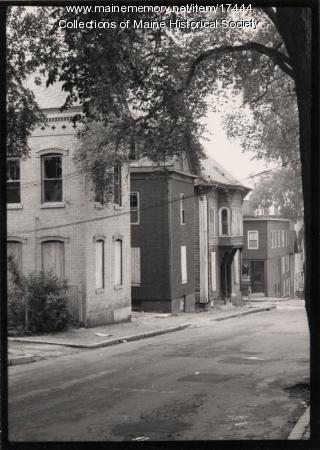
Above: Franklin and Oxford Streets in the 1950s. The other historic photo (below) shows another stretch of the long-lost Franklin Street (historic photographs courtesy of Maine Memory Network)
This photograph here is what the corner of Franklin and Oxford Streets looked like about 50 years ago, before the WASPs on the City Council noticed the Irish name on the corner store, called it a "slum," and bulldozed it all to create the hated Franklin Arterial.

Below, another photograph from the same site of another spot on the former Franklin Street. It's hard to know exactly where, since the buildings, shady elm trees, and even the sidewalks have been gone for decades. For those readers who have never been to Portland, here's what urban renewal gave us instead: a grass median full of garbage, some scrubby trees growing over the old neighborhood's rubble, and four lanes of traffic unencumbered by crosswalks or sidewalks. Here's a photo (the Franklin Towers, Portland's tallest building and a fine example of Soviet Sentimental architecture, commands a fine view of the no-man's-land):


Note how all of these "slum dwellings" in the old photos bear striking resemblance to historic homes that now sell for over $1 million in surrounding neighborhoods. Way to invest in real estate, you jingoist highway-engineering dipshits.

Here's some good news, though: my new buddy Patrick writes about schemes to repair past urban renewal idiocy with a new Franklin Boulevard in the Bollard this week: read about it here. Tomorrow at the Franklin Towers will be a "revisioning workshop" to brainstorm new ideas for the blighted pavement - perhaps I'll see you there. Finally, here's a previous post about fixing Franklin Arterial.

Tuesday, May 29, 2007

Updates from the Rogue Blogger

Exciting news! While helping out at the farmer's market over the weekend, I heard from two separate sources that Chris Busby, editor of The Bollard, Portland's electronic news source, has been disparaging yours truly as "a rogue blogger." Yarr!

Busby's apparently upset about this article from last week's Forecaster, which broke the news of a newly-formed group that is organizing to oppose the Portland Public Library's move to a smaller and more expensive building away from Monument Square.

This very loose organization evolved from informal discussions between Jed Rathband, a local political consultant, and me. Basically, we griped about what seemed to be an impulsive decision that affects a very important public space, and we decided to do something about it. Hence, the PEEPs: Portlanders for Economic and Educational Priorities (Jed came up with the name a few minutes before the Forecaster's press deadline).

Now, even though we didn't really have a name, we did have several supportive individuals encouraging us from the get-go. Like us, they don't have a lot of time or resources to dedicate to the cause, but they do agree it's worth more discussion. We the PEEPs exist to vocalize these opposing views, which, we're finding, are more widespread than the conventional wisdom would have it.

But Chris Busby is definitely not down with the PEEPs. After hearing about our group's humble origins from Jed over a beer at the local watering hole for 30-somethings, the erstwhile amiable Busby reportedly went home and wrote an nasty letter to the editor of the Forecaster. He called for the original article's retraction, criticized reporter Kate Bucklin for writing it, and dismissed the PEEPs as the work of only two people: Jed and "a rogue blogger." Who is me.

Mr. Busby's criticism misses the mark, though. We'd heard from others who oppose the library's move before we had the idea for PEEPs, and following the publication last Friday of this op-ed column of the subject (take a moment to admire the solidity of its arguments and the well-formed prose), we've been hearing from more and more people who agree that the Library shouldn't spend a million dollars to move into a smaller space.

Chris Busby has been working hard to establish The Bollard as a legitimate alternative to other local news sources. This is someone who usually champions free speech and alternative media - so why doesn't he use his own forum to discuss the issue, instead of trying to meddle with the editorial decisions of another newspaper? It strikes me as being a little bit petty, and my esteem for The Bollard's been bruised a bit.

Besides, Busby doesn't know me well enough to realize that he's only encouraging me by labeling me a "rogue blogger." He might as well have called me Captain Awesome. So, lock up the women and children and stay tuned to this blog for more about the PEEPs, why the library should stay where it is, and other rascally roguery.

Tuesday, May 22, 2007

Take two of these pills, get plenty of rest, and DON'T TOUCH THE FLOWERS.


Mercy Hospital planted some lovely flowers right outside their main entrance a few weeks ago. There's nothing like some cheerful little violets pansies to lift the spirits of our sick and infirm.

Unless those flowers are drenched in pesticides. As these are.

The little sign says "CAUTION. Pesticide Application. Keep off [buster symbol] until 5/19."

This is the kind of profit-maximizing synergy we like to see in the modern health care industry: Mercy Hospital has got their landscapers drumming up business for the oncologists.

[EDIT 5/24: Correction: these are pansies, according to Dr. Turbo. Violets do not get planted in front of hospitals because they have been shown to have a greater effect than placebo flowers in lowering the spirits of the sick and infirm.]

Sunday, May 20, 2007

Sane ideas for the Adams School site

A couple of weekends ago I climbed to the top of the Munj to attend a community charrette for the future of the Adams school and the two blocks of East End neighborhood it occupies.

Billed as a workshop for "crazy ideas," the event was intended to guide the neighborhood association towards a set of goals and guidelines for a forthcoming Request for Proposals for the future development of the site. The ideas turned out to be not so crazy, for the most part - at least, no one proposed a space port or anything like that. More often, people struggled with the tradeoffs of more quotidian desires for a neighborhood with scarce land: Would the neighborhood like to see more housing or more parking? More retail space or more grassy lawns?

We split up into three groups, each of which was guided by some Muskie School planning students and an architect or two to put our ideas on paper. We began by ranking our priorities for the neighborhood: family housing came up most strongly, but so did environmental sustainability and open space.

The conflict between these values struck me early on. Every additional quarter acre dedicated to "open space" means one to three families who won't be able to live in the East End (and they'll likely move to the hinterlands of Scarborough or Standish instead - certainly less than a "sustainable" outcome). Besides, the Eastern Prom, one of Portland's biggest open spaces, is just a short walk away from the school in two directions.

But we also discussed how the East End's plentiful open space is actually used. As it turns out, a lot of it isn't very functional: the majority of it is just a pretty frame for views of the ocean or (in the case of the park on North Street) of the White Mountains. A lot of East Enders use their grassy "open space" primarily as a toilet for their pets, if at all. Even if that is a valid priority, people generally agreed that it shouldn't outrank the need for in-town housing.

But the Adams School's existing playground isn't just a grassy lawn (although the site does have one, and again, it's a dog toilet). It's also an active playground and basketball court that's still well-used even two years after the school's closure. This, it turned out, was what the neighbors in my group really valued: not an empty field faking pastoralism in the middle of the city, but a busy, public square where kids could play and neighbors could meet.

So this is what we came up with:


Triple-decker rowhouses (purple) front Vesper and Munjoy and a new pedestrian court between Beckett and O'Brien Streets. A sun-facing playground and plaza (orange-ish, with green trees) open up along the southern end of the pedestrian connection along Wilson Street, and facing the plaza are storefronts for local non-profits (in blue), topped by additional housing. Two alleys (also orange) through the site access flexible storage space (pink) that can be used as parking or as studio space, at the owner's discretion.

Nan Cumming, who attended as a neighbor but also happens to be the executive director of Portland Trails, advocated early on for connecting O'Brien and Beckett Streets as a pedestrian thoroughfare. Also, our group considered reusing the school, but ultimately rejected the idea in order to make the most of the real estate, recycle the old building's materials, and build new, efficient buildings instead. A sub-group discussed possible ownership models for the housing and concluded that the project should sell affordable, deed-restricted condos built for and marketed to young families.

Then we went to present these ideas to the other groups and hear about their own "crazy" (but not really) ideas. As it turned out, the other groups seemed to hold similar values: housing was definitely the most prominent element of every plan, as was a small playground or garden on the southern end of the site. The other two plans proposed reusing the existing Adams School building for "community" uses or as business incubators, but they also suggested hollowing out the middle portion of the building to provide the same pedestrian connection our group had proposed. No one wanted big parking lots (speaking of which, I wonder if anyone from Ocean Properties is reading this blog yet).

This site plan came from the same group that created the lovely adaptive-reuse drawing above. They've got housing on the north side of the site, along Munjoy, and above commercial uses on Wilson, plus an urban square in the middle and a garden to the south. The school building is would be reused for "community" uses, although I'm not sure how "community" uses would fill all that space and I can't recall the details of their presentation. They proposed adding a sort of pedestrian arcade through the building (see drawing above).

The final group had the prettiest drawings (in my opinion) and the most urban site plan:


They proposed four-story townhouses (top left drawing) along Wilson, Munjoy, and Vesper Streets, and a rehabbed school building with new additions for retail and business incubator space. I thought that their drawing of the reused school was particularly awesome (at right): a sort of warehouse/treehouse perches on top of the old school building with wind turbines.

However, all of the good-looking density that comes with this plan comes at a price: they proposed underground parking, which costs a lot more than surface-level lots or garages. While underground parking looks better, it would probably make the housing here prohibitively expensive for most people.

Now that the conceptual designs are in, the School Reuse Committee will consider the options in its final report to City Council, which will probably put out a Request for Proposals or a Request for Qualifications sometime soon.

Tuesday, May 15, 2007

Twilight for the Bayside Glacier

A couple of months ago I wrote about the Bayside Glacier, a three-story-high pile of snow formed by the plowing activities of Portland's Public Works Department.

Two months of spring weather have taken a big toll on Portland's last relic of the recent ice age. Compare the top left photo from March to the bottom right photo taken last weekend. The bulldozer, an important agent in the glacier's genesis and growth, provides a sense of scale.

As was noted previously, the glacier's ice had collected a good deal of debris as it traveled across city streets. Now, as the top layers of ice melt away, that debris is being deposited in a scattered "terminal moraine" of garbage at the melted edges of the glacier.

The amount of garbage in the terminal moraine is so substantial that some Portland residents seem to have mistaken it for a new city dump, and left their own deposits of heavier trash in the same place:


In this photograph, the melting glacier reveals the layers that scribe its formation: there, above the yellow trash bag, for example, is the stratum of the Valentine's Day storm. Rising above the conglomerate of ice and trash is the marquee of Portland's new Whole Foods Market (right) and the piles of scrap metal at E. Perry Metal Recycling (left).

Alpinists traveling over the surface of the glacier should exercise extreme caution, as the melting opens up hazardous crevasses that gape beneath the surface. I made sure that my footing was extremely secure before I took the photograph at right.