According to Earth2Tech, "The researchers built a synthetic chromosome and inserted it into a living bacterial cell, where it — for the first time and published in the journal Science today — took over the cell and became a new life form."
So the world's first man-made life form is also a body-snatcher.
Venter's research is being funded largely on the hopes that it will produce new organisms to help convert sugars into ethanol, or to engineer a new algae that not only absorbs CO2, but also could be used as a transportation fuel. In fact, Venter's startup, Synthetic Genomics, Inc., has been operating in partnership with ExxonMobil's research and development office.
There's a strain of environmentalism that believes that climate change is catastrophic and unavoidable, and the best option for us now is not to reduce greenhouse gas emissions, but to embark on large-scale "geo-engineering" projects to reverse-engineer the Earth's atmosphere into a cooler state. Ideas range from pumping smoke into the upper atmosphere to give us more shade, to seeding the oceans with iron to promote plankton growth.
These ideas horrify mainstream environmentalists because there's nothing to indicate that these ideas would work, or that they wouldn't inflict serious unforeseen consequences. To me, the worst thing about the geo-engineers is that they think it's a good idea to spend a lot of money and exert massive efforts in order to treat the symptoms of climate change - not the causes.
It seems to me that Dr. Venter's devotion to synthetic life has too much in common with the geo-engineers' perspective, even though his work is on a microscopic (instead of planetary) scale.
It's a huge effort, a science-fiction fantasy come to life, and for what? So we can fuel our minivans with the world's agricultural crops instead of with oil. Thanks, science - I guess.
In 1992, a container ship crossing the Pacific Ocean from China lost its cargo of nearly 29,000 rubber duck toys during a winter storm. In the nearly two decades since then, the toys - easily identified by the "First Years" brand name etched in the plastic - have washed up on the shores of Alaska, Chile, and Australia, drifted through Arctic pack ice, and - as of 2007 - started showing up on the shores of Europe.
Now, another petroleum-based consumer product is giving us a real-time lesson on how ocean currents work in the Gulf of Mexico. Here's a satellite view of the big oil slick from Monday, via NASA's Earth Observatory:
See that long tendril of an oil slick stretching out towards the southeast? That's the Gulf Loop Current, and here's where it's taking the oil next (via the Palm Beach Post):
At the beginning of this week, Paul Krugman wrote about the Gulf's oil spill as an old-fashioned, photogenic environmental disaster, one that might finally spur America's leaders to grow a backbone and fight for clean energy:
Environmentalism began as a response to pollution that everyone could see. The spill in the gulf recalls the 1969 blowout that coated the beaches of Santa Barbara in oil. But 1969 was also the year the Cuyahoga River, which flows through Cleveland, caught fire. Meanwhile, Lake Erie was widely declared “dead,” its waters contaminated by algal blooms. And major U.S. cities — especially, but by no means only, Los Angeles — were often cloaked in thick, acrid smog.
It wasn’t that hard, under the circumstances, to mobilize political support for action... [yet] as visible pollution has diminished, so has public concern over environmental issues. According to a recent Gallup survey, “Americans are now less worried about a series of environmental problems than at any time in the past 20 years.”
This decline in concern would be fine if visible pollution were all that mattered — but it isn’t, of course. In particular, greenhouse gases pose a greater threat than smog or burning rivers ever did. But it’s hard to get the public focused on a form of pollution that’s invisible, and whose effects unfold over decades rather than days.
So suddenly we have a very visible reminder of why we need alternatives to oil. Some good could come of this, right?
But there's a big problem with this line of reasoning. As terrible as this oil spill has been, and will be, the scale and impacts of this disaster don't come anywhere near the scale and impacts of global climate change. They are separate problems.
True, oil has been a trigger for both problems, and therefore, Krugman reasons, they might share a common solution: generate more clean energy, burn less oil.
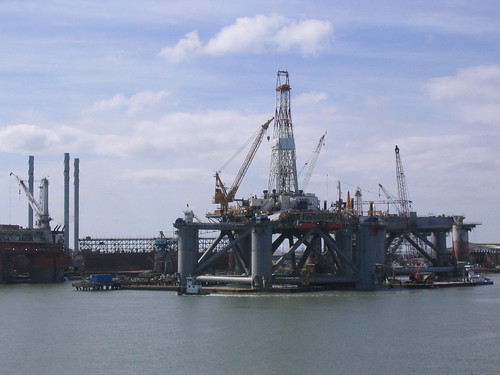
Oil rigs under construction in Galveston, Texas in spring 2008. These are huge, tremendously complex and expensive machines. BP may have been the organization responsible for the Deepwater Horizon rig, but we - the American motoring public - were the financiers.
But the fact that global warming and this oil spill are very different problems also means that they don't necessarily have to share the same solution. In fact, the dominating conclusion that people on the left have been jumping to is one that actually won't do a damn bit of good for the climate in the long term.
That knee-jerk "solution" is to ban offshore drilling, without doing much of anything to reduce our energy use or develop alternatives. This addresses the visible part of the disaster - the part that Krugman sees as the biggest opportunity. But it doesn't do anything to address the more insidious, less visible threat of climate change.
Attendant with this has been a lot of facile political mockery of the "drill baby drill" contingent. This may be fun, but it's not especially productive. The oil spill is creating a political spectacle as well as an environmental one:
Whether this spill turns out to be the result of a freakish accident or a cascade of negligence, the likely political outcome will be a moratorium on offshore drilling. Emotionally, I love this idea. Who wants an oil drill in his park or on his coastline? Who doesn’t want to punish Big Oil on behalf of the birds?
Moratoriums have a moral problem, though. All oil comes from someone’s backyard, and when we don’t reduce the amount of oil we consume, and refuse to drill at home, we end up getting people to drill for us in Kazakhstan, Angola and Nigeria — places without America’s strong environmental safeguards or the resources to enforce them.
It's worth noting that this disaster is happening in the Gulf Coast because the poorer states of the Deep South share a predilection for weak environmental laws, and therefore their coastlines are the only place in United States waters where drilling is allowed. Plenty of people who find drilling distasteful are only too happy to burn the fruits of the Gulf Coast's rigs and refineries: see "Exporting Pollution to Dixie," from December 2007.
Margonelli goes on to suggest that "we should throw our newfound political will behind a sweeping commitment to use less gas." But that, of course, would require more than political will: it would require environmentalists to set aside our Palin-bashing, "we told you so" grandstanding to actually accept our own personal responsibility for the oil we use, and do something foresighted and intelligent.
It would also require us all to share culpability for this oil spill, by acknowledging that everyone who burns gasoline shares responsibility for the thousands of oil rigs in the world's oceans, and the risks that those rigs create for our environment.
Personally, I'm not holding my breath for that outcome. Earlier in the same column, Margonelli notes that BP's ludicrous "Beyond Petroleum" slogan had been extremely successful, in part, because it "accurately reflect[s] drivers’ desire to buy unlimited gasoline while remaining 'beyond' all the mess" [side note: you may recall that BP was also the force behind Los Angeles's "green" gas station a few years ago].
The facile fantasies that banning offshore drilling will save our environment, or that it's all Sarah Palin's fault, are inextricably linked to the fantasy that driving hundreds of miles every week can ever be "sustainable" - the fantasy of the 20th-century American Dream.
Put another way: it's a lot easier to caricature evil corporations and score political points against stupid Republican slogans than to examine the lifestyle we take for granted, take personal responsibility for it, and work to change the economy that spends trillions of dollars to squeeze oil from our oceans.
It is "Commute Another Way" month, if anyone's interested in burning a little less oil.
Two weeks ago, my wife and I spent a weekend in Port Aransas, Texas for our the wedding of Katy and Zach, who love the beach as well as each other. For our first two days there, it was hazy and muggy and difficult to see very far. Still, in the evenings we could see lights out at sea.
But on the third morning, rain showers had cleared the air. When we looked out to the ocean, we were suddenly able to see dozens of oil rigs and platforms scattered along the horizon, as though they had just appeared overnight.
Port Aransas drilling platforms, by Flickr user austrini.
It might be because I grew up in Maine, but looking out at the ocean has never really inspired a sense of awe in me, the way it seems to for others. But seeing the oil rigs at Port Aransas made me feel differently. Looking at these huge machines as tiny blips on the horizon really impressed me with how huge the ocean really is. Each of these rigs had crews that would be flown in by helicopter to live there for month-long shifts. They're tiny villages isolated by miles and miles of ocean, like outposts on a watery and hostile prairie.
But the biggest feeling of awe didn't come from contemplating the vast ocean. It came from contemplating the tremendous wealth and social complexity necessary to plant thousands of these rigs and their crews miles out to sea.
A map of offshore oil and gas platforms in the Gulf of Mexico, from Wikipedia.
From Port Aransas we drove through a landscape of ride fields and petrochemical refineries to Houston, home to the headquarters of most major oil companies doing business in the United States, including BP. While we were there, BP's Deepwater Horizon drilling rig, operating in deep waters beyond the edge of the continental shelf, exploded and sank to precipitate what could become the worst oil spill in history.
But in those first few days, there wasn't much to indicate that it would be such a disaster. With thousands of oil rigs operating in the Gulf, accidents are inevitable. At the airport the next morning, we read through a discarded copy of the April 21st Houston Chronicle. I remember noting that the newspaper was lighter and smaller than it had been five years before, when I'd lived in Houston. But I don't remember any stories about the Deepwater Horizon. We wouldn't know the scale of the disaster until later. We probably still don't know.
How we respond reveals a lot about the state of environmentalism, energy policy, and our economy. I have a lot more to say on this - in the meantime, here's an old post about my visit to the Texas Star offshore oil rig museum in Galveston:
During a few days spent in New York, I had a chance to briefly visit the Safari 7 Base Camp, set up in Grand Central for Earth Week.
Safari 7 is pretty much exactly what I have been thinking about doing ever since I worked as an Urban Park Ranger a few years ago in Inwood Hill Park: a guided tour that highlights nature and ecology in the places we typically overlook those things. I'm glad that someone actually had the initiative to make it happen. From the project's description:
“The 7 line is a physical, urban transect through New York City's most diverse range of ecosystems. Affectionately called the International Express, the 7 line runs from Manhattan's dense core, under the East River, and through a dispersed mixture of residences and parklands before terminating in downtown Flushing. Safari 7 circulates an ongoing series of podcasts and maps that explore the complexity, biodiversity, conflicts, and potentials of New York City's ecosystems. Tours are available online and can be experienced independently, or in group expeditions and workshops organized by the Safari 7 team.”
The "Base Camp" at Grand Central included an array of gorgeous banners that highlighted things like the aquatic wildlife of the East River, the ecosystems of decomposition at work in the city's huge “cemetery belt,” and the dual role of urban chickens, as food sources and as illegal fighters. The centerpiece of the project is a series of podcasts, short enough to listen to between stops, that describe various ecological phenomena at work at each stop along the line.
Thus, as you ride under the East River, you can listen to a podcast about the tiny island formed from that tunnel's excavation, and learn about the cormorants that nest there. Or hear about the ecology of courtyard gardens in Queens, while you try to get a glimpse of one from the elevated portion of the line.
Over the next few weeks, I plan to write more about those individual podcasts and some of the issues they discuss in more detail. Much of the subject matter isn't unique to Queens - no matter what city or backwoods internet-enabled cabin you live in, there's something for you to learn about your own human habitat. Visit safari7.org to download your own safari audio tour.
At the urging of some of my neighbors, I have undertaken a bid for Maine's State House, to represent District 119 (the Bayside and Parkside neighborhoods) when Rep. Herb Adams retires this year.
If you read this blog, you're probably familiar with where I stand on a lot of issues. Obviously, getting the state to take more aggressive action on climate change, and making the Maine Dept. of Transportation more considerate and proactive about sustainable modes of transportation, are big goals of mine. But I'm also interested in doing more to cultivaqte small businesses as an economic development strategy, promoting more walkable downtown development in Maine's smaller villages and Main Street areas, and doing more to support immigrant populations in our neighborhood and across the state.
In order to have a fighting chance, I need to collect 60 $5 contributions in one week, in order to qualify for the state's Clean Elections Funding. These contributions all have to come from the Bayside, Parkside, and East Bayside neighborhoods. So if you're my neighbor, PLEASE go to the state's secure website and make a contribution online:
Note that even though I've changed my name to "MilNeil," I'm still listed as "McNeil" with the state. Hopefully this will be sorted out by November.
Even more importantly (because I definitely need help with this), if you know anyone else who lives in Bayside or Parkside, please vouch for me and ask them to chip in five bucks as well. Send them here, or to facebook.com/milneil, if they'd like to learn more about me.
Last week's New Yorker has an exhaustively researched report on Mark and Delia Owens, two conservationists who worked for much of their life running a well-funded conservation foundation in eastern Zambia's North Luangwa National Park.
The Owenses have long been minor celebrities of conservation, having written two successful books about their projects in Africa. One of the most interesting aspects of Jeffrey Goldberg's report is how it collects quotes and details from other public publications and broadcasts, from National Geographic to Sports Illustrated, in previous coverage of the Owens's work in Zambia. Much of the past coverage more or less portrays the Owenses as white saviors for the dark continent - a sort of Kipling fable where environmentalism has replaced the Anglican church. The Sports Illustrated story was even headlined "A Light in the Darkness" (as far as I can tell, Joseph Conrad didn't get any credit).
And just like a Kipling fable, it took the audience a little while to realize just how fucked up this seemingly-innocent story about wild animals in Africa really is.
When they first arrived in Zambia, there was a massive trade in ivory that was decimating elephant populations, and poaching inside the park became an early bête noir for the couple. At first, they focused on offering more productive and sustainable alternatives to local residents, with small agricultural industries that simultaneously provided jobs and alternative sources of protein to local residents. To their credit, the Owenses kept up this local economic aid throughout the duration of their work in Zambia, and supplemented it with medical care, schools, and other social programs.
But when these measures didn't produce the results they wanted, the couple turned to the small force of "scouts" that were charged with protecting park wildlife. Under their authority, and with funding from American conservation funders, these "scouts" evolved from a bedraggled and non-confrontational band of government employees into an intimidating paramilitary force. Goldberg makes a compelling case, based on dozens of personal accounts and writings from the Owenses themselves, that this force regularly operated outside the rule of law, with deadly results.
The central episode of the story is a literal hour-long episode of a 1996 ABC News documentary, broadcast on national television, about the Owenses and their work in Zambia. The program included a snuff film: footage of an alleged poacher getting shot and killed in the woods. The off-camera murderer was not identified in the program, and ABC's crew never notified Zambian authorities. It's hard to believe, but the televised killing seemed to have little effect on the Owens Foundation and their aggressive way of operating in Zambia.
These crimes, and the American media's permissive, even reverent attitude towards them, illustrate some uncomfortable truths about traditional environmentalism. First, it illustrates the arrogance of the myths we keep about an Edenic, pre-civilized nature, or of Nature as a place where there are no people. The truth is that people have lived in the wild for a million years, and they have important roles in natural ecosystems - we're part of nature, not above it.
Many of the alleged "poachers" in Zambia were recent descendants of natives who had hunted in North Luangwa for generations before British colonialists expelled them to create an artificially human-free "park" in the 19th century. Americans did the same thing to Blackfoot tribes in Glacier National Park and to the Nez Perce who lived in Yellowstone. The idea of a wild frontier without human neighbors is closely bound to the history of atrocities from American and European colonial ambitions.
Second, the Owens story reveals how, as with any important cause, environmentalism can sometimes grow to seem so important to its adherents that it supersedes their own sense of humanity. Mark Owens claimed to be sickened at the gunfire exchanged between his patrols and the poachers. But nevertheless he went out every night in his plane to do battle with them. For him, protecting (and perhaps avenging) the lives of the park's elephants was more important than human life - even if it ended up being his own.
I won't spoil it for you, but there's a substantial Maine connection to the story as well. Goldberg's report takes a taut 17,000 words to cover all the angles, and for such a complicated story - one that spans several decades and involves dozens of characters - the article maintains a tight sense of suspense throughout. I won't even bother linking to the online version - find or borrow a copy of the magazine and enjoy it over the course of a long evening.
The first and only Portland Maine Bike Map highlights bike routes, lanes, and paths from Falmouth to Scarborough, Casco Bay to Westbrook - almost everyplace you can comfortably reach in an easy hour's ride from downtown Portland.
Garbage Land. An exploration of the secretive pathways of waste.
The Works: Anatomy of a City. An atlas of urban ecology, with detailed descriptions of all the infrastructure needed to sustain America's largest and densest human habitat.


 As of today, artificial life is real. Craig Venter, one of the founding fathers of genomics, has successfully created a new life form built from scratch from a synthetic, engineered genome.