Thursday, January 05, 2012

Occupy Heathrow

I've been meaning to write here about how the Occupy movement has brought an element of wilderness survivalism into the downtown districts of out largest cities. How corporate plazas in financial districts have transformed into undeveloped campsites.


Before I do, though, I'd like to show you how they're doing it in England. Earlier this fall, the New York Times ran an article about England's remarkable squatters' laws:
Currently, it is a crime to occupy a house where someone is living or plans to move in imminently. But squatting in an empty commercial property is a civil offense, and such squatters can be removed only by court order.

Homeowners are allowed to use “reasonable force” to get rid of squatters, though it is unclear what that means. Giles Peaker, a housing lawyer, said no one wanted to do anything that might provoke counterclaims of assault. Violence is out. No baseball bats, no pepper spray, no household weapons...

As for commercial owners, they cannot use any force, not even to break into their own property or muscle their way past the occupiers. Property owners say that the police are loath to intervene, except in the most blatant cases, without formal court orders.
Notwithstanding lurid tales told in the sensationalist British tabloids, having responsible tenants to take care of abandoned and foreclosed properties has generally been a good thing for England during these years of financial crisis. Without the squatting law, England would have more homeless, and more abandoned neighborhoods in terminal decline.

Think of it as an Occupy movement for the dross of the collapsed real estate market.

One prominent squatters' community mentioned in the Times piece is the Grow Heathrow encampment in the village of Sipson, just north of London's massive Heathrow Airport and in the path of a proposed runway expansion.


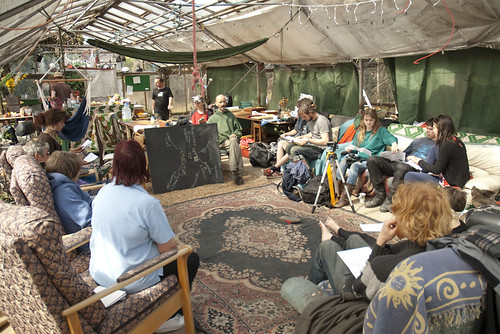
Citing British squatter laws, the community has successfully cleaned up an abandoned nursery, and turned its broken greenhouses back into functional (and beautiful) spaces for living, growing produce, and organizing activists against the airport expansion.

The proposed third runway at Heathrow has become a national issue in British politics. Ousted Labour leader Gordon Brown had been a supporter of expansion, but environmental activists - many of whom live at Grow Heathrow - have successfully delayed the proposal to the point where even airport executives acknowledge its unlikelihood.

One reason Brown and other political leaders had been pressing for a third runway is because the expansion had been seen as a necessity to preserving London's status as a global financial center.


In this light, Grow Heathrow and other opponents of airport expansion are not just fighting against airplane pollution. They're making a vital contribution to the Occupy movement, by inconveniencing Britain's bankers and hedge fund managers in their pursuit of global commercial domination.

All photos courtesy of Transition Heathrow's Flickr.
Tuesday, January 03, 2012

Best Reads of 2011

I read some really excellent things in 2011. So as I did around this time last year, I thought I'd share some of them with the people who enjoy reading this blog. In my opinion, all of these books are worth owning and sharing (if you click the links to buy them from Powell's website, you'll help finance my own book habit with a small commission), but they should also be available from your local library.

And don't forget to support your hometown libraries as they sprint to the finish line with their annual fundraising drives. For my local readers, here's a link to donate to the Portland Public Library.


The Information: A History, A Theory, A Flood by James Gleick

2400 years ago in Greece, Plato made this commentary on the newly-invented technology of the written word (we know, because somebody wrote it down, and I know, because James Gleick included it in an early chapter of this book):

"The fact is that this invention [writing] will produce forgetfulness in the souls of those who have learned it. They will not need to exercise their memories, being able to rely on what is written, calling things to mind no longer from within themselves by their own unaided powers, but under the stimulus of external marks that are alien to themselves."

At a time when people are wringing their hands over whether the Internet might be making us stupid, it's nice to have this ancient reminder from Plato that humans have always fretted about these things. From writing, to the printing press, to wikipedia, new information technologies have changed the way humanity thinks as much as they've changed how we communicate.

Reading this book literally made me feel high: every chapter gave the distinct impression that my mind was being expanded with new insights into how humanity's information technologies have made mutable our fundamental concepts of what humanity itself is all about. Each chapter I read required several days for me to absorb and marvel at its ideas - it was a book to savor, and I found it highly accessible (although readers without much mathematics background might disagree about the book's more technical later chapters).

Reading this book also made me a more creative, curious person, and helped kick off an effort to teach myself computer programming this year.


Various short novels by Philip K. Dick, including Flow My Tears, the Policeman Said, and A Maze of Death.

I started reading more Philip K. Dick after finishing The Information, since a number of themes from his novels reflect some of the more metaphysical ideas from information theory (particularly the idea that different perceptions in a human mind can have tangible effects on reality itself).

Dick's novels have a weird mood to them. They tend to have clunky dialogue and retro-futurism that betray their pulp-novel roots. But his stories are also full of ambiguity and uncertainty, with unreliable narrators, delusions, and shifts between realities and simulations. All this makes his work disorienting and a bit challenging to read through - I often feel a bit hungover after reading his work - but if you can bear that, these novels manage to blend swashbuckling sci-fi with deeper metaphysical questions of reality and sanity.


About A Mountain, by John D'Agata

An amazing long-form essay about Las Vegas, suicide, and the Yucca Mountain nuclear waste repository. I wrote a blog post about this book last January, but wanted to mention it again here as one of my favorite reads of the past year.


Infinite Jest, by David Foster Wallace

I spent the last four months of the year reading two big novels - this one and 1Q84 (below). It was great, and I admit I feel a bit lost, reading-wise, now that I'm done with them.

I'd long thought about reading Infinite Jest but had been intimidated by its length and a perception that it would be too intellectually complex and experimental, like Ulysses or Gravity's Rainbow.

But it's actually very engaging and fairly easy to read, and very, very funny. There are aspects of the plot that I probably lost amidst the dozens of characters and storylines, but I didn't worry too much about it and it didn't affect my enjoyment of the book.

(If you need encouragement and guidance, I was also helped along by the Infinite Summer reading guide, and particularly by the "How to Read Infinite Jest" post.)

In fact, I found this book so engaging that I began to wonder if it might be a bit unhealthy, just as drugs, alcohol, tennis, film, and other entertainments become unhealthy obsessions for the novel's various characters. Wallace draws a number of stories and plots from his own participation in and experiences from AA meetings, and I feel that reading this book made me more aware of and compassionate for the forgotten members of our society who struggle with addiction.

My wife Jess got a little jealous of Infinite Jest at times, but I hope she'll read it soon so I can enjoy it vicariously one more time.


1Q84, by Haruki Murakami

Murakami is one of my favorite authors. His new book doesn't rise to the level of Kafka on the Shore and the Wind-Up Bird Chronicle, in my opinion, but it is still an amazing and extremely imaginative piece of literature.

Like Philip K. Dick, Murakami writes about strange parallel worlds where strange things happen without any explanation. Unlike Dick, though, Murakami has a style that makes these fantastic events feel a lot more natural and real. It's like the logic of a dream: it may be bizarre, but it's easy for you to take it for granted while you're inside of it.

Unfortunately, having read this novel, I find myself with no new Murakami fiction to read - at least until his next novel gets published and translated. That makes me a bit sad, like there's no new territory in his fictional worlds for me to discover, and it's made it harder for me to get into a new novel for the new year.

If you have any recommendations for me, I'd love to hear them in the comments.

Monday, December 12, 2011

Thursday, November 03, 2011

The Bayside Sentinel


The north half of the downtown block bounded by Forest Ave., Cumberland, and Casco is a "telco hotel" owned by Fairpoint - a complex of large buildings filled with telecommunications equipment and servers. I don't think that the microwave tower on top has an official name, but it's a local landmark and deserves to be called something. The Bayside Brainmelter? The Dishrack? Please leave suggestions in the comments.

Inspired by Burrito Justice's animated GIF of the Sutro Tower.

Friday, October 28, 2011

The Ranked Choice Voting Game

This November, voters in Portland, Maine will elect their new mayor using a ranked-choice ballot. Voters will be able to rank as many as 15 candidates in their order of preference.

The ranked choice system will provide a lot of advantages over traditional elections, where you can only choose one candidate. No longer will we have to worry about the "spoiler effect" of third-party candidates: now, we can vote for Ralph Nader AND Al Gore.

Nevertheless, with fifteen candidates (and up to fifteen possible rankings to choose), the novelty of the ranked choice system is causing some confusion for local voters. It's difficult to explain the dynamics of a ranked-choice election in prose, and some attempts have been downright misleading.

So (and I'm puffing my chest out as I write this, because this represents my first substantial foray into practical programming) I've written a Ranked Choice Election simulation game to let people experience firsthand how a ranked choice election will work.


Fill out up to 50 different ballots as though they were coming from different voters. The program will then run through the Instant Runoff counting process, sequentially eliminating last-place contenders and explaining the process of reallocating the ballots along the way, until one winner crosses the crucial 50% threshold.

It may not look like much, but I spent many, many hours working on this over the summer and fall, so please consider leaving a tip if you find it useful (or, click often on our fossil fuel propagandist advertisers). I've tried my best to debug it across various browsers but it'll work best on Chrome, Safari, or Firefox, and don't bother if you're on a phone.

Thursday, October 06, 2011

Fundraising Drive!

After publishing the last post, which attempted to line my pockets at the expense of the dirty coal industries and their duplicitous PR efforts, my ad revenues spiked by $15 in a day - a nice little sum from my good friends at America's filthy fuel industries.

This seems like a promising way for folks to support this blog in a small way. Thanks, readers!

However, a number of you reported seeing only ads for solar panels, or hydraulic pipes. You're welcome to click those ads if you're interested in them, but I'm really trying to vindictively leverage the desperate advertising efforts of the coal and oil industries against them. Making money on advertising is one thing, but making money at the expense of the Corporate Enemies of Life on Earth is much better.

So I'm trying another tack. Google will also give me commissions if you click on ads from searches that originate here on this blog. Searches give you much more control over what kinds of ads you might see, which in turn gives you better choices among propaganda efforts you can drain financially, $2 or $3 at a time, through the simple click of a mouse.

So, for instance, if you were to search in the box below for "clean coal america's power", and click on the ad for the Pro-Asthma-and-Lung-Cancer advocacy group americaspower.org, then the coal industry would generously sacrifice a couple bucks to me for giving them the opportunity to make their case to you. I'm pretty confident that they won't fool you, so give it a try:


Or say you'd like to get back at Chevron for the $20 you sent to Chevron the last time you filled up your gas tank. Just try searching for "oil safe energy technology", click the ad that pops up on the top of the results, and repeat 8-9 times:
Or learn all about how fracking for natural gas is definitely not poisoning water supplies or raising greenhouse gas emissions by searching here for "safe natural gas fracking safe" (wink, wink):
If enough of you click on Coal and Oil propaganda ads to extract $100 from their PR budgets into my pockets, then I will personally buy a round of beers at Awful Annie's for any of you who care to join me in Portland. It'd be nice to meet more readers in person, and nicer still to drink at the coal and oil companies' expense.

Thanks again to our advertisers!

Tuesday, October 04, 2011

Coal: (undermining) America's Power

Here's a funny thing. If I write a blog post about coal, the medieval energy technology that gives us cancer and bakes our atmosphere to the point of incurring massive extinctions, etcetera, you will probably see, at the very end of the post, some kind of ad that promotes "Fossil Fuels Part of a Cleaner Energy Future" or some such B.S. that anyone who reads this isn't going to fall for.

However. If you were to click on those ads, and submit your eyes to Clean Coal America's Power facts about keeping energy cheap and old-fashioned, the funny thing is that you'd then be forcing the Fossil Fuels and Clean Coal public relations machines to spend some of their money on me, who hosts this advertising space, and on Google, which places those ads and also invests the revenue into efforts to make fossil fuel industries obsolete through clean tech venture capital investments.

I think that this is kind of a delicious irony. So please support our advertisers, below and at right, and learn all about how CLEAN and AMERICAN it is for us to take a deep hit of coal and mainline its juices into our nation's sclerotic arteries of commerce.

Monday, October 03, 2011

The Economist Rends A Hole In the Very Fabric of the Space-Time-Economic Continuum

There's an old joke about the economist who walks over the $20 bill on the sidewalk without picking it up because, if the $20 were really there, someone else would have already picked it up, so therefore, the $20 bill does not really exist, Q.E.D.

Here's a more detailed explanation of the joke if you don't get it, but don't worry too much about it, as it is not funny. Instead of calling it a joke it might be better to call it a basic illustration of the Efficient Market Hypothesis, one of the cornerstones of classical economics.

Just like classical economics itself, the Efficient Market Hypothesis is really more of a gross oversimplification that makes messy economics easier for the dimwitted than something you'd actually want to apply to real life, lest you end up denying the existence of free money lying on the ground. Nevertheless, some poor saps do take it seriously.

One of the places I've seen the Efficient Market Hypothesis occasionally spouted as a real-world Theory is in the Economist, where you'll still find, every now and then, a journalist whose undergraduate econ coursework resurfaces in ill-advised editorializing on behalf of Classical economic silliness.

So, here's a question for the remaining acolytes of Milton Friedman who remain at large in the newsroom of my favorite weekly newspaper:

SIR - Please explain how these two separate subscription offers came to be delivered to the exact same address (mine) on the exact same day from your enterprise, which, like all enterprises, must be classically efficient?


Because, SIR, to me it looks as though The Economist has simultaneously entreated me to buy the same product for $51 or $69 - my choice. Which is kind like finding an unexpected $18 in my mailbox.

And yet, according to the Efficient Market Hypothesis, that $18 couldn't possibly exist there because if it did, The Economist would have picked it up and pocketed it before the ink was even dry on the mailing label, and saved itself the postage to boot. Or, conversely, if it actually wanted me to have the $18, it would have saved itself the trouble of sending me the second mailing, right?

It would appear that The Economist has inadvertently created a dangerous paradox - A PARADOX THAT MAY WELL THREATEN THE VERY FABRIC OF THE ECONOMIC SYSTEM. I hope they'll stop diddling around with the Euro crisis long enough to address this urgent matter.


Footnote: It's funny how the "BEST RATE" renewal offer kind of pales next to the less-impressive-sounding "RETURNING SUBSCRIBER DISCOUNT". Economist subscribers, take note: it pays to let your subscriptions lapse, and make them beg to take you back.