Monday, April 30, 2007

Carbon Indulgences


Yesterday's Week in Review section of the NY Times had a great article on "carbon offsets,"
which supposedly atone for the sins of greenhouse gas pollution by paying for projects that reduce pollution elsewhere. This industry is almost completely unregulated, but it's worth $100 million and is growing quickly.

There's some question about whether the projects that these "offsets" finance are actually effective. There's also a more philosophical dispute over whether these programs are enabling our fossil fuel addictions: can we really ride a jet guilt-free if we pay someone else to plant some trees in Guatemala? The article quotes the president of an environmental foundation who compares some carbon-offset programs to " the Catholic Church’s sale of indulgences back before the Reformation... Instead of reducing their carbon footprints, people take private jets and stretch limos, and then think they can buy an indulgence to forgive their sins."

According to economic theory, putting a price on carbon should reduce carbon pollution. For example, if I look at a plane ticket and the price of carbon is too expensive, I'll opt for a train ride instead.

But offsets don't really work that way. For one thing, in the absence of global regulation, no one really knows what the price of carbon should be – and if you’re relying on voluntary schemes, the price is almost certainly way too low.

For another, the reasons that people purchase offsets seem to be more psychological (and perhaps psychotic) than economic. Instead of confronting consumers with an up-front price that reflects the environmental costs of their purchase, the offset salesmen usually jump in after the consumer has already made the purchase in order to capitalize on feelings of guilt.

Even an SUV owner or wanton jetsetter with an indulgence can't avoid guilt altogether: don't they realize that they could do twice as much to avert the climate crisis by buying their offsets and leaving the gas-guzzlers idle?

Friday, April 27, 2007

India is the new Exchange

That's India, the street, not the subcontinent. While the Maine State Pier catches most of the attention, this entire neighborhood is in the midst of a huge transformation that will extend the pedestrian environment and high rents of the Old Port two or three blocks eastward, over the barrier of the Franklin Arterial and up to the base of Munjoy Hill.

Just breaking ground on the corner of Fore and India Streets (look for the rubble of the old Breakaway Tavern) is the Riverwalk development, which has been in the works for a couple of years now. The City sold most of the land for this project to the developers on an agreement that they would build a massive parking garage that will extend along the entire block of Fore Street between India and Hancock.

The development will also incorporate and renovate the Grand Trunk Railway office building on the corner of Commercial and India Streets. The vaguely nauseating pastels in the architectural rendering (left) depict the project from Commercial Street looking west. I'm a little bit creeped out by the trees that have been genetically engineered for semi-transparency, but otherwise, I'm encouraged that the architects and developers seem to be working hard to create a vibrant streetscape on the waterfront, even if there's a huge white-elephant parking garage going up in back.

Just across India Street, a proposed Westin Hotel and luxury condo development that would have replaced the Jordan Meats hot dog factory has lapsed into a dead proposal. Among the factors leading to the project's downfall are rising interest rates and a cooling residential market, some sleazy dealings by one of the developers, and the prospect of a publicly-subsidized hotel a few blocks away on the Maine State Pier.

In spite of these problems, all of the activity going on in the neighborhood makes it very likely that this site will be a big redevelopment site in the next few years. In the meantime, the abandoned hot dog factory remains to entice trespassers, and yet another exciting automobile storage enterprise is bustling in the building's old parking lot.

Finally, just up the hill on Newbury Street, the owners of the Village Cafe are thinking about tearing down their building and surrendering their Wal-Mart-sized parking lot to make way for a complex of 4-6 story condo buildings. Here are two grainy photos of the development proposal I snapped at City Hall a few weeks ago:

The buildings would include ground-floor retail space and a new home for the Village Cafe along Middle Street (at lower left in this picture):


I've witnessed some grumbling about the new luxury condos "gentrifying" this neighborhood, but for the most part, all these buildings are replacing are a bunch of dirt parking lots. It's true that some neighbors will probably see their rents increase as the area becomes a nicer place to live. At the same time, though, a significant increase in housing supply here will help keep home prices affordable across the region, and many of the households moving into a new condos on the Eastern Waterfront will put less-expensive homes for sale elsewhere. And I'm sure that the hundreds of new residents of these tony buildings will be cash cows for Portland's precious local businesses: for instance, all those lap dogs moving in should induce a Pavlovian response from our city's platoon of pet boutiques.

Additionally, even as rents grow more expensive in the neighborhood, an enhanced pedestrian environment and new retail space downtown could reduce transportation costs for all Portlanders as we find ourselves less reliant on our automobiles. This, of course, is another irony of the huge parking garage going up in the middle of the district, but nevertheless, I'm looking forward to this brand-new Old Port.

Monday, April 23, 2007

Can mixed uses preserve the working waterfront?

The idea of putting office buildings and hotels on the Maine State Pier has a lot of problems, but there's also one big merit: new development could raise a lot of money to fix and preserve the pier's deep-water berth, an important piece of waterfront infrastructure.

In the 1980s, a few developers solved the problem of pier maintenance by building condos (on Chandler's Wharf, for example), but the condos effectively evicted marine industries and led the City to enact protective zoning for the working waterfront. New residences are now forbidden on the harbor and non-marine commercial uses are restricted. This solution does a reasonable job of preserving the working waterfront, but Portland's wharves are in bad shape, and some waterfront buildings are tragically underutilized (I'm thinking of a historic 5-story brick warehouse near the Portland Fish Pier in particular: a beautiful building in a great, central location, but its windows are bricked in and the structure is being used for storage).

In effect, the problem is this: we'd like to preserve the working waterfront as a place that's affordable and practical for fishermen and marine industrial businesses to do business, but those businesses are having a hard time paying for the maintenance of Portland's piers and wharves.

Here's a possible solution: allow mixed-use developments on Portland's waterfront, with any kind of space (residential, office, retail, or hotel) allowed above the first floor, on the condition that the ground levels of new buildings are reserved only for marine industrial uses.

By allowing other types of activity on (or rather, above) the piers and wharves of Portland harbor, we can attract more private investment to pay for waterfront infrastructure. At the same time, stipulating that the ground floor of waterfront buildings must be reserved for fishermen and industry will preserve their access to the working waterfront.

Mixed-use development is gaining in popularity, but the idea of industrial mixed-use is still fairly new. One early example could be built in West Oakland, California, where a developer is proposing residential high-rises above manufacturing warehouses (see rendering at left). The proposal would preserve some of the Bay Area's scarce industrial land while providing new housing for a tight residential market.

Ground-floor industrial uses are also allowed under new zoning schemes in Brooklyn's Greenpoint neighborhood and Vancouver, Canada: both are cities where overheated housing prices are crowding out traditional blue-collar industries.

I think it's an intriguing idea for Portland, but I'm curious to know what others think. Could mixed uses preserve the working waterfront and its infrastructure while making better use of haborfront property? Or would it be another nail in the coffin of our fishing and marine industries? I hope that some of you readers will comment and share your thoughts.

Wednesday, April 18, 2007

Whale watch in the Gowanus Canal

Brooklyn's Gowanus Canal isn't exactly teeming with wildlife the way it was in 1630, when the Dutch government first began to take an interest in Brooklyn real estate. A network of creeks in the area once drained a network of wild salt marshes and meadows; nearly four centuries of European settlement have paved the banks and straightened out the watercourse into one channel surrounded by auto shops, oil tanks, scrap yards and all-you-can-eat PCBs.

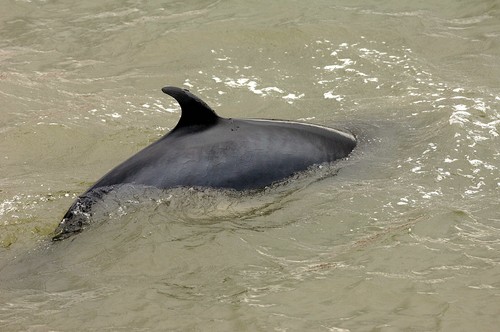
But if you think that the Gowanus Canal is the antithesis of nature, there's at least one baleen whale that would disagree:


This critter swam into the Gowanus Canal yesterday and immediately became a New York City celebrity (the local tabloids dubbed it "Sludgy the Whale"). What makes the story even more incredible is the fact that the heavy rains associated with the Patriot's Day storm had overloaded Brooklyn's sewers and sent thousands of gallons of raw sewage into the canal (see The New Watersheds, my post on New York's sewer system that I wrote while working as an Urban Park Ranger last summer).

Sludgy didn't swim into the Gowanus to make a point, but that won't stop me from making on on her behalf: for all the concern that exists in our cities for our natural environment, and for all of the laments over the loss of "wild nature", we too often disregard the wild places that still exist right under our noses. Who knows how many whales might visit Gowanus if those famously progressive environmentalists who live in Park Slope cared more about the watershed in their own brownstone back yards?

The Gowanus Canal might not have made a great impression on this particular whale, but perhaps the water will be in better shape for the next cetacean who wanders in.

Tuesday, April 17, 2007

Fixing Franklin Arterial

I finally made it to the "Lost Sites" exhibit at Aucocisco gallery this weekend. The exhibit seems to have generated a good deal of thoughtful discussion about some of the underutilized places we have in Portland's central city, including an abandoned brick shell of a building on India Street and a locked-up alley that connects Congress Square to a parking lot behind the Schwartz Building.

But most of the submissions dealt with a prominent "lost site" that cuts between the East End and downtown: the Franklin Arterial median strip, a depressed (in more ways than one) strip of grass and trees between four lanes of downtown expressway. Of all the abandoned, marginalized places in downtown Portland, this median strip feels the most out of place and the most forlorn, but also filled with the most possibility.

Franklin Arterial is a product of what they called "urban renewal" in the 1960s. One proposal at Aucocisco includes a panel of what Franklin Street used to look like: a narrow way densely lined with historic buildings (Franklin Street is highlighted in red):


Downtown "revitalization" plans in 1967 and 1968 emphasized bringing more cars into Portland so that the Old Port and Congress Street could compete with suburban strip malls. At the same time, the idea of "slum clearance" was near its peak of popularity: cities nationwide were following the lead of Robert Moses in New York to bulldoze poor neighborhoods and replace their homes with freeways and ghetto high-rises. In hindsight, these concepts weren't so much "urban renewal" as they were "urban eugenics." Nevertheless, these ideas converged along Franklin Street when city planners decided to clear out tenement houses and replace them with a new expressway that connected Portland's waterfront to the planned interstate freeway along Back Cove, now I-295 [Here's a more detailed history of the planning process behind Franklin Arterial].

So, Portland has coped for nearly four decades now with Franklin Arterial, a road designed as an expressway through the center of the city, with no sidewalks, fast traffic, few legal pedestrian crossings and no street life to speak of. It is a moat that divides downtown and the East End, a case study of the failures of urban renewal, a no-man's land surrounded by acres of parking lots and inaccessible "open space."

But here's the good news: there are serious efforts afoot to make Franklin Arterial better. Narrowing the street, adding bike paths and on-street parking, and slowing down the traffic could open up acres of developable land worth tens of millions of dollars (more than enough money to rebuild the street). All three "lost sites" proposals for Franklin Arterial proposed these ideas to some degree, and a joint Munjoy Hill/Bayside Neighborhood Association meeting later this spring (May 31, 6 PM at Franklin Towers) will discuss options for the future of the street.

In the meantime, here are the ideas from the Lost Sites exhibit:


The "Gateway Park" idea makes the open space in Franklin's median strip accessible and more inviting by offering pedestrian access through two underpasses beneath the traffic that would reconnect Oxford Street (one of the streets that had been disconnected by the Arterial's original construction). This would replace the dirt path and the two illegal road crossings that many Munjoy Hill residents currently use to get downtown.


The other two ideas proposed complete realignments of Franklin into a European-style boulevard. These proposals would restore the neighborhood street grids, open up acres of land for redevelopment, and turn Franklin into a more pedestrian-oriented, livable space. As an added bonus, a boulevard realignment would restore the historic Lincoln Park to its original size and proportions (construction of the Arterial sliced of 1/3rd of the park and made it a lot more difficult for East End residents to get to or enjoy the space).


As it stands now, Franklin Arterial blocks new development and diminishes property values in surrounding neighborhoods. Realigning and improving the street might cost tens of millions of dollars, but the new development that would follow would provide new property tax revenue and return the city's investment several times over. Portland's leaders and planners need to get to work and restore this "lost site" into a working asset.

Monday, April 16, 2007

The New Coastline Arrives


Just two days after we marched down Commercial Street to demonstrate what a modest rise in sea-level would do to the coast of Portland, a powerful Nawth-Eastah combined with astronomical high tides to actually flood parts of Portland's waterfront (pictured: Portland Pier, courtesy of the Press Herald).

The storm surge added two feet to an already high tide, inundating several of Portland's wharves as well as parts of Bayside and Baxter Boulevard. As coastal geologist Peter Slovinsky noted on Saturday, Maine's sea levels are already on the rise, and continued greenhouse gas pollution will only increase the incidence and severity of these floods.

Saturday, April 14, 2007

The New Coast Parade

Thanks to everyone who turned out this morning in the Old Port to march along Portland's New Coastline to demand comprehensive cuts in greenhouse gas pollution. Thanks especially to Sara, Harry, and Valerie, who pulled most of the weight to organize this event.

I counted about 200 people who passed me while I was parade marshalling at Middle and Market Streets. We also had a number of our state congressional delegation there, and today's event should make a strong case for making the Regional Greenhouse Gas Initiative (currently under consideration in the Legislature) a high priority for them.

I was a little bit giddy from having so many people show up (I'd been needlessly fretting that no one would come), but I got the impression that a lot of other people had a good time, too. Even the people who were waiting in traffic for our parade to pass by were smiling.

You can see photos from the other 1500 events around the nation at www.stepitup2007.org.

UPDATE: I nearly forgot: the old media were at this event in full force, and it looks like some of tonight's 6 o'clock news shows will boil down the crucial arguments for greenhouse gas legislation into a 2-second sound bite from yours truly. Here's the report from the WCSH 6 TV station:
Activists are urging the federal government to cut carbon dioxide emissions 80% by the year 2050.

"It's not too late, [it's] totally achievable," said activist Christian McNeil.
Note how the word "totally" constitutes 1/6 of my sound bite. Way to be articulate, dude.

Wednesday, April 11, 2007

New on the blogroll

In the past week I've found some worthy additions to the blogroll here. And in spite of the Pine Tree State's analog tendencies, these are all local new media:


  • A lot of political blogs seem like tabloids that are obsessed with DC instead of LA. Borrowed Suits is an exception: it brings some thoughtfulness to local and national political issues in long posts with progressive perspectives, and it doesn't mind digressing into other interesting topics (which is good, because there are a whole lot of topics more interesting than Maine politics).

  • Portland Newly Seen will someday be a blog about Portland's urban landscapes. We're just waiting for the author, a newly-minted urban planner, to get her act together and start writing some posts.

  • Finally, there's the new GrowSmart Maine blog. I made this one myself and am still writing most of the posts, so consider my self-promotion fully disclosed. The blog is just getting started, but look here for news on economic development and smart growth throughout Maine.