Wednesday, September 28, 2011

Creative Destruction


"The conditions of bourgeois society are too narrow to comprise the wealth created by them. And how does the bourgeoisie get over these crises? On the one hand by enforced destruction of a mass of productive forces; on the other, by the conquest of new markets, and by the more thorough exploitation of the old ones. That is to say, by paving the way for more extensive and more destructive crises..."


"New York, you're perfect
Don't please don't change a thing

Your mild billionaire mayor's
Now convinced he's a king

So the boring collect
I mean all disrespect

In the neighborhood bars
I'd once dreamt I would drink."

- LCD Soundsystem, "New York, I Love You But You're Bringing Me Down"


We live in a nation that no longer makes things, and maybe that's why we're so foggy-headed when it comes to discussions of wealth, class, or even of basic entrepreneurial instinct. How can we hope to understand wealth when "luxury" is pitched to us as a shoddily-built McMansion, and twenty years' worth of retirement savings can disappear in a stock market crash? What does it mean to speak of labor when work is a mind-numbing interval in a cubicle?

Maybe this economic existentialism is also why it's so popular to talk about the "creative economy" these days. Creative industries hold the last vestiges of America's tangible economic output - our last chance to make anything for ourselves.

Like many other cities, my hometown of Portland, Maine is gung-ho about its "creative economy," even though they haven't even finished building the "Biotechnology Park" left over from the last economic development fad.

On the surface, this seems like a positive thing - who wouldn't want more creativity? After chasing smokestacks for decades, City Hall is bringing a long-overdue focus on the small businesses and vibrant neighborhoods that really make our cities welcoming and attractive.

And yet (if the fad comment hasn't already tipped you off) it's beginning to feel like a lot of bullshit to me.

The germ of my ambivalence came from a real estate development proposal in my neighborhood. A billionaire hedge fund manager (and the husband of our congresswoman) owns a pied-à-terre apartment a few blocks away from us, and wants to transform several of the area's working-class tenement buildings that are in his portfolio into a newly renovated cluster of live-work spaces for quote-necessitated-because-I-don't-really-trust-a-billionaire-hedge-fund-manager's-use-of-the-word-unquote "artists".

So. I have some issues with said hedge fund manager's imposition of his aesthetic values on the landscape of our neighborhood, and on the creative output of local artists vis-a-vis the terms of their rental agreements. That's one thing and it might be entirely unjustified.

But I feel more nervous - and more certainly justified in this unease - about how the hedge funded artist colony is going to affect the larger creative environment of the city at large.

His proposed development is located on one of the last working-class neighborhoods of the city. It was part of Portland's Little Italy, and it's one of the few immigrant neighborhoods that wasn't demolished during the urban renewal purges of the 1960s and 1970s.
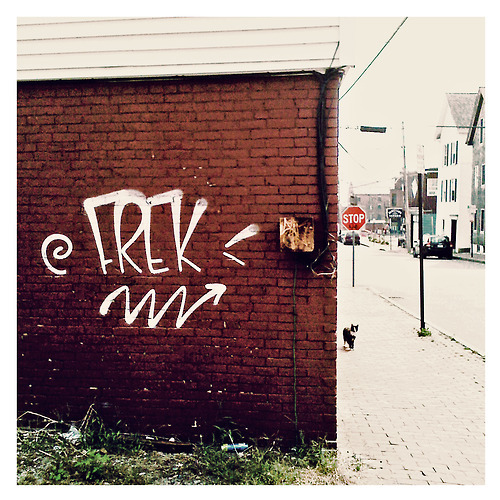


At one end of the street is the city's friendliest dive bar; at the other end is a day labor agency. It happens to be a pretty great place for artists to live and work right now, as it is. But it's also a great place where teachers, hotel workers, office cleaners, and dozens of other working-class families can still afford to live, within walking distance of downtown's jobs and services. Why would we want to kick those people out?

Simultaneously (and potentially relatedly), a number of the city's economic development professionals and business leaders have recruited ArtSpace, a nonprofit developer of affordable buildings for artists, to investigate the possibility of their developing a project in Portland (possibly on Hampshire Street, and possibly elsewhere).

It may seem counter-intuitive, but even if we did create a walled garden for artists here - and it matters little whether it's built by a hedge fund manager or a nonprofit institution - the experiences of numerous other cities and neighborhoods before us forebodes that the wealth it brings in pursuit of "creative" entertainments will jeopardize the neighborhood's affordability and diversity, and thus undermine the fertile conditions that generate the very creativity we value.

Look at New York City: wealth drove out artists first from SoHo into the Lower East Side, then into Williamsburg, and now deep into Bed-Stuy. If the southeastward exile continues, in thirty more years all the artists will be drowned in the waters of Jamaica Bay.

Forty years ago, Donald Judd tried to escape it by moving from Manhattan to live among ranchers in a miniscule town in west Texas. Today, even that miniscule town is itself losing its identity with the influx of more and more wealth.


The Marfa Prada, a half-joking commentary on "Judd-effect gentrification", on the plains outside of Marfa, Texas. Photo via eartharchitecture.org.

And I saw it happen firsthand in Portland, Oregon, at the turn of this century:
In 1999, I set off to go to college in Portland, Oregon — then known only as a rainy mid-sized city with scenic parks. In the five years I spent out there, I saw the city morph into a self-satisfied model of progressive hedonism. But, as I found after graduation in 2003, and as thousands of other young people have found since then, it’s awfully hard to land a decent job there, and it’s getting harder all the time to find an affordable place to live. (source)
A creative economy requires creative people, and creative people seek out the frisson of affordable, diverse city neighborhoods, where it's easy to discover and interact with new ideas and with people who possess a diversity of cultural and economic backgrounds.

Creative people also require capital: they need affordable places where they can live and create things. But creativity, after all, is fun to be around: it attracts wealth, which ends up competing for the same resources that the creative people need. Thus, to paraphrase Marx, the accumulation of creative capital sows the seeds of its own destruction.

Sure, you can create protected islands of creativity amidst the sterile ruins of luxury condos and fusion restaurants. That's what the hedge fund manager and Artspace want to do, and I suppose that in some circumstances that might be the best option. But how creative can such a place really be, in its isolation? And aren't we declaring defeat prematurely by pursuing that option so soon, while our neighborhoods are still fairly egalitarian and diverse and functional just the way they are?

More importantly, is the exile of creative people from the neighborhoods they make great inevitable? Is the "creative economy" just the post-industrial manifestation of Marx's inevitable creative destruction?

Admittedly, the track record from places like New York isn't great. But I think there are two reasons to be optimistic.

I often think of Houston, where I lived for a year, as one of the most creative places I've lived (it certainly had Portland, Oregon beat). Sure, miles and miles of the city were dead zones of strip malls and cul de sacs. But for every time someone bulldozed a historic edifice to build a Wal Mart, someone else was doing something amazing in a vacant rice factory or shotgun house they bought for dirt cheap. That city thrived on constant change. From the outside, the city might look monstrous, constantly consuming itself and spreading out larger and larger. But on the ground, there was always something new.

If we lose Hampshire Street to a bunch of navel-gazing painters who are condemned to mediocrity because they never meet anyone or anything that challenges their assumptions, then I'll be sad, not least because that's my very own neighborhood that will become a more boring place.

But we live in a city, and cities are meant to change. Creative destruction, after all, is still creative. If one neighborhood becomes boring, another will become interesting. House shows will spring up in unexpected places; empty warehouses or abandoned big-box stores will become artists' squats. If we, as a city, embrace change (and Portland, to own the truth, has some issues with this, a few hang-ups with its nostalgia for the status-quo), then creativity has a way of surviving.

Still, I'd still rather let it thrive. And that brings me to a second reason to have some hope, because here we have a billionaire who wants to do right by downtrodden artists, and it seems churlish to complain about his methods when the impulse carries so much possibility.

If I ever had the chance to meet my billionaire neighbor, this is what I would tell him.

Portland's neighborhoods aren't ruined yet - they're still by and large egalitarian, and affordable, and authentically creative. Even better, a lot of the wealth that might threaten those neighborhoods' creativity is possessed by people who actively want to support a creative environment.

You and the other creative economy boosters want to do the right thing by carving out a refuge for artists - but you haven't yet considered the consequences of how that kind of project could exile dozens of other people who may not make art per se but are nevertheless vital to maintaining the conditions of a creative city.

May I suggest instead diverting your considerable resources toward finding ideas and investments that make the city more equitable and affordable to all people, not just for "artists"? If we can accomplish that, then the entire city stands a better chance of fostering the ideal conditions that generate more and more creative places.

Instead of relying on an institution to build us one Artspace, we could build hundred of Artspaces for ourselves, on our own terms, to our own standards. Sounds good - am I right?


Postscript: I've started writing a biweekly column in a small local paper, the Portland Daily Sun, and I wrote on this subject last week. But 800 words wasn't enough to fit in all the nuances of my mixed feelings about the "creative economy" business, hence this elaboration.

Wednesday, September 14, 2011

Publishing

I've been slacking on blog updates in order to work on various other projects and today I'm happy to report that one of them is ready to publicize.

After six years of blogging for free, I've graduated into the realm of paid analog publishing, with the printing and preliminary distribution of the first-ever Portland Maine Bike Map (!).

My first venture into for-profit cartography covers bike routes, lanes, and paths from Falmouth to Scarborough, Casco Bay to Westbrook - almost everything you can comfortably reach in an easy hour's ride from downtown Portland.

It's retailing for $6, currently at all of our locally-owned bike shops in Portland (I'm still negotiating the purchasing departments of the chain stores), plus Longfellow Books in Monument Square, Art Mart on Congress Street, Pinecone and Chickadee on Free Street, any of the three Portland Coffee By Design shops, Green Hand Books, and Bathra's Market in Willard Square.

Thanks to Sean Wilkinson of Might & Main for making it look so sharp (he designed the cover and advised on typography and colors).

If you own or work at a greater Portland business that might be interested in selling a few of these, please get in touch with me. If you'd like to bulk-purchase more than 10 at our wholesale rate for your workplace's commuting and parking management programs, your should also get in touch with me.

Did I mention that 10% of our proceeds, after covering our costs, will benefit the Bicycle Coalition of Maine and Portland Trails? Well yes, I just mentioned that.

But first I have to cover my costs and I am deeply in the hole for the time being. Not that I'm a charity case but almost I am. Please buy my map.

Tuesday, September 13, 2011

A Supposedly Fun Thing Invades Portland

From midsummer until the end of fall foliage season in late October, cruise ships like the one pictured below dock at the Maine State Pier in downtown Portland, Maine. When they're in port, they loom over the small city's skyline and disgorge thousands of well-fed passengers onto our downtown city streets.

The cruise ships that arrive here are taller than most of the city's modest high-rises, and with 2500-3500 passengers, their arrival increases the city's population by about 5%. They have a certain looming effect on the city's landscape, and not just from their striking physical resemblance to the alien mother ships that blot out the sun above human cities in movies like Independence Day and District 9 (see below at right). They flood the city's streets with a certain breed of well-fed, middle-aged idler, toting cameras and stylized cartoon maps of the downtown district.

The effect isn't limited to the infusion of strangers - it also changes the behavior of the city's native residents.

When a ship's in town, improvised kiosks selling lighthouse paintings, secondhand junk, and items marketed as "redneck wallets" proliferate near the ferry terminal. "The Screamer" and other familiar victims of the state's social service cuts become mysteriously absent, while there's a marked increase in downtown police cruisers. Slow, rubber tired omnibuses roam the downtown area behind incongruous teams of draft horses, a bizarre, segregated, and for-profit public transportation system for tourists.

In short, the cruise ships, while they may look innocuous, also seem to beam advanced psychoactive waves into the city's brains to stimulate desperate entrepreneurial pandering. There's money to be made if we behave like a quaint second-world outpost replete with cheap handmade crafts and sweating, shitting modes of transport.

An acquaintance today remarked that the city's transformation reminded him of Heisenberg's Uncertainty Principle, the concept of quantum physics that tells us how the observation of certain properties of a particle limits our knowledge of other physical properties.* Or, to put it another way, that the simple act of observing something, and your choice of what to observe and how to observe it, can change various properties of that thing's essential nature.

This elegantly applies to tourism, especially the mass-market variety of tour buses and cruise ships. An entertaining thought experiment: how would Portland (both the physical landscape of the city and its citizenry) change if the hundreds of thousands of tourists who came here every summer instead arrived as undocumented migrant laborers? How would the city look if those thousands became occupiers of an imperialist army?

And which of those two landscapes - the city of cheap labor, or the occupied city - is more foreign from the city we know today?**

The idea that we occupy a different, parallel universe from the one that our tourists reside in - and that I, as a tourist anywhere, am unlikely to know the true essence of the places I visit - feels as lonely to me as an insomniac night on a cruise ship at sea, "when all the ship's structured fun and reassurances and gaiety-noise ceased."

But then again, shouldn't the possibility of changing the city you know with a shift in perception also offer us new frontiers to explore without leaving at all? And doesn't the uncertainty principle also apply in all sorts of other ways - not just in how we perceive places, but also people and things? We hear rumors of a scandal and a trusted person becomes repulsive to us; make eye contact two or three times across a crowded room, and a stranger becomes an object of fixation.

So even when you live in a small city that's frequently colonized by tourist hordes, there's no need for us to get discouraged when we perceive ourselves in a rut, in an absence of strangeness and possibility.

There's an infinity of alternative cities available to us, all similar to this one and different in significant ways, every time we seek a new way of seeing things.


*Credit for this insight goes to Dan, who's highly versed in the idea of how shifts in our perceptions can affect our lifestyle.

**Personally, I think that our wealthy tourists and our customer-service-oriented culture make us a lot closer to the empire/colony dynamic than we are to being a land of opportunity - then again, that's just the product of my own observations.

Monday, August 01, 2011

Back to the land... in outer space!

The peak of the American suburban impulse may well have been the year 1975, the year a group of earnest technocrats and back-to-the-land hippies converged to make the case for orbiting shopping plazas and ranch-style homes in deep space.

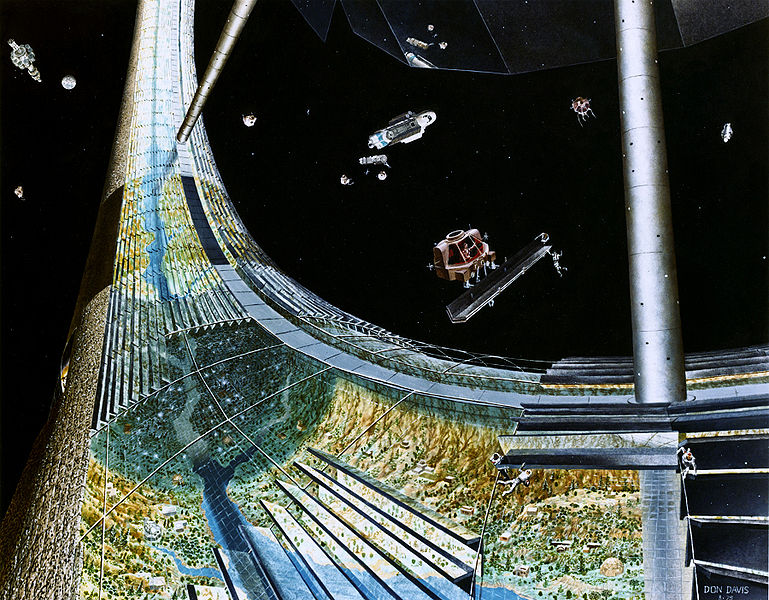
When I was a kid obsessed with astronomy, I spent hours staring at paintings by Don Davis, an American artist best known for his sci-fi illustrations. The works that I remember most vividly were his depictions of the space colonies advocated by Princeton physicist Gerard O'Neill in the mid-1970s, which were brought to my attention recently by a recent blog post on The Atlantic's technology blog.


These paintings were, and still are, utterly bewildering. To simulate gravity by centrifugal force, the theoretical colonies generally had a cyclindrical or toroidal design, which meant that landscapes didn't recede to a vanishing point on a horizon, but instead curved up and overhead. Meanwhile, mirrors and shades on the exterior controlled night and day cycles, and blended scenes of clouds with the starry dark of deep space. All in all, trying to figure out the logic of perspective in these paintings is like puzzling through a complicated Escher print.


But even weirder than all that were the pastoral scenes depicted, floating around in tubes through the vacuum of space. The picture above was intended to simulate the northern Californian coast, according to an autobiographical statement on Davis's website:
"It was painted this way under the direction of Gerard O'Neill himself, who related a recent impression of the vantage point from Sausalito being an excellent scale reference for a possible setting inside a later model cylindrical colony... I deliberately wanted to imply the challenge of trying to transplant a workable ecosystem to a giant terrarium in Space."
Many of these paintings came out of a NASA-sponsored summer camp for space theorists held at Ames research center in 1975. In that same year, Stewart Brand, the creator of the Whole Earth Catalog, gave O'Neill several pages to make the case for space colonies in his new publication, the CoEvolution Quarterly.


It's easy to ridicule these space suburbs now, with the benefit of hindsight. In 1975, though, the brand-new Space Shuttle was being designed and promoted as our cargo utility truck to the heavens, and the idea of space colonies resonated with at least a few back-to-the-land hippies (like Stewart Brand) who dreamed of a new frontier in which to escape the Earthbound troubles of energy shortages, nuclear war, and the decline of American cities.

Big-name environmentalists of the era mostly ridiculed the idea of space colonies - but they still took the idea seriously enough to send in responses to the idea for Brand's magazine, something that would be hard to imagine today.

Some, like Buckminster Fuller and Carl Sagan, doubled down on their faith in high technology and fully endorsed the concept. But most of Stewart Brand's readers and contemporaries were more skeptical. Steve Baer, a designer of off-grid houses, had this critique, which reads like a purloined passage from J. G. Ballard or Don Delillo:
"I don't see the landscape of Carmel by the Sea as Gerard O'Neill suggests... Instead, I see acres of air-conditioned Greyhound bus interior, glinting slightly greasy railings, old rivet heads needing paint - I don't hear the surf at Carmel and smell the ocean - I hear piped music and smell chewing gum. I anticipate a continuous vague low-key "airplane fear."
And Gary Snyder, the beat poet who practiced Zen Buddhism in the rural suburbs of the Sierra Nevada foothills, bemusedly shrugs off Brand's enthusiasm:
"Thanks for the invitation to comment on O'Neill's space colony. I'm sure you already suspect that I consider such projects frivolous, in the all-purpose light of Occam's Razor my big question about such notions is "why bother?" when there are so many things that can and should be done right here on earth. Like Confucius said, 'Don't ask me about life after death, I don't understand enough about life yet.' Anyway. I'm hopelessly backwards, I'm stuck in the Pleistocene. That is, seriously... I'm still mucking around in the paleo-ethno botany, which is a kind of zazen."


While I agree with the substance of what Snyder and Baer say, I find their commentary ironic in light of the back-to-the-land lifestyles they practiced and advocated. Baer, after all, made his living by designing off-the-grid homes for communes like Drop City - space stations for the deserts of the southwest, in other words. And while I admire much of what Snyder wrote, I also regret that his political and environmental activism suffered from his self-imposed suburban exile in the Californian foothills. When he writes "there are so many things to be done right here on Earth," I want to shake him out of his meditation long enough to point out the racial and social iniquities in his own backyard.

In the end, isn't an idyllic sylvan landscape millions of miles away from the nearest city the logical extreme of the back-to-the-land movement that Baer, Snyder, and a million other Whole Earth Catalog readers dreamed of? Lewis Mumford, the famous champion of closely-knit urban neighborhoods, is a more reliable critic of space suburbs, and sure enough, his critique was the sharpest and most succinct of the bunch:
"I regard Space Colonies as another pathological manifestation of the culture that has spent all of its resources on expanding the nuclear means for exterminating the human race. Such proposals are only technological disguises for infantile fantasies."
Simply replace "Space Colonies" with "shopping centers" or "subprime mortgages", and it can still apply today in our post-space age.

Thursday, July 21, 2011

Burning Oil to Stay Cool

As the summer's first heat wave sets in on the Northeast, and millions of A/C units start cranking in synchrony, the east coast's electric utilities are firing up every power plant they have at their disposal in order to meet demand.

That includes some of our dirtiest, oldest, most inefficient power plants, smoke-belching relics that are only used on days like these when there's absolutely no better alternative available to keep the lights on.

We're beating the heat by incinerating vast amounts of fuel in thousand-degree infernos. And to make matters worse, forecasters are also expecting unhealthy levels of ozone and particulate air pollution all along the eastern seaboard today.


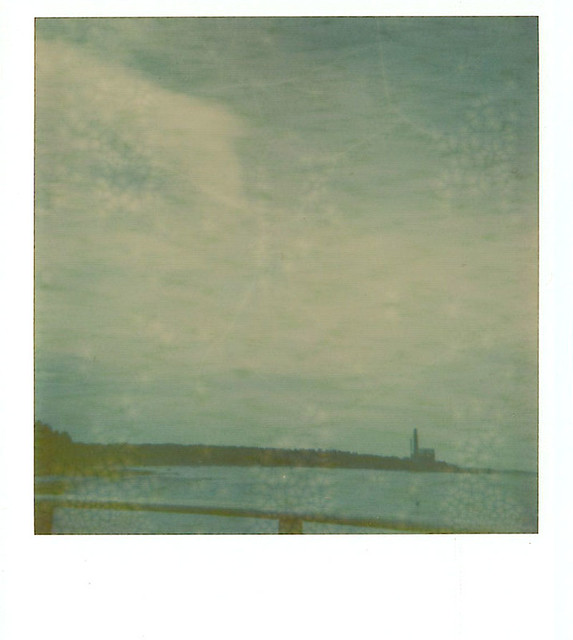
Wyman Station, a 1970s-era oil-burning power plant on Cousins Island in Casco Bay.
Photo by Bryan Bruchman.

The upshot of this is that any conservation efforts will make a bigger difference today than any other time of year. If a few of us shut down our workstations for the lunch hour and find some unplugged work to do during the hottest part of the day, then they'll burn fewer BTUs at the power plants and send less smoke into our hot, haze-saturated atmosphere.

Side bonus: your office will also be cooler with fewer machines generating heat indoors.

Alternatively, immersing yourself in 65 degree ocean water at the beach is another good way to not burn fossil fuels today. It's bad business for me to say so, but it just isn't a good day to read blogs.


Related: Hot Days Incinerate Oil, from July 7, 2010.

Friday, July 08, 2011

End of the Space Age

The Space Shuttle Atlantis rides off into the sunset (photo from 2006, courtesy of NASA).

Two weeks before I was born, in April, 1981, the first Space Shuttle mission went into orbit over Cape Canaveral.

Now, thirty years later, the Space Shuttle will soon make its final landing, never to rise again. Earthbound, at the beginning of my thirties, I'm left with a strange feelings of nostalgia for my old childhood expectations of the twenty-first century.

I feel like I've outlived the future.


Monday, June 20, 2011

Where not to go swimming in Casco Bay

Tonight, Portland's City Council will vote on a 25-year plan to reduce the amount of sewage that gets dumped into Casco Bay during wet weather.


The green warning signs like the one pictured above (located next to the city's cruise ship dock) mark the locations of Portland's combined sewer overflow outlets. During wet weather, when millions of gallons of rainwater flow into storm drains and overwhelm sewer pipes, these outlets keep sewerage from backing up into the streets, by dumping it into local waterways instead (read all the details here).

These combined sewer outlets can be found in surprising places: there are three in the heart of the Old Port, the city's tourism district, including one right next to the outdoor dining area of the Portland Lobster Company, another at the busy ferry terminal, and a third next to the city's cruise ship berth. Along with a few more further down the waterfront, these outlets collectively dump 145 million gallons of sewage into Portland Harbor in a typical year.

Seventeen more outlets ringing Baxter Boulevard, a popular city park, dump over 400 million gallons of mixed sewage into the shallow, stagnant waters of Back Cove. By way of comparison, last year's BP oil spill in the Gulf of Mexico dumped about 210 million gallons of oil into the Gulf.

Nearly twenty years into the city's efforts to separate storm drains from toilet flushings, the city has managed to shut down ten CSO outlets, including the one located nearest to the city's East End Beach, as well as most of the outlets that had dumped into Capisic Brook in the city's western suburbs. But dozens of overflow outlets still remain. The map below shows where they all are (the handful of star icons represent former outlets that have been closed):


As disgusting as this problem is, solving it won't be cheap, quick, or easy. The City is looking at a range of strategies, from building new green infastructure that can absorb rainwater into the ground before it flows into storm drains, to building huge underground storage tanks that can expand the system's capacity to hold sewage without spewing it out into the harbor.

Altogether, the recommended projects will cost the city $170 million - about $2,500 for every individual resident of the city - over the course of 25 years. That would roughly double our sewer bills, and not even then would we have a sewer system that avoids dumping sewage into Casco Bay altogether (the engineers estimate that we'd still dump 87 million gallons a year, an 88% reduction over current levels).

A fair and effective way to pay this bill would ask property owners who contribute the most to the city's sewer overflows to pay a greater share, by charging a fee in proportion to the amount of sewage and stormwater their properties send into the pipes. A one-inch rainstorm on an acre of pavement sends 26,000 gallons of oil-soaked stormwater (the equivalent of 15,000 toilet flushes) down the drains, so the owner of a large parking lot ought to pay substantially more to fix our sewers than an apartment dweller or a homeowner with a rain-absorbing garden.

This wouldn't just be a fairer way to pay for the city's sewer upgrades - it would also encourage property owners to make their own small efforts to help relieve the amount of stormwater flowing into our sewers, whether by tearing up some pavement to install a rain garden, or by fitting in more housing units on smaller lots. Small efforts multiplied thousands of times across the city's watersheds could substantially reduce the impacts of Portland's sewer problems, and the costs of fixing them.

Monday, June 13, 2011

Psychosis and the Suburb

I just finished reading J. G. Ballard's novel Super-Cannes, a scary psychological thriller that runs its gruesome course in the Silicon Valley of the Euro zone, the high-tech suburban office parks in the hills above the French Riviera.


Ballard convincingly asserts that the suburban office park is the architectural manifestation of nihilism. "Thousands of people live and work here without making a single decision about right and wrong," writes Ballard. "The moral order is engineered into their lives along with the speed limits and the security systems."

In Super-Cannes, the absence of moral agency drives executives into bouts of managed psychosis, employed to advance the greater good of executive productivity and shareholder value. As the novel advances, the degree of this executives' violence, sexual predation, and racist xenophobia become more and more intense and unnerving, but Ballard anchors it all in realism by name-dropping familiar corporations (a next-door neighbor who clubs Arabs by night is a Mitsubishi executive by day, a gruesome gunfight takes place on the roof of the Siemens carpark) - and mundane descriptions of the familiar office park landscape.

It's like a right-wing Fight Club, where repressed men band together to enforce corporate power instead of taking it down. And frankly, Ballard's vision - the Man sticking it to us with clubs, a private police force, and a hefty bribery budget to keep other authorities quiet - seems a lot more realistic than any of us sticking it to the Man.

Interestingly, right after I finished reading this, my wife had me listen to a recent This American Life podcast about psychopathy. In Act 2, Jon Ronson (author of the recent The Psychopath Test) interviews a successful business executive and finds that a lot of the traits he considers intrinsic to his success could also be interpreted as indicators of psychosis (actual doctors may find that a stretch, but the guy definitely has antisocial tendencies).

Also interestingly, there's been a flurry of articles this week about the decline of suburban office parks. A special report in Crain's Chicago Business declares that "Like the disco ball, the regional shopping mall and the McMansion, the suburban corporate headquarters campus is losing its charm," and goes on to profile several large corporations that are moving their headquarters offices back downtown.
"The whole corporate campus seems a little dated,” says Joe Mansueto, chairman and CEO of Morningstar... “We've always liked being in Chicago. It helps keep employees on the pulse of what's happening in our society. It keeps them current with cultural trends and possibly technological ones.”
Corporations moved their employees into the highly-controlled landscapes of office parks so that workers would be cloistered from competing job offers and isolated from social distractions for 60-hour work weeks. But maybe killing their workers' social connections and isolating them from creative ideas wasn't so good for profits, after all. Maybe there's still hope for sanity.