Thursday, February 23, 2012

The Disappearing Bicyclist!

This isn't particularly on-topic, but I thought it was cool.

I spotted the original image of this wheel via Maria Popova's Twitter feed, which I've recently discovered. The first thing I thought when I saw it was, "I wish I could actually spin it!" And the second thing I thought was, "I'll bet that I could spin it, by using some of the new tricks in HTML5!"

Thus, here's my small contribution to global internet procrastination: a functional, digital version of the DISAPPEARING CYCLIST trick (drag the slider beneath the image to spin the wheel).


This is the sort of educational goofing off you can do when you're a freelancer with no pressing deadlines in view. Enjoy!

Wednesday, February 15, 2012

A Very Situationist Valentine's Day

The Occupy camps have been dismantled — and yet, none of the motives behind the movement have disappeared. Maybe that's why I've noticed a revival of Situationist thought on city streets in my hometown and elsewhere around the globe.

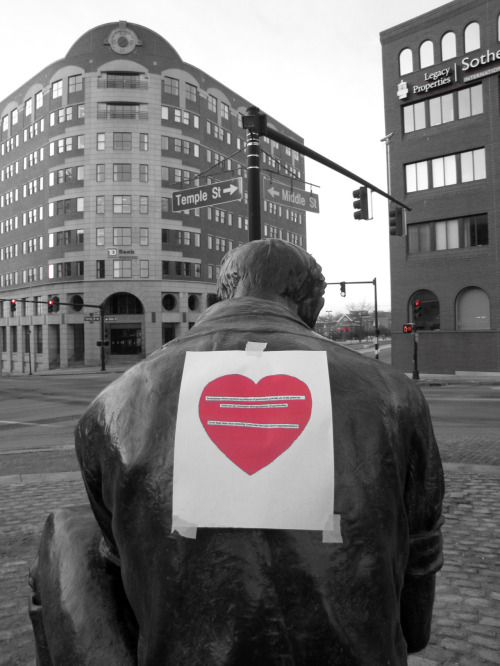
Yesterday, for Valentine's Day, a Good Samaritan posted these flyers around Portland, Maine:

(photo by shannont, via Unseen Portland)

It reads: “In societies where modern conditions of production prevail, all of life presents itself as an immense accumulation of spectacles. Love that was once directly lived has become mere representation.” From Guy Debord's Society of the Spectacle.

Another flyer reads "Young people everywhere have been allowed to choose between love and a garbage disposal unit. Everywhere they have chosen the garbage disposal unit" (another quote from Debord).

And in London, artist Robert Montgomery has appropriated billboards to post his Situationist poetry. This one is probably my favorite (via The Morning News, which has more samples of his work):


Valentine's Day might be the perfect Situationist holiday, especially now, when its hyper-commodified version of love is drawing so much cynicism towards itself in our bailout economy.

And yet, for anyone lucky enough to enjoy real love — not the spectacle, but the genuine article, without the chintzy chocolates or greeting cards or mall-bought lingerie — real love is an act of revolution: a reminder that we can be rich without the fake wealth of the global economy.

Thanks to Jess, I count myself in that number. All the hedge fund managers can go fuck their garbage disposal units (and I'd love to see them try).


Friday, February 10, 2012

How the Baby Boom Became the Apocalypse Boom

I recently started following the amazing Twitter feed of William Gibson, author of Pattern Recognition, Neuromancer, and a new collection of essays called Distrust That Particular Flavor.

The title of the latter, it turns out, comes from an essay about his childhood reading of H.G. Wells's Time Machine, around the time of the Cuban Missile Crisis. Quoting at length from the end of this essay, titled "Time Machine Cuba":


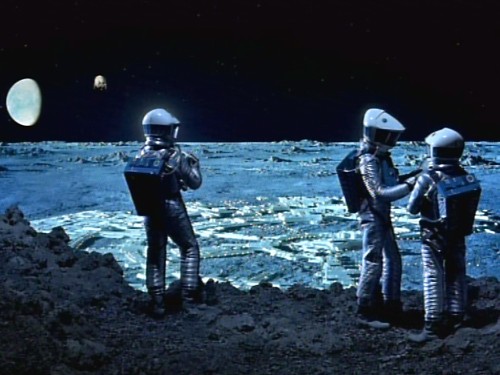
The future, according to Hollywood, in 1968 (from 2001: A Space Odyssey) and in 2009.

"In his preface to the 1921 edition of The War in the Air, Wells wrote of World War I (still able to call it, then, the Great War): 'The great catastrophe marched upon us in daylight. But everybody thought that somebody else would stop it before it really arrived. Behind that great catastrophe march others today.' In his preface to the 1941 edition, he could only add: 'Again I ask the reader to note the warnings I gave in that year, twenty years ago. Is there anything to add to that preface now? Nothing except my epitaph. That, when the time comes, will manifestly have to be: "I told you so. You damned fools." (The italics are mine.)'

"The italics are indeed his: the terminally exasperated visionary, the technologically fluent Victorian who has watched the 20th Century arrive, with all of its astonishing baggage of change, and who has come to trust in the minds of the sort of men who ran British Rail. They are the italics of the perpetually impatient and somehow perpetually unworldly futurist, seeing his model going terminally wrong in the hands of the less clever, the less evolved. And they are with us today, those italics, though I've long since learned to run shy of science fiction that employs them.

"I suspect that I began to distrust that particular flavor of italics when the world didn't end in October of 1962. I can't recall the resolution of the Cuban missile crisis at all. My anxiety, and the world's, reached some absolute peak. And then declined, history moving on, so much of it, and sometimes today the world of my own childhood strikes me as scarcely less remote than the world of Wells's childhood, so much has changed in the meantime.

"I may actually have begun to distrust science fiction, then, or rather to trust it differently, as my initial passion for it began to decline, around that time. I found Henry Miller, then, and William Burroughs, Jack Kerouac and others, voices of another kind, and the science fiction I continued to read was that which somehow was resonant with those other voices, and where those voices seemed to be leading me.

"And it may also have begun to dawn on me, around that same time, that history, though initially discovered in whatever soggy trunk or in whatever caliber, is a species of speculative fiction itself, prone to changing interpretation and further discoveries."

I love that last sentence. There's a whole academic field of historiography: the study of how our historical narratives change and have changed over time. Historiography is essentially a literary exercise: understanding the stories we tell about ourselves. Is there really much difference between the stories we tell about our pasts and the so-called science fiction stories of our futures?

"That particular flavor" of dystopian science fiction is particularly strong right now, with heady notes of Mayan prophecies and mideast uprisings and financial collapses. In a recent interview with Wired magazine, Gibson elaborates on his skepticism:

"Futurists get to a certain age and, as one does, they suddenly recognize their own mortality, and they often decide that what’s going on is that everything is just totally screwed and shabby now, whereas when they were younger everything was better.

"It’s an ancient, somewhat universal human attitude, and often they give it full voice. But it’s been being given voice for thousands and thousands of years. You can go back and see the ancient Greeks doing it. You know, 'All that is good is gone. These young people are incapable of making art, or blue jeans, or whatever.' It’s just an ancient thing, and it’s so ancient that I’m inclined to think it’s never actually true. And I’ve always been deeply, deeply distrustful of anybody’s 'golden age' — that one in which we no longer live."

As concerned as I am about human civilization's capacity to commit suicide, I'm still with Gibson here. America's baby boomers have been a uniquely self-important generation — and uniquely destructive. But the idea that they're the apex of a million years of humanity, after which everything must decline, really takes the cake for arrogance.

Monday, January 30, 2012

The Drone Surveillance Agents of the Amateur E.P.A.

"And the third angel poured out his vial on the rivers and fountains of waters; and they became blood." - Revelation 16:4


In Dallas, an amateur drone hobbyist, flying his homemade surveillance rig around the skies of Oak Cliff, recently noticed something strange about the hue of Cedar Creek, which flows into the Trinity River just upstream of the city's showcase new kayaking park.


The amateur surveillance agent submitted his photographic evidence to the Texas Commission on Environmental Quality, which discovered an underground pipe from a nearby pork slaughterhouse that was sloughing volumes of pig blood and other slaughterhouse wastes directly into the stream. The slaughterhouse now faces serious criminal charges while the residents of the Trinity River watershed cope with their nausea (the Trinity watershed doesn't merely encompass greater Dallas; it also empties into Galveston Bay on the outskirts of Houston, which means the shrimp I ate last month might have included a few nanograms of diluted pig blood or the various pathogens that feed on it).

I have to wonder how long this was going on: the photo above shows how egregiously bloody the stream was, and it was happening within the inner neighborhoods of a huge city. Why did it take a hobbyist's flying machine to notice that something terrible was going on in Cedar Creek? Why didn't any of the millions of gravity-bound residents of Dallas think to ask why the river was running red — or did any of them even notice?

Maybe nobody had ever thought to look at the creek before this. Maybe, running through the middle of a city of millions of people, the creek had managed to surround itself in enough urban camouflage — industrial warehouses and power lines and cyclone fencing and weed-choked empty lots — to become completely anonymous, a secret hidden in plain sight.

Maybe the camera on a flying drone and a hobbyist's enthusiasm provided the first opportunity in years for a Dallas resident to peer into Cedar Creek without disregarding it as a short-lived streak of weeds seen peripherally through the car window at 40 miles per hour.

[as seen on the Field and Stream Conservationist blog, and at grist.org]

Friday, January 27, 2012

The Whole Earth 2012: Snowless and Drought-Ridden

Yesterday, NASA released a composite photo of the "Whole Earth" as seen from space, like the ones taken by Apollo astronauts of the 1970s. This one was taken on January 4, 2012 (around 4 pm Eastern time, by the looks of it - you can just barely see New England in the upper right corner passing the horizon into the winter nighttime).


Source: NASA (click for the large version)

It's a stunning image, without a doubt. And it got lots of attention yesterday on Twitter and on various blogs.

But the most relevant insights, I think, came from Dr. Jeff Masters at the Weather Underground blog:
The image is very interesting meteorologically, and extremely strange. It is obvious that it is a winter image, as revealed by the large area of stratocumulus clouds off the U.S. East Coast all the way to South Florida, caused by cold Canadian air blowing offshore. However, the U.S. and Canada are virtually snow-free and cloud-free, which is extremely rare for a January day. The lack of snow in the mountains of the Western U.S. is particularly unusual. I doubt one could find a January day this cloud-free with so little snow on the ground throughout the entire satellite record, going back to the early 1960s.
Such is the Earth in 2012: baked and drought-ridden.

Tuesday, January 17, 2012

Houston Is Weird: David Adickes's Giant Presidents

The first time I visited to David Adickes's presidents was during my first-ever trip to Houston in 2004, when Jess was trying to disabuse me of my Yankee prejudices against the place. It was an eerie, muggy night with lightning flashing on the horizon. We got lost for a while among huge silent grain elevators and half-abandoned warehouses near the city's main east-west railroad line, but Jess wouldn't tell me what we were looking for, insisting that it was a surprise.

Then we coasted down a dead-end street and through an open chain-link gate, and saw this:

Left to right: Martin Van Buren, Barack Obama, George Bush Sr., Lyndon B. Johnson, and others (back in 2004, of course, the bust of Barack Obama hadn't been made yet).

A field of gigantic presidents' heads looming in the hazy yellow light of the city, with a distant thunderstorm approaching over the city's suburban prairies: that was an experience I won't soon forget. I moved to Houston a few months later.

Lincoln, Jackson, and Theodore Roosevelt.

You know the "Keep Austin Weird" bumper stickers? Like saving the whales or supporting our troops, it's a halfhearted expression of nostalgia for a condition that's long been on the wane. Houston doesn't need that kind of bumper sticker, because Houston just is weird – though not in the cute ways that people romanticize. There are inflatable gorillas on top of freeway car dealerships, and ubiquitous faux-Mediterranean parking garage/condo buildings, and the flying cockroaches.

Because Houston is so sprawling, it has plenty of room for relatively ordinary people to do weird things on a grand scale, and that's exactly what David Adickes does. He's probably best known for his 70-foot statue of Sam Houston, looming over Interstate 45 about 60 miles north of the city.

Adickes makes cheap concrete sculptures on a monumental scale. His art is quintessentially Houstonian: campy, favoring quantity over quality, and scaled to a freeway audience driving 70 miles per hour. He's purchased additional real estate along I-10, possibly the city's busiest freeway, to become a roadside permanent collection for his sculptures, including a 30-foot tall representation of the Beatles and a huge "We Love Houston" sign.

In a 2004 newspaper article, he said, "the endless road through Houston is filled with a lot of junk on both ends. This will offer a little relief." Or at least some slightly different junk for people to look at.

Until that roadside attraction opens, the sculptures are in storage in a big fenced yard next to Adickes's studio. Personally, I think it's a much cooler place to see them – away from the freeway, you can enjoy them at a leisurely 2 miles per hour, and finding them feels like a discovery. It feels like wandering through a Titan grandmother's knick-knack drawer.

Visiting the presidents' heads make for a good bike ride. They're just a couple of blocks south of the very pleasant Heights Bike Trail, which extends northwest from downtown into the heart of the Heights neighborhood. As you're heading west from downtown, the bike path crosses White Oak Bayou, goes under the freeway, and enters a residential neighborhood. From there, you can take one of the side streets to your left to Summer St., then follow Summer to the end, It's about 2 miles from downtown, an easy 10 minute bike ride. You'll know the place when you find it. I mean, look, the heads are even visible from space:


View Larger Map

Thursday, January 05, 2012

Occupy Heathrow

I've been meaning to write here about how the Occupy movement has brought an element of wilderness survivalism into the downtown districts of out largest cities. How corporate plazas in financial districts have transformed into undeveloped campsites.


Before I do, though, I'd like to show you how they're doing it in England. Earlier this fall, the New York Times ran an article about England's remarkable squatters' laws:
Currently, it is a crime to occupy a house where someone is living or plans to move in imminently. But squatting in an empty commercial property is a civil offense, and such squatters can be removed only by court order.

Homeowners are allowed to use “reasonable force” to get rid of squatters, though it is unclear what that means. Giles Peaker, a housing lawyer, said no one wanted to do anything that might provoke counterclaims of assault. Violence is out. No baseball bats, no pepper spray, no household weapons...

As for commercial owners, they cannot use any force, not even to break into their own property or muscle their way past the occupiers. Property owners say that the police are loath to intervene, except in the most blatant cases, without formal court orders.
Notwithstanding lurid tales told in the sensationalist British tabloids, having responsible tenants to take care of abandoned and foreclosed properties has generally been a good thing for England during these years of financial crisis. Without the squatting law, England would have more homeless, and more abandoned neighborhoods in terminal decline.

Think of it as an Occupy movement for the dross of the collapsed real estate market.

One prominent squatters' community mentioned in the Times piece is the Grow Heathrow encampment in the village of Sipson, just north of London's massive Heathrow Airport and in the path of a proposed runway expansion.


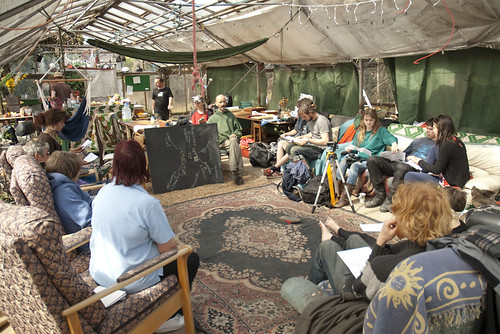
Citing British squatter laws, the community has successfully cleaned up an abandoned nursery, and turned its broken greenhouses back into functional (and beautiful) spaces for living, growing produce, and organizing activists against the airport expansion.

The proposed third runway at Heathrow has become a national issue in British politics. Ousted Labour leader Gordon Brown had been a supporter of expansion, but environmental activists - many of whom live at Grow Heathrow - have successfully delayed the proposal to the point where even airport executives acknowledge its unlikelihood.

One reason Brown and other political leaders had been pressing for a third runway is because the expansion had been seen as a necessity to preserving London's status as a global financial center.


In this light, Grow Heathrow and other opponents of airport expansion are not just fighting against airplane pollution. They're making a vital contribution to the Occupy movement, by inconveniencing Britain's bankers and hedge fund managers in their pursuit of global commercial domination.

All photos courtesy of Transition Heathrow's Flickr.

Tuesday, January 03, 2012

Best Reads of 2011

I read some really excellent things in 2011. So as I did around this time last year, I thought I'd share some of them with the people who enjoy reading this blog. In my opinion, all of these books are worth owning and sharing (if you click the links to buy them from Powell's website, you'll help finance my own book habit with a small commission), but they should also be available from your local library.

And don't forget to support your hometown libraries as they sprint to the finish line with their annual fundraising drives. For my local readers, here's a link to donate to the Portland Public Library.


The Information: A History, A Theory, A Flood by James Gleick

2400 years ago in Greece, Plato made this commentary on the newly-invented technology of the written word (we know, because somebody wrote it down, and I know, because James Gleick included it in an early chapter of this book):

"The fact is that this invention [writing] will produce forgetfulness in the souls of those who have learned it. They will not need to exercise their memories, being able to rely on what is written, calling things to mind no longer from within themselves by their own unaided powers, but under the stimulus of external marks that are alien to themselves."

At a time when people are wringing their hands over whether the Internet might be making us stupid, it's nice to have this ancient reminder from Plato that humans have always fretted about these things. From writing, to the printing press, to wikipedia, new information technologies have changed the way humanity thinks as much as they've changed how we communicate.

Reading this book literally made me feel high: every chapter gave the distinct impression that my mind was being expanded with new insights into how humanity's information technologies have made mutable our fundamental concepts of what humanity itself is all about. Each chapter I read required several days for me to absorb and marvel at its ideas - it was a book to savor, and I found it highly accessible (although readers without much mathematics background might disagree about the book's more technical later chapters).

Reading this book also made me a more creative, curious person, and helped kick off an effort to teach myself computer programming this year.


Various short novels by Philip K. Dick, including Flow My Tears, the Policeman Said, and A Maze of Death.

I started reading more Philip K. Dick after finishing The Information, since a number of themes from his novels reflect some of the more metaphysical ideas from information theory (particularly the idea that different perceptions in a human mind can have tangible effects on reality itself).

Dick's novels have a weird mood to them. They tend to have clunky dialogue and retro-futurism that betray their pulp-novel roots. But his stories are also full of ambiguity and uncertainty, with unreliable narrators, delusions, and shifts between realities and simulations. All this makes his work disorienting and a bit challenging to read through - I often feel a bit hungover after reading his work - but if you can bear that, these novels manage to blend swashbuckling sci-fi with deeper metaphysical questions of reality and sanity.


About A Mountain, by John D'Agata

An amazing long-form essay about Las Vegas, suicide, and the Yucca Mountain nuclear waste repository. I wrote a blog post about this book last January, but wanted to mention it again here as one of my favorite reads of the past year.


Infinite Jest, by David Foster Wallace

I spent the last four months of the year reading two big novels - this one and 1Q84 (below). It was great, and I admit I feel a bit lost, reading-wise, now that I'm done with them.

I'd long thought about reading Infinite Jest but had been intimidated by its length and a perception that it would be too intellectually complex and experimental, like Ulysses or Gravity's Rainbow.

But it's actually very engaging and fairly easy to read, and very, very funny. There are aspects of the plot that I probably lost amidst the dozens of characters and storylines, but I didn't worry too much about it and it didn't affect my enjoyment of the book.

(If you need encouragement and guidance, I was also helped along by the Infinite Summer reading guide, and particularly by the "How to Read Infinite Jest" post.)

In fact, I found this book so engaging that I began to wonder if it might be a bit unhealthy, just as drugs, alcohol, tennis, film, and other entertainments become unhealthy obsessions for the novel's various characters. Wallace draws a number of stories and plots from his own participation in and experiences from AA meetings, and I feel that reading this book made me more aware of and compassionate for the forgotten members of our society who struggle with addiction.

My wife Jess got a little jealous of Infinite Jest at times, but I hope she'll read it soon so I can enjoy it vicariously one more time.


1Q84, by Haruki Murakami

Murakami is one of my favorite authors. His new book doesn't rise to the level of Kafka on the Shore and the Wind-Up Bird Chronicle, in my opinion, but it is still an amazing and extremely imaginative piece of literature.

Like Philip K. Dick, Murakami writes about strange parallel worlds where strange things happen without any explanation. Unlike Dick, though, Murakami has a style that makes these fantastic events feel a lot more natural and real. It's like the logic of a dream: it may be bizarre, but it's easy for you to take it for granted while you're inside of it.

Unfortunately, having read this novel, I find myself with no new Murakami fiction to read - at least until his next novel gets published and translated. That makes me a bit sad, like there's no new territory in his fictional worlds for me to discover, and it's made it harder for me to get into a new novel for the new year.

If you have any recommendations for me, I'd love to hear them in the comments.