Saturday, March 17, 2012

David Lynch's Nature Film

Hollywood types supposedly love making heavy-handed ecological allegories to brainwash us into being more considerate and thoughtful. It turns out that David Lynch was no exception. Here's a short film about inner-city wildlife in Lynch's signature "neo-noir" style, from 1991:

Tuesday, March 13, 2012

A Relic from the Gold Rush Space Program

A couple years ago I wrote about the Mannahatta project, an effort to reconstruct the pre-colonial ecosystems that existed on Manhattan Island, and the gorgeous computer-generated birds-eye-views that it produced.

Now, a Californian geographer named Mark Clark has made a similar speculative map, showing most of California as it might have looked from space in 1850 (via the Strange Maps blog):

What's most striking to me is how edenic the Central Valley looks with its original rivers and marshes streaming snowmelt from the Sierra Nevada into the lush swirl of marshes in the Sacramento-San Joaquin delta in the north, or, in the south, into the long-lost Tulare Lake, once the largest freshwater body west of the Great Lakes.

Now, the same landscape is all massive monoculture farm fields spotted with dusty, heat-blasted cities like Bakersfield and Fresno. Even more remarkable is that most of the transformation happened within a single generation during the early 20th century. Why aren't there more Hollywood blockbusters about this story?

And speaking of native Californian hydrology, a friend recently turned me onto the L.A. Creek Freak blog, which is all about trying to restore watersheds and their ecological functions in the Los Angeles metro area. I'm actually planning a visit to southern California early this summer — if any Californian readers want to leave tourism suggestions in the comments, or just say "hello," it would make my day.

Thursday, March 01, 2012

High-Rise Forestry

This pair of luxury housing high-rises under construction in Milan includes beefy cantilevered balconies that have been designed to support hundreds of fully-grown trees and shrubs.

Architect Stephano Boeri boasts that the project "is a model of vertical densification of nature within the city." The trees that will be suspended off of its balconies are equivalent to a hectare's worth of flat-land forest, while the homes inside the buildings represent five hectares' worth of single-family homes in the Italian suburbs.

It's called Bosco Verticale, or Vertical Forest.

These construction photos are by Daniel Iodice, and come from the Stephano Boeri Architetti website:

And a close-up of the tree boxes:


Here's the architect's vision of how the buildings will look when complete:

The plantings, which will include holly oak, European wild pear, and a mix of shrubs like Cain Apples and hawthorns, seem to have been chosen for their tolerance for constrained soil conditions and for their ability to improve the environmental quality inside and around the towers — shading the windows on hot summer days, insulating the apartments from city noise and particulate pollution, and filtering the apartments' grey water.

I first saw this project on the Green Futures blog, which included this critique:
Alexander Felson, Director of the Urban Ecology and Design Laboratory at Yale University, agrees that “there will potentially be microclimate and air particulate removal benefits”, but warns that the “overall energy required to construct a building that would support both trees and the wet weight of soil” places some serious question marks over its overall sustainability. He favors a more modest approach focusing on green roofs.
True, all that beefy steel and concrete required to hold up trees on an Italian balcony probably required the environmental sacrifice of a good chunk of China.

Still, I think Dr. Felson is missing the point (maybe he just can't see the forest for the trees?). This is a luxury high-rise, after all. While the architect Boeri is clearly interested in sustainability, he's also interested in creating a nice place to live for wealthy Milanese city-dwellers who can pay his commission. There are lots of luxury high-rises — the vast majority of them, actually — that blow their budgets waste construction material on much more masturbatory design flourishes.

What I find most interesting about these buildings is their approach to re-introducing wild nature into the city. I write about that idea often on this blog, but this project takes it to a new level (literally) by marrying a forest with a skyscraper. It's not merely creating a park that's geographically delineated from the rest of the city: it's integrating a forest with one of our most anthropocentric infrastructures: a high-rise apartment building.

That's pretty cool, not just for the people who live there, but for everyone in Milan who will be able to look at a vertical forest in their city's skyline.

Notwithstanding the technical questions of the construction project's sustainability, the buildings still presents an extremely bold vision of a sustainable city — a city in which nature is prominent and integrated into daily life.

Thursday, February 23, 2012

The Disappearing Bicyclist!

This isn't particularly on-topic, but I thought it was cool.

I spotted the original image of this wheel via Maria Popova's Twitter feed, which I've recently discovered. The first thing I thought when I saw it was, "I wish I could actually spin it!" And the second thing I thought was, "I'll bet that I could spin it, by using some of the new tricks in HTML5!"

Thus, here's my small contribution to global internet procrastination: a functional, digital version of the DISAPPEARING CYCLIST trick (drag the slider beneath the image to spin the wheel).


This is the sort of educational goofing off you can do when you're a freelancer with no pressing deadlines in view. Enjoy!

Wednesday, February 15, 2012

A Very Situationist Valentine's Day

The Occupy camps have been dismantled — and yet, none of the motives behind the movement have disappeared. Maybe that's why I've noticed a revival of Situationist thought on city streets in my hometown and elsewhere around the globe.

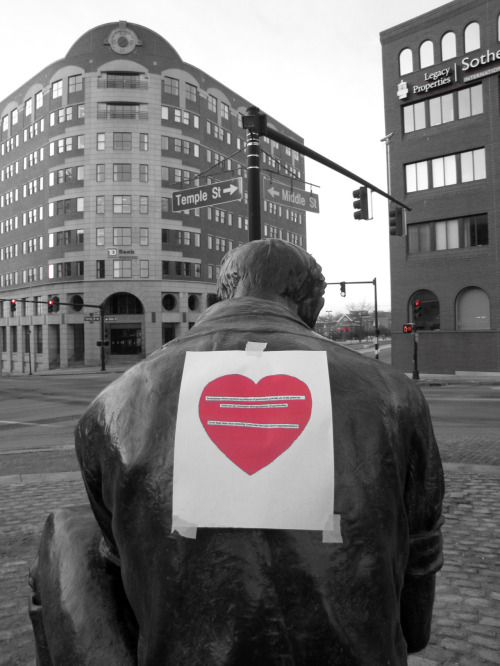
Yesterday, for Valentine's Day, a Good Samaritan posted these flyers around Portland, Maine:

(photo by shannont, via Unseen Portland)

It reads: “In societies where modern conditions of production prevail, all of life presents itself as an immense accumulation of spectacles. Love that was once directly lived has become mere representation.” From Guy Debord's Society of the Spectacle.

Another flyer reads "Young people everywhere have been allowed to choose between love and a garbage disposal unit. Everywhere they have chosen the garbage disposal unit" (another quote from Debord).

And in London, artist Robert Montgomery has appropriated billboards to post his Situationist poetry. This one is probably my favorite (via The Morning News, which has more samples of his work):


Valentine's Day might be the perfect Situationist holiday, especially now, when its hyper-commodified version of love is drawing so much cynicism towards itself in our bailout economy.

And yet, for anyone lucky enough to enjoy real love — not the spectacle, but the genuine article, without the chintzy chocolates or greeting cards or mall-bought lingerie — real love is an act of revolution: a reminder that we can be rich without the fake wealth of the global economy.

Thanks to Jess, I count myself in that number. All the hedge fund managers can go fuck their garbage disposal units (and I'd love to see them try).


Friday, February 10, 2012

How the Baby Boom Became the Apocalypse Boom

I recently started following the amazing Twitter feed of William Gibson, author of Pattern Recognition, Neuromancer, and a new collection of essays called Distrust That Particular Flavor.

The title of the latter, it turns out, comes from an essay about his childhood reading of H.G. Wells's Time Machine, around the time of the Cuban Missile Crisis. Quoting at length from the end of this essay, titled "Time Machine Cuba":


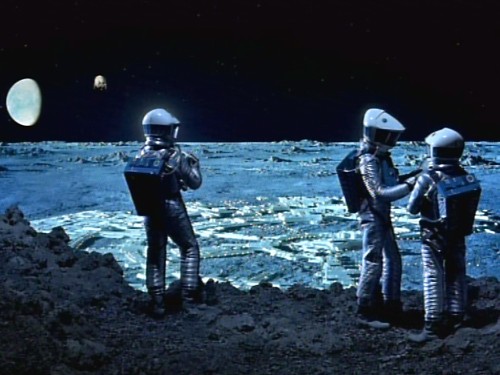
The future, according to Hollywood, in 1968 (from 2001: A Space Odyssey) and in 2009.

"In his preface to the 1921 edition of The War in the Air, Wells wrote of World War I (still able to call it, then, the Great War): 'The great catastrophe marched upon us in daylight. But everybody thought that somebody else would stop it before it really arrived. Behind that great catastrophe march others today.' In his preface to the 1941 edition, he could only add: 'Again I ask the reader to note the warnings I gave in that year, twenty years ago. Is there anything to add to that preface now? Nothing except my epitaph. That, when the time comes, will manifestly have to be: "I told you so. You damned fools." (The italics are mine.)'

"The italics are indeed his: the terminally exasperated visionary, the technologically fluent Victorian who has watched the 20th Century arrive, with all of its astonishing baggage of change, and who has come to trust in the minds of the sort of men who ran British Rail. They are the italics of the perpetually impatient and somehow perpetually unworldly futurist, seeing his model going terminally wrong in the hands of the less clever, the less evolved. And they are with us today, those italics, though I've long since learned to run shy of science fiction that employs them.

"I suspect that I began to distrust that particular flavor of italics when the world didn't end in October of 1962. I can't recall the resolution of the Cuban missile crisis at all. My anxiety, and the world's, reached some absolute peak. And then declined, history moving on, so much of it, and sometimes today the world of my own childhood strikes me as scarcely less remote than the world of Wells's childhood, so much has changed in the meantime.

"I may actually have begun to distrust science fiction, then, or rather to trust it differently, as my initial passion for it began to decline, around that time. I found Henry Miller, then, and William Burroughs, Jack Kerouac and others, voices of another kind, and the science fiction I continued to read was that which somehow was resonant with those other voices, and where those voices seemed to be leading me.

"And it may also have begun to dawn on me, around that same time, that history, though initially discovered in whatever soggy trunk or in whatever caliber, is a species of speculative fiction itself, prone to changing interpretation and further discoveries."

I love that last sentence. There's a whole academic field of historiography: the study of how our historical narratives change and have changed over time. Historiography is essentially a literary exercise: understanding the stories we tell about ourselves. Is there really much difference between the stories we tell about our pasts and the so-called science fiction stories of our futures?

"That particular flavor" of dystopian science fiction is particularly strong right now, with heady notes of Mayan prophecies and mideast uprisings and financial collapses. In a recent interview with Wired magazine, Gibson elaborates on his skepticism:

"Futurists get to a certain age and, as one does, they suddenly recognize their own mortality, and they often decide that what’s going on is that everything is just totally screwed and shabby now, whereas when they were younger everything was better.

"It’s an ancient, somewhat universal human attitude, and often they give it full voice. But it’s been being given voice for thousands and thousands of years. You can go back and see the ancient Greeks doing it. You know, 'All that is good is gone. These young people are incapable of making art, or blue jeans, or whatever.' It’s just an ancient thing, and it’s so ancient that I’m inclined to think it’s never actually true. And I’ve always been deeply, deeply distrustful of anybody’s 'golden age' — that one in which we no longer live."

As concerned as I am about human civilization's capacity to commit suicide, I'm still with Gibson here. America's baby boomers have been a uniquely self-important generation — and uniquely destructive. But the idea that they're the apex of a million years of humanity, after which everything must decline, really takes the cake for arrogance.

Monday, January 30, 2012

The Drone Surveillance Agents of the Amateur E.P.A.

"And the third angel poured out his vial on the rivers and fountains of waters; and they became blood." - Revelation 16:4


In Dallas, an amateur drone hobbyist, flying his homemade surveillance rig around the skies of Oak Cliff, recently noticed something strange about the hue of Cedar Creek, which flows into the Trinity River just upstream of the city's showcase new kayaking park.


The amateur surveillance agent submitted his photographic evidence to the Texas Commission on Environmental Quality, which discovered an underground pipe from a nearby pork slaughterhouse that was sloughing volumes of pig blood and other slaughterhouse wastes directly into the stream. The slaughterhouse now faces serious criminal charges while the residents of the Trinity River watershed cope with their nausea (the Trinity watershed doesn't merely encompass greater Dallas; it also empties into Galveston Bay on the outskirts of Houston, which means the shrimp I ate last month might have included a few nanograms of diluted pig blood or the various pathogens that feed on it).

I have to wonder how long this was going on: the photo above shows how egregiously bloody the stream was, and it was happening within the inner neighborhoods of a huge city. Why did it take a hobbyist's flying machine to notice that something terrible was going on in Cedar Creek? Why didn't any of the millions of gravity-bound residents of Dallas think to ask why the river was running red — or did any of them even notice?

Maybe nobody had ever thought to look at the creek before this. Maybe, running through the middle of a city of millions of people, the creek had managed to surround itself in enough urban camouflage — industrial warehouses and power lines and cyclone fencing and weed-choked empty lots — to become completely anonymous, a secret hidden in plain sight.

Maybe the camera on a flying drone and a hobbyist's enthusiasm provided the first opportunity in years for a Dallas resident to peer into Cedar Creek without disregarding it as a short-lived streak of weeds seen peripherally through the car window at 40 miles per hour.

[as seen on the Field and Stream Conservationist blog, and at grist.org]

Friday, January 27, 2012

The Whole Earth 2012: Snowless and Drought-Ridden

Yesterday, NASA released a composite photo of the "Whole Earth" as seen from space, like the ones taken by Apollo astronauts of the 1970s. This one was taken on January 4, 2012 (around 4 pm Eastern time, by the looks of it - you can just barely see New England in the upper right corner passing the horizon into the winter nighttime).


Source: NASA (click for the large version)

It's a stunning image, without a doubt. And it got lots of attention yesterday on Twitter and on various blogs.

But the most relevant insights, I think, came from Dr. Jeff Masters at the Weather Underground blog:
The image is very interesting meteorologically, and extremely strange. It is obvious that it is a winter image, as revealed by the large area of stratocumulus clouds off the U.S. East Coast all the way to South Florida, caused by cold Canadian air blowing offshore. However, the U.S. and Canada are virtually snow-free and cloud-free, which is extremely rare for a January day. The lack of snow in the mountains of the Western U.S. is particularly unusual. I doubt one could find a January day this cloud-free with so little snow on the ground throughout the entire satellite record, going back to the early 1960s.
Such is the Earth in 2012: baked and drought-ridden.