Tuesday, July 03, 2007

Rx for the Portland Public Market

Neil Takemoto writes one of my favorite blogs, CoolTown Studios, which focuses on how high-quality, vibrant cities and towns attract the creative individuals and businesses that drive the 21st-century economy.

In a recent post, he critiques our own Portland Public Market:
"This is what a public market should look like, but not developed and managed... In the end, it was lack of a public-private partnership, not as much the norm back in the mid 90s as it is today, that simply made the project too costly for the private sector to succeed alone. This is especially the case with new construction - as noble as replacing a parking lot is, private sector new development without public partnerships typically means it must be upscale, and that's simply not what public markets are about."
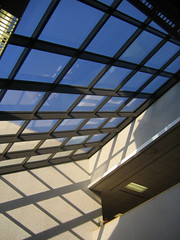
Guilty as charged - particularly towards the end, the Market felt more like a fancy food court than a place to buy fresh veggies from a local farmer. The following post on CoolTown Studios takes a look at the "grungy" Pike Place Market (the photos at left accompany the post), which is celebrating its 100th anniversary as the longest-running and most-successful public market in the nation.

Seattle's a lot bigger than Portland, but other markets in smaller cities and towns are thriving all over the place. We have a strong food products sector in Portland: in addition to farms and the fishing industry, we've got growing value-added food producers with businesses like Morrison's Chowder and Standard Baking. We also have lots of tourists anxious to import dollars into the local economy, and there's the busy, twice-weekly farmer's market. A truly public Public Market - not a food court - would have clear and measurable benefits for the whole region, if not the entire state.

So who's got the economic development strategy to revitalize the public market - at least the idea, if not the building itself - as a self-sustaining institution that supports local farms and businesses?

Friday, June 29, 2007

Scenic Coast, Toxic Air

43.57 -70.21

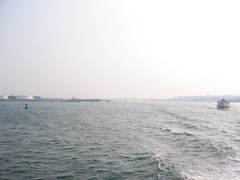
Casco Bay haze
The harbor, a ferry, and oil tanks.
Mercifully, a cold front finally came through Maine last night and cleared away the humid blanket of polluted air that had been smothering us for most of the week.

On Tuesday, the ozone monitoring station at Two Lights State Park in Cape Elizabeth recorded the season's first violation of federal air quality standards, and on Wednesday, recorded levels of ground-level ozone went even higher, edging into the code-red "unhealthy" zone. We can't blame midwestern power plants for this one: ozone pollution is a local product of our own tailpipes and gas-fired power plants.

Strangely enough, this all happened just a few days after the Bush administration came out with a rare proposal to strengthen pollution regulations: specifically, to reduce acceptable levels of ozone from 80 parts per billion (where we were on Tuesday) to 70 parts per billion. This would have significant ramifications for Maine: Portland is just barely in compliance with the current limits, which are based on a three-year moving average, but the entire Maine coast usually has three or four days a summer when ozone exceeds 70 ppb - and we've already had three of those days so far in 2007, with the summer smog season barely underway.

When the new standards take effect and we start breaking them, the federal government isn't going to send in agents to arrest O3 molecules. Instead, they'll place restrictions on Maine industries, reduce our share of highway funding, and force gas stations to sell more expensive, cleaner-burning varieties of gasoline. This will improve air quality, in theory, but it will also put a substantial ball and chain on the Maine economy.

What's the Maine Turnpike Authority, which oversees our state's largest single source of air pollution, doing to help Maine avoid this unpleasant situation? Well, those traffic engineers are in estrus over plans lay down an expanded six-lane freeway just upwind of us, but they can't be bothered to build a sidewalk around the edge of their new Portland headquarters building. But that rich topic deserves an entire post of its own.

Tuesday, June 26, 2007

Stagnant Air: Don't Piss in the Bath


Mainers and the tourist hordes may have heard a cryptic warning of "stagnant air advisory" on the radio this morning. And indeed, the National Weather Service has colored the coast of Maine a dark shade of gray on this morning's weather map (right).

The simple explanation is that low wind speeds and high levels of UV radiation will force us to stew in our own juices for the duration of the day. The ozone will be particularly bad: as of 8 AM, ozone levels at Two Lights State Park in Cape Elizabeth were already twice as high as they were among the oil refineries of Texas City near Houston, an area that typically leads the nation in ozone pollution. And this was before the morning commute, when Maine motorists will send thousands of tons of volatile organic compounds out of their exhaust pipes to bake in the hot summer sun.

If you were planning on breathing today, you'll be more likely to suffer from the various effects of ozone pollution: coughing, wheezing, shortness of breath, headaches, general listlessness, aggravated pulmonary conditions, etcetera, etcetera. The Maine economy will probably lose a couple of million dollars to lost productivity today, and our lungs will age a little faster.

Since they're warning us not to exert ourselves outdoors, it seems like a good day to sit inside and think about air pollution instead.

Air pollution has always been a difficult cause for environmentalism. For one thing, you can't really see it. By most objective standards, cleaner air is more important than preserving a wilderness area in Alaska. But the Nature Conservancy can print glossy photography of unbroken forests to open philanthropists' wallets, while the American Lung Association is left behind quoting dry statistics on childhood asthma.

The other problem with air pollution as an environmental cause is the fact that our atmosphere is so big. You wouldn't want to piss in your own bathtub, but it doesn't seem as revolting when a cruise ship dumps tons of raw sewage at sea. Similarly, there aren't many non-addicts who would willingly spend time in a small, cramped smoker's lounge, but there's nothing especially disgusting about spewing a few hundred pounds of VOCs out from the tailpipe every day. Because we share the atmosphere with the entire world, we discount the marginal effects of our own behavior.

But today is different. Stagnant air means that we kind of are our pissing in our own bathtub when we burn our fossil fuels. It may get better tomorrow, when the winds return, but that just means that all this crap will be blowing someplace else. The atmosphere may be really, really big, but so is our capacity to foul it.

Tuesday, June 19, 2007

The New Coastline: Floods Near the Harbor, Fourth Graders Take the High Ground


Brooklyn's new coastline, near Jamaica Bay. From the New York Times
Using NASA data and flood maps, an artist is tracing the high water line of future floods along the coast of Brooklyn.

The line traces a contour line about 10 feet above sea level. Currently, New York experiences floods along this line at a frequency of once every 100 years: a 1% chance of flooding in any given year. In 2020, the odds of flooding are expected to have doubled to 2.3%, and by 2080, floods could be reaching this line once every four years.

Here in Portland, we traced a portion of our own high water line in this spring's New Coast Parade. Portions of our parade route on Commercial Street, which is also about 10 feet above typical high tides, actually did flood a week after the parade during the Patriot's Day Storm.

If you think that's bad news, you can at least count your blessings that you're not among the increasingly desperate ranks of global warming skeptics, who brought their ebbing tide of climate change "debate" down to childish levels over the weekend.

Following the publication of a global warming opinion piece by kids at the East End Community School, the nation's right-wing conspiracy theorists followed a link from the Drudge Report to focus their righteous rage on Portland's fourth graders.

Student Jacob Austin (aged 9) impetuously responded to the criticism by replying, "I thought they should do a little research, and then they can tell me we did a bad job."

Bah! You can keep your precious research, Jacob! But who really occupies the moral and intellectual high ground - environmentally-concerned fourth graders, or the crackpot adults who spend their weekends hurling insults against them?

Monday, June 18, 2007

Parking is for losers.

Nothing kills a downtown like cheap and abundant parking. This, essentially, is the conclusion of Philadelphia Federal Reserve Bank economist Richard Voith in this 1998 research paper.

Downtowns, or Central Business Districts (CBDs), are increasingly competing with suburban office complexes and subdivisions. Theoretically, each has its own niche: the burbs offer cheap and abundant parking, but you'll die at an early age from the sedentary lifestyle and all the crap you'll eat from lousy franchise restaurants. CBDs, on the other hand, offer cultural events, good restaurants, and pleasant, walkable neighborhoods, but parking is difficult and expensive.

The suburbs seldom try to compete with the CBD by tearing out a parking lot and building a performance arts venue or a celebrity chef's restaurant. But for some reason, CBDs frequently try to compete with the 'burbs by subsidizing cheap parking at the expense of their vibrant communities and neighborhoods.

Voith offers cities two choices, depending on the competitive position of a downtown area: if your office workers and households couldn't care less about your central city and its amenities, then by all means, tear it all down and build cheap parking. Voith admits that "this approach is unlikely to dramatically improve a downtown’s competitive position because the suburbs have a comparative advantage in land uses that demand a lot of space, such as parking lots and roads." Detroit is probably the largest city to have followed this self-destructive model.
"Alternatively, if enough people and firms still find that the dense development found in CBDs is as valuable as ever, adopting policies to increase parking is likely to be counterproductive. Rather, policies should seek to provide high-quality alternatives to driving and parking while accommodating those potential visitors and commuters who must drive, but at prices reflective of both the high value of CBD land and the costs of increased congestion associated with cars in the CBD. Basically, this means improving transit access to the CBD by broadening markets served and improving the price and quality of transit...

Regardless of which view of the value of CBD agglomerations one subscribes to, increasing the parking supply is not a panacea for CBDs. In fact, parking prices in highly successful CBDs are bound to be high relative to those of other competing economic centers. Low parking prices in the CBD are more likely to reflect the failure of the CBD to maintain its unique position as a regional center than to reflect successful parking policies." (Voith, 1998)

In other words, cheap, subsidized parking is a dangerous drug of last resort for failing downtowns.

On a related note, the Wall Street Journal reports that mass transit stations have a strong positive influence on neighborhood property values, and "transit-oriented development" is gaining favor among developers and real estate investors. Read it soon before it goes into the pay archives.

Thursday, June 14, 2007

Forest preservation, next to the ketchup

As a general rule, good environmental stewardship gets more and more difficult as our global economy distances and renders abstract the connections between what we consume and the natural resources from which it all comes.

For example, most people wouldn't want to dump raw sewage into the local river or harbor, but most of our cities have combined sewers (buried out of sight) that do precisely that during every rainstorm. Maybe if every shower, washing machine, and toilet had a live video feed of the underground sewer system and overflow discharge pipes (maybe something like the scene 30 seconds into this music video), people would generate less wastewater and our rivers and oceans might be cleaner.

That's probably neither feasible nor palatable, but here's a cheap idea that can save a tree's worth of paper every year: the "These Come From Trees" sticker for napkin and paper towel dispensers.

The idea behind this sticker is to help people make the connection between forestry and paper products in the moment before they grab a fistful of napkins at the fast food restaurant or coffee shop. This is great environmental activism: it's not a dogmatic "you shouldn't use these" message, nor is it a condescending "thank you for your cooperation" message.

Instead, it's sort of a field guide to North American condiment islands and washrooms that gives us the natural history of our paper products. And according to the guy who's promoting them, one of these stickers can prompt people to cut back their use of paper from a particular dispenser of copy machine by 100 pounds - roughly one tree's worth - every year.

Learn more and order your own stickers from thesecomefromtrees.blogspot.com. Portland readers should be advised that I've already ordered 50 and I'm willing to share.

Monday, June 11, 2007

I We Love This Building

43.65713 -70.247076

UPDATE 6/13: Portland voters rejected the proposal to move the Library by a comfortable 56% to 44% margin. Thanks to all of you who voted or provided free publicity to our scrappy opposition campaign.

Portlanders have a reputation for architectural conservatism: it's a rare building that goes up downtown without a faux-historical coating of red brick. I suspect that this is one reason that the central library's brash modernist architecture doesn't receive the respect it deserves.


But I love this building. The gravity-defying front entrance (above) creates a quiet, shady courtyard that both expands the public space of Monument Square and provides a calming refuge from the bustle of the city center.


Inside, a skylit ramp leads to the circulation desk and the amply daylighted collections of new books and current magazines. Keep in mind that while this building may have been built before the "green" architecture fad, it was built during a serious energy crisis, and the architecture responds with ample daylight and elements of passive solar design.

I'm especially fond of the side of the building along Elm Street. Metro riders are familiar with this facade and the thoughtful clock that complements the bus schedules posted at the Elm Street transit center. The building mirrors the climbing topography of the street, and a series of one-story "steps" makes the transition from the low-rise neighborhood around Cumberland Avenue to the monumental architecture of Monument Square in the space of one block. From the sidewalk, the long, low main level looks like a delicate counterweight that balances the jumble of higher stories massed near Monument Square:


To be sure, the interior of the Library needs to be updated: how we use libraries has changed dramatically since this building opened in 1979. But the overall structure of the building continues to serve the Library's public education mission remarkably well in spite of its age, and I believe that the generous interactions between the public library and the public square in front of it are a tremendous credit to the building's success.

Now, the old public market building is also nice. But it wasn't designed to be a library: in order to fit in the necessary stacks, desks, and office space, the library's trustees plan to block views of the dramatic post-and-beam ceiling with a second floor in between the ground level and the roof. The renovated market would lose much of its architectural appeal, and at 3/4 the size of the current library, it's going to be cramped to boot.

On a more pragmatic note, the relocation plan would spend millions of dollars in public and private foundation money that would be better spent on things like books, computers, librarians, and educational programs.

The election that will determine this building's fate will be held tomorrow. Vote, please. And if you don't live in Portland, Maine, come and visit our awesome library sometime.

Look at more photos of our library here.

Sunday, June 10, 2007

Certified Green Neighborhoods

LEED (Leadership in Energy and Environmental Design) has become the standard certification system for green architecture in the United States - and the organisation that oversees LEED ratings, the US Green Building Council, is growing by leaps and bounds as architects and developers catch on to the fact that LEED-certified buildings fetch higher rents and incur lower operating costs.

As LEED becomes more popular, though, it is also attracting more criticism: its objective, point-based rating systems largely ignore differences in regional environments and assign equal point values to building technologies that vary widely in their costs and beneficial impacts. Also, LEED ratings typically assign little value to a building's site context: many LEED-certified buildings (including Maine's first Platinum-level LEED home in Freeport, at right) have been built in automobile-dependent rural hinterlands, creating instances of "green" suburban sprawl.

To address the latter problem and to introduce some economies of scale to developers who are interested in the LEED process, the USGBC has introduced a "LEED for Neighborhood Design" pilot program. The LEED-ND rating system was developed in concert with the Congress for the New Urbanism and the Natural Resources Defense Council.

Aside from certain requirements - smart location, street and sidewalk connectivity, avoiding sensitive habitats - a LEED certified neighborhood will also have to attain a certain number of points by reducing automobile dependence, locating near existing housing and jobs, managing stormwater throughout the neighborhood, or offering diverse housing types.

The LEED-ND program is only in its pilot phase for now, while a few test cases go through the certification process to evaluate its impact and areas for improvement. Incidentally, we recently learned that the Olympia Companies' proposal for the Maine State Pier development won a slot in the LEED-ND pilot program.

Once the pilot program gives way to an official framework to certify green neighborhoods, the certification process will be open to existing neighborhoods as well as new developments. Looking over the criteria, it seems to me that most of Portland could qualify for LEED-ND certification, and the peninsula's neighborhoods could easily rank a LEED gold rating.

I wouldn't recommend actually persuing certification - we don't really need another distinction to raise property values around town - but the LEED-ND framework does provide a tidy list of criteria by which we can judge our city's livability and environmental impact.

More about the LEED for Neighborhood Development program:
Congress for the New Urbanism
US Green Building Council