Wednesday, October 06, 2010

High-Rise Birdhouses

Artists in London have installed clusters of hundreds of birdhouses on Ailanthus Altissima trees (a.k.a. the Tree of Heaven, Ghetto Palm, or the Tree that Grows in Brooklyn) growing in the terrace gardens various public housing projects.


The high-density birdhousing is meant to mimic the high-density human housing of the surrounding human neighborhood. And also, perhaps, to mimic the proliferation of Ailanthus trees throughout most of the world's cities.


Saturday, October 02, 2010

Go to Detroit, Young Man, and Grow Up

Bizarrely, a boot company and the guy from "Jackass" have teamed up to debunk the hopeless, epicenter-of-the-recession "ruin porn" that dominates everyone's perception of the Motor City. It's pretty fantastic, so I'll buy into their viral marketing scheme by re-posting and recommending their film here:


Here's the link for the whole 3-part series. It visits some of the famous ruins of Detroit, but only in the context that people are reviving and doing exciting things for those ruins. In this telling, the empty prairies and abandoned buildings don't necessarily represent blight; they represent possibility. Like the frontier in Horace Greeley's day, Detroit offers amazing opportunities for people to reinvent themselves - and reinvent the city.

A lot of what appeals to me in this video reminds me of the things I loved about Houston. Because in spite of its rapid growth and booming economy, Houston (like any other big city) also had a fair share of abandoned buildings, even entire neighborhoods overgrown in weeds, and those were the places I loved to explore.

It was also cheap to live there, partly because Houston has a sprawling geography and very few rules about what people do with their real estate - there is literally no zoning law there.

And so: one man I'd met bought the concrete shell of an old rice mill near the bayou, lived in a bus parked inside its empty walls, and made art cars. Our friends bought an abandoned apartment complex and the old pool hall next door to house a successful after-school program. And the summer we lived there, Art League of Houston commissioned this project for two abandoned houses that had been slated for demolition in the Montrose neighborhood (which is one of the city's most vibrant, by the way):


So in general, the most amazing parts of Houston were the places that had recently been abandoned, and were on the verge of re-creating themselves. I think that the same goes for most cities.

So I guess I disagree, somewhat, with the derogatory term "ruin porn." There are at least a few of us who are ogling Detroit's gorgeous, abandoned architecture and new prairies not out of scorn for the Government Motors bailouts, nor for the sake of wallowing in self-pity about this recession, but out of genuine sense of possibility. We are imagining ourselves making something new there, and being a part of the revival.

Sunday, September 26, 2010

A Natural History of Playgrounds

For some time now, I've been meaning to write something here about playgrounds, which are substantial components in the natural areas and parklands of most cities worldwide.

I was first inspired by Rebecca Mead's "State of Play" feature in a July issue of the New Yorker. That article is mostly about a new generation of "imagination playgrounds" that are beginning to appear in Manhattan, but Mead begins her article with a description of the rainy opening day at the Lower East Side's Seward Park Playground, the first ever municipally-built playground in the United States:
"By 2 p.m., when the opening ceremony was scheduled to begin, twenty thousand children had swarmed the playground and its surrounding streets, climbing on rooftops and fire escapes for a better view of the seesaws, swings, and sandboxes... Eventually, the kids stormed the park gates, overwhelming two hundred police officers who were trying to keep order. 'They swept around and through the policemen, and, without pausing, leaped over the iron fence about the playground,' the Times reported the next day...

Mayor Low did speak, although the noise of the crowd was such that only those in his immediate vicinity could hear what he had to say: 'The city has come to realize that it must provide for its children, that they have a right to play as well as to work.'"
-Rebecca Mead, "State of Play"
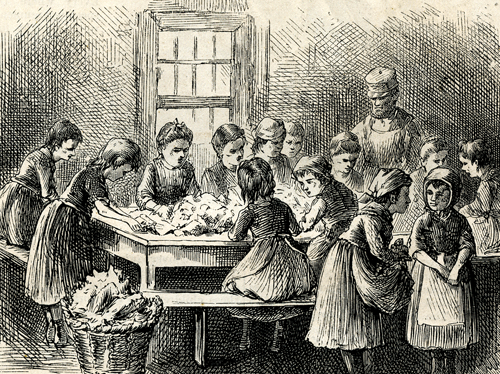
Now that playgrounds have become a common feature in every city, town, and schoolyard in the nation, it's hard to imagine how the opening of one could inspire a riot of 20,000 children. But in 1903, when Seward Park opened, the Lower East Side was packed solid with poor immigrant families whose children worked from an early age.

Children stripping tobacco, from "The Little Laborers of New York City,"
Harper's New Monthly Magazine, August 1873.

Mayor Low was one of the first New York City mayors of the progressive era and an anti-Tammany Hall reformer. The playground he opened reflected a philosophy of social reform, that children "have a right to play," and that they needed opportunities to escape the crowded conditions of the tenements.

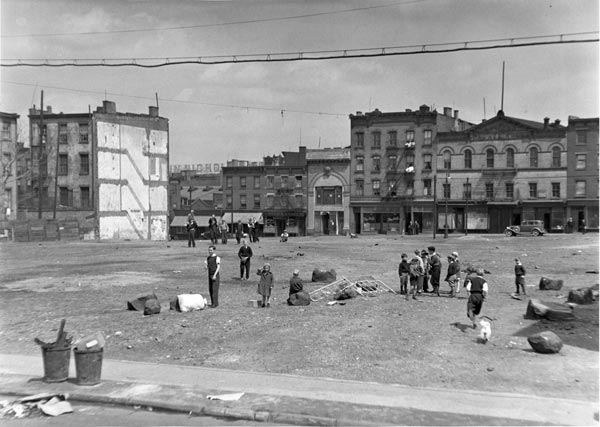
Kids playing in an empty Brooklyn lot, 1934. From the New York City Parks Department archive.

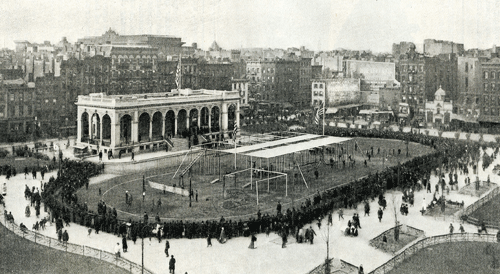
Seward Park had a lot of the ingredients we associate with playgrounds today: open fields, slides, monkey bars, swings, and sandboxes.

Seward Park at the corner of E. Broadway, Canal, and Essex Streets in 1912. Image from the Library of Congress.

In photographs, the playground equipment of 1903 looks incredibly dangerous to my modern eyes:

Seward Park playground in 1912. Image from the Library of Congress.

The height of those high monkey bars remind me that eugenics for the lower classes was also a progressive era fad that the playground's designers might, possibly, have had in mind. But that's probably just my paranoid perspective as someone who is both afraid of heights and living in a litigious society.

In addition to the play equipment, which was designed to encourage vigorous physical activity, the playground also had designated park employees who would lead children in athletic games, segregated by gender. In this 1908 photo from the Parks Department archives, a Seward Park employee leads a group of girls in something called a "Ten Pin Pursuit Race":
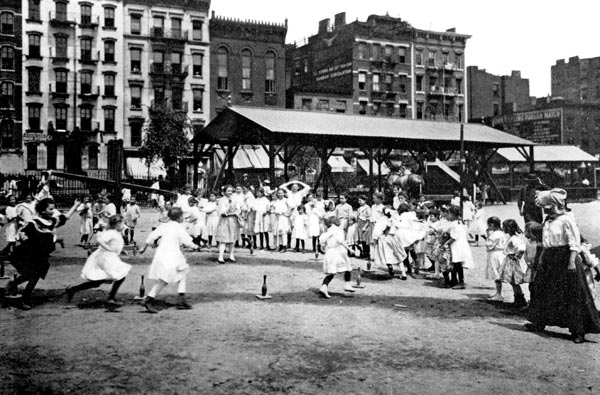
So, in spite of the chaos of the opening day, the city's first playground was clearly designed and programmed to control the playing behavior of the lower-class neighborhood's kids, who had been overrunning the streets in rough reenactments of Spanish-American War battles, and playing in the filth of the city's vacant lots.

This is a theme of playgrounds that continues to this day. Just last week, I attended a neighborhood meeting about a proposal to build fancy new basketball courts next to one of Portland's larger public housing complexes. The phrase "get kids off the streets" came up several times, even though, if the goal is to get troublemakers off the streets, some kind of playground for middle-aged alcoholics might be more useful.

Every park is the product of human values and physical interventions. Even our most remote, backcountry "wilderness" areas are shaped by hiking trails, fire policy, and the historical extirpation of native peoples by military force.

But playgrounds take the physical manifestation of our social values in the outdoors to the extreme. They're the section of a city park where nearly all plants have been removed and the soil itself has been replaced with a kind of soft, antiseptic ground cover (usually wood chips, or sometimes a kind of rubberized pavement). The way playgrounds are designed - how they dictate the terms of how children play - are a faithful reflection of a city's hopes and anxieties for the next generation.
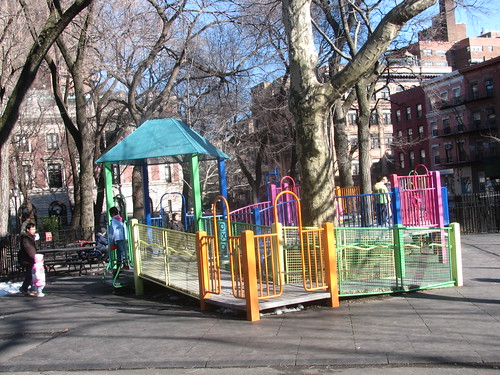
Seward Park Playground
Seward Park Playground in 2004, courtesy of edenpictures on Flickr.

A century later, Seward Park still exists in the Lower East Side, and there's a newly-renovated playground there. It is strikingly less vertical than the first one, and probably safer. But there is no mob of twenty thousand children, breaking down the fences, desperate to start playing.

Tuesday, September 07, 2010

How I Spent My Unemployed Vacation

Last fall, with a month to spare between jobs, I spent a week hiking through Maine's Hundred-Mile Wilderness on a freelance assignment from Maine magazine. It's just been published in their September issue, and illustrated with photos by Craig Dilger. Here's a short excerpt:

...right before our group descended below the tree line, a gust of wind suddenly cleared away the clouds. All at once, the vast forest across which I had trekked over the past week lay spread out below us under remnant wisps of valley fog: wrinkled piles of mountain ridges streaked with yellow birches, red sugar maples, boreal greens, and shimmering ponds.

From up here, it certainly looked like a wilderness. But that name glosses over the complexities of this landscape: it’s a solitary place populated with personable people, and a wild place entangled in the often oppositional industries of tourism and forestry.
Read it online if you're from away and can't find the magazine at a newsstand. Otherwise, buy a copy on paper, because this issue also contains writer Chelsea Holden Baker's and photographer Mark Marchesi's amazing profile of the people and businesses that wrangle huge oil tankers in and out of Portland's harbor.

Wednesday, August 25, 2010

Refugee Camps for the Middle Class

A 100 kilometer traffic jam that's persisted for nine solid days on a highway west of Beijing this week is just another spectacle of the sort we've come to expect out of the growing nation - an epic traffic jam to complement its equally epic public works, skyscrapers, and factories.


Xinhua, a state-run news agency, reports that truck drivers are camped out on the jammed highway, playing cars amongst themselves and forced to buy supplies from opportunistic vendors at inflated prices. Reports printed in this morning's newspapers claimed that some drivers had managed only to move a mile over the course of an entire day on the road's worst stretches, and that the jam could last another month, until a road construction project ends.


All of these mythic reports come closely on the heels of news that China's economy has surpassed Japan's to become the world's second largest. The surreal traffic jam was an emblem of the nation's surreal growth and ambition.

But instead of delivering the promised capitalist paradise, an overdose of machinery and trade creates a sort of homeless gypsy encampment on the road to Beijing.

The news story reminded me of this scene in Week End, when bourgeois French families exercise their "freedom" to leave the city and enjoy the countryside, only to get imprisoned in an interminable traffic jam:


This scene itself was said to be inspired by Julio Cortazar's surrealist short story, "L'Autoroute du Sud," in which a Sunday afternoon traffic jam south of Paris dissolves into a days-long purgatory of survivalism and black market trade. Characters throughout the story are named only by the cars they occupy:
"Surprise would have been the last thing expressed by anyone at the way in which the water and supplies were being obtained. The only thing Taunus could do was manage the pot of money and try to barter as best he could. Ford Mercury and Porsche came every night to peddle their provisions; Taunus and the engineer took charge of distributing them, taking into consideration each person’s health. Incredibly, the old woman in the ID was still alive, lost in a stupor the women were trying to dissipate. The lady in the Beaulieu, who just a few days before had been vomiting and suffering from nausea, had recovered in the cold weather and and was one of those who helped the nun most with her companion, weak still and a little disoriented. The soldier’s wife and the woman from the 203 were minding the children; the travelling salesman, perhaps to distract himself from the fact that the girl in the Dauphine had preferred the engineer, spent hours telling them stories. At night the lives of the group took on a stealthy, more private character; the car doors would open silently to let in or out some shivering silhouette; no-one looked at anyone else, their eyes as blind as their very shadow. Beneath dirty anoraks, with overgrown fingernails, smelling of being confined in stale, old clothes, there was still a degree of happiness here and there."

- translation by Danny Fitzgerald

France's situation in the 1960s was similar to China's today: record-breaking economic growth after the war, greater mobility, and increasing status among the world's great nations. In both 1960s France and contemporary China, the traffic jam is a symbol of modern opportunity and success, but it's also a nervous reminder of the brutal, survivalist lifestyle that both nations had recently left behind. They're refugee camps for the new middle class.


Tuesday, August 17, 2010

The Great Plastic Migration

This nature documentary about the trans-oceanic migrations of plastic bags is making the rounds today. The Californian nonprofit Heal the Bay is promoting the video as a means to rally support Assembly Bill 1998, which proposes to ban single-use plastic bags at California shops.


Note the appearance of the Los Angeles River around 2:20.

Though tongue-in-cheek, I would love to see more nature documentaries like this one. How about an episode about the larval stages of plastic bags, from the oil refinery to the grocery store?

Anyway, it's one thing to zoomorphize plastic bags. Why not anthropomorphize them as well - let them carry a human personality as they drift through the wind, freed from their more material cargo? This personality would necessarily need to have mixed feelings about its immortality - simultaneously self-important and lonely. And it would also have to feel a deep bitterness about its lack of agency, and resentment for the external natural forces that dictate its fate.

If you're saying to yourself, "Hey, that sounds a bit like Werner Herzog," you're in luck! He's precisely the man who narrates the thoughts of a lonely plastic bag in this video by director Ramin Bahrani:


After a tedious journey, Herzog the bag ends up in the Pacific Ocean as well, not particularly fulfilled by its migration, and somewhat bitter at its own failure to die.

Wednesday, August 11, 2010

"Environmentalism" fiddles while the planet burns

In case you missed it, the United States Senate has given up on trying to pass a law that would slow down the nation's greenhouse gas emissions. Even after the nation's worst oil spill in history and scorching heat waves worldwide, Democrats failed to gain any Republican support for their proposals.

So we'll just have to let the planet stew in its own juices and wait until the next time progressive lawmakers with a 60-vote majority in Washington might be compelled by a massive environmental emergency to do something. But who wants to bet that can happen before our modern society and political institutions melt away in the heat?

In the last few days, there's been a lot of hand-wringing and finger-pointing from pundits and politicians. But I think that one of the best responses came from David Roberts at Grist, in a post headlined 'Environmentalism' Can Never Address Climate Change.

Roberts writes:
Environmentalism has a well-defined socioeconomic niche in American life. There are distinct cultural markers; familiar tropes and debates; particular groups designated to lobby for change and economic interests accustomed to fighting it; conventional methods of litigation, regulation, and legislation. Environmental issues take a very specific shape.

The thing is, that shape doesn't fit climate change. Climate change -- or rather, the larger problem of which climate change is a symptom -- isn't like the issues that American environmentalism evolved to address.
He goes on to make the point that the environmental establishment had its genesis in, and grew from, its battles against industry. Early environmental activists shut down factories that were dumping sludge into rivers and lakes and rammed their boats against whaling ships. Later environmental activists took industry to court over more abstract environmental problems like mercury emissions and underground groundwater contamination.

Those big problems have been largely addressed: by most measures (if you leave out greenhouse gas pollution), our American physical environment has less pollution to deal with now than we've had since the industrial revolution took hold.

So: can the same environmental establishment that gave us the Clean Air and Clean Water Acts save us from global warming? The recent failure in Washington does not inspire confidence, and Roberts makes a compelling case for why that is:
The entry of the problem [climate change] into American politics via environmentalism has set it on a certain cultural and political trajectory that is both inadequate and extremely difficult to escape.

Addressing the climate challenge will crucially involve restraining industry emissions (the vaunted "cap"). But that is only one of myriad strategies and changes that will be necessary. The environmental advocacy community has tried, of late, to reshape itself to the contours of the problem before it. It has tried to act with a more singular focus, in a more unified way, and to bring other interest groups (military, religious, etc.) into the fold. It has tried to reorient around a more forward-thinking, positive agenda ("clean energy"). Contrary to a lot of the sniping you hear these days, the efforts of those involved have been heroic.

But it's an impossible task. There is no siloed progressive interest group that can engineer the wholesale reindustrialization of the United States. Period. No amount of clever framing or thoughtful policy proposals can overcome the basic limitations of interest group politics.

Many green leaders are now saying that what's missing is a climate movement. That's obviously true in some sense; this will be the work of generations. But the question is whether "the environmental movement" can catalyze a big enough movement to be effective on this problem.

What needs to happen is for concern over earth's biophysical limitations to transcend the environmental movement -- and movement politics, as handed down from the '60s, generally. It needs to take its place alongside the economy and national security as a priority concern of American elites across ideological and organizational lines. It needs to become a shared concern of every American citizen regardless of ideological orientation or level of political engagement. That is the only way we can ever hope to bring about the urgent necessary changes.
To put it another way: this can not be a traditional environmentalist battle against industry, because nearly everyone agrees that industry - and the entire economy - is what needs to be reinvented in order to stop burning fossil fuels and start finding more innovative, efficient forms of energy.

I have worked for years inside and in league with a number of old-line environmental groups, and from that perspective, I unfortunately have to agree with Roberts's diagnosis. "Environmentalism" carries too much baggage from the baby-boom generation whose suburban-back-to-the-land, materialist lifestyle has done so much climate damage.

For many people my age, it's extremely frustrating to see dominant "environmental" organizations behave as though the most productive thing we can do is to buy up lots of land for conservation reserves. Or worse, when we pour thousands of dollars' worth of nonprofit resources to file injunctions against the "scenic impacts" of clean energy projects.

Sure, these things satisfy the comfortable baby-boomers who want to have a nice view outside the picture windows of their ski condos.

But these kinds of actions, and their funders, are calcifying the environmental establishment into something that's demographically old and elite, and politically out-of-touch and ineffective.

Nero fiddled while Rome burned; the environmental establishment fiddles while the entire planet burns.

Wednesday, August 04, 2010

How the Last Big Oil Spill Helped Create the Credit Crisis

My last post casually mentioned credit default swaps, a fancy financial trick that helped create the credit crisis of 2008 (Planet Money did an amazing reporting series on credit default swaps for NPR back while the crisis was happening).

What I didn't know when I started writing that post was that the Exxon Valdez oil spill actually inspired the invention of credit default swaps. In a way, the loan for restoring Prince William Sound was the first-ever subprime mortgage- the ultimate fixer-upper.

Here's how it happened. In the first court judgment against Exxon Mobil for the 1989 Exxon Valdez oil spill, an Anchorage jury awarded the defendants $5 billion in punitive damages. This was in 1994.

Author Gillian Tett, a financial writer who possesses a valuable background in social anthropology, describes what happened next in her book "Fool's Gold," a detailed history of the financial innovations and machinations that led up to the credit crisis. John Lanchester provides a succinct summary in his June 2009 New Yorker review:
Exxon needed to open a line of credit to cover potential damages of five billion dollars... J. P. Morgan was reluctant to turn down Exxon, which was an old client, but the deal would tie up a lot of reserve cash to provide for the risk of the loans going bad. The so-called Basel rules, named for the town in Switzerland where they were formulated, required that the banks hold eight per cent of their capital in reserve against the risk of outstanding loans. That limited the amount of lending bankers could do, the amount of risk they could take on, and therefore the amount of profit they could make. But, if the risk of the loans could be sold, it logically followed that the loans were now risk-free; and, if that were the case, what would have been the reserve cash could now be freely loaned out. No need to suck up useful capital.

In late 1994, Blythe Masters, a member of the J. P. Morgan swaps team, pitched the idea of selling the credit risk to the European Bank of Reconstruction and Development. So, if Exxon defaulted, the E.B.R.D. would be on the hook for it—and, in return for taking on the risk, would receive a fee from J. P. Morgan. Exxon would get its credit line, and J. P. Morgan would get to honor its client relationship but also to keep its credit lines intact for sexier activities. The deal was so new that it didn’t even have a name: eventually, the one settled on was “credit-default swap.”
So the new "credit default swap" allowed Exxon borrow on more attractive terms than it otherwise would have gotten, while J.P. Morgan got to export the risk of the loan to Europe, and free up more of its own money to lend to other borrowers.

To draw a more familiar analogy, Exxon was like the shady homebuyer who might lose his job at any moment, and J.P. Morgan was the mortgage broker who nevertheless assured him that he was still completely qualified to borrow. And the oil-soaked Prince William Sound was the fixer-upper whose cleanup costs were on the bottom line. Thanks to the credit default swap, the actual responsibility for that mess - like the actual responsibility for millions of underwater mortgages today - wouldn't really be owned by anyone.

The irony is that this first-ever credit default swap actually worked out well for its players: Exxon merged with Mobil and the new company, ExxonMobil, now makes around $40 billion in profits in a typical year. The $5 billion punishment was also recently rejected by the Supreme Court. So needless to say, the risky loan never defaulted, and the European Bank of Reconstruction and Development kept its money.

J.P. Morgan, meanwhile, was able to offer more and more credit default swaps, and merged with Chase bank in 2000. By 2008, when it became evident that many of those credit default swaps were tangled up in a worthless house of cards, the company was one of the nation's four largest banks deemed "too big to fail," and received a $25 billion bailout from the federal government.

Most people would agree that ExxonMobil still hasn't served justice for the Exxon Valdez spill, but look at it this way: the company made $45 billion in profits in 2008, but a year later, it pulled in less than half that amount, thanks in large part to the global financial crisis. By seeking a cheap loan to cover its ass and pass the buck back in 1994, the corporation helped invent the financial device that inadvertently brought the world's economy (and the world's thirst for oil) to its knees. ExxonMobil still cleared almost $20 billion last year, though, so the schadenfreude is admittedly dim.

It's more interesting to think about how BP and the global financial markets will cope with the cleanup bill for the much larger Deepwater Horizon disaster. Suddenly, the multi-trillion dollar business of drilling for oil miles below the surface of the ocean looks a lot riskier. But it's still an extremely lucrative enterprise, which means that the world's bankers will inevitably invent new contortions and pyramid schemes to cover those risks and finance more wells.

So what will become of our economy and society when those schemes, like the underwater wells they're designed to finance, inevitably fail one more time?