Monday, December 03, 2012

Making the Geologic Now

I'm taking off on the bus for New York early tomorrow morning to visit some friends and stop by the launch party for Making the Geologic Now, the new book edited by Jaime Kruse and Elizabeth Elsworth of the Friends of the Pleistocene and smudge studio


The book includes an essay on the Bayside Glacier contributed by yours truly. I'm really proud to be part of this project, among many writers and bloggers whom I've long admired. I've had a chance to see parts of it already, and it looks fantastic.

After tomorrow's launch party, you'll be able to download a free e-book at Punctum Books’ website, or browse an interactive web version at www.geologicnow.com. Pre-orders of the print version, which should ship in December, will also be available soon through Punctum’s website.

Image: the Sable Oaks glacier, a municipal snow dump located in the flight path of the Portland International Jetport.

Tuesday, November 27, 2012

Cities & Memory


From Italo Calvino's Invisible Cities:


In Maurilia, the traveler is invited to visit the city and, at the same time, to examine some old post cards that show it as it used to be: the same identical square with a hen in the place of the bus station, a bandstand in the place of the overpass, two young ladies with white parasols in the place of the munitions factory.


Photo courtesy of the Friends of the Eastern Promenade


If the traveler does not wish to disappoint the inhabitants, he must praise the postcard city and prefer it to the present one, though he must be careful to contain his regret at the changes within definite limits: admitting that the magnificence and prosperity of the metropolis Maurilia, when compared to the old, provincial Maurilia, cannot compensate for a certain lost grace,


Photo by Corey Templeton

which, however, can be appreciated only now in the old post cards, whereas before, when that provincial Maurilia was before one's eyes, one saw absolutely nothing graceful and would see it even less today, if Maurilia had remained unchanged; and in any case the metropolis has the added attraction that, through what it has become, one can look back with nostalgia at what it was.


Beware of saying to them that sometimes different cities follow one another on the same site and under the same name, born and dying without knowing one another, without communication among themselves. At times even the names of the inhabitants remain the same, and their voices' accent, and also the features of the faces; but the gods who live beneath names and above places have gone off without a word and outsiders have settled in their place.


It is pointless to ask whether the new ones are better or worse than the old, since there is no connection between them, just as the old post cards do not depict Maurilia as it was, but a different city which, by chance, was called Maurilia, like this one.


Photo credits:
Historic postcards from MaineMemory.net.

Present-day photos courtesy of (from top to bottom): Friends of the Eastern Promenade, Corey Templeton via the archboston.org forums, Corey Templeton via the Portland Maine Daily Photo blog, and Panaramio user sacoo.

Sunday, November 11, 2012

The Must-Have Christmas Toy of 2012: The Tickle-Me Bionic Cockroach

A pair of grad students in Michigan has started a line of educational toys designed to teach kids the basics of neuroscience by letting them hack roaches and rewire their nervous systems. These 21st-century Lincoln Logs are going by the trade name Backyard Brains.

Their first kit, the SpikerBox, encourages kids to cut off a roach's leg ("don't worry, they can grow back," the instructions reassure us) and hook up each end to electrodes in order to listen to the neurons fire, or "spike," in response to stimulus. A more advanced experiment with the same kit encourages kids to feed similar electrical impulses back into another roach leg to reanimate it post-amputation.

These guys should look into product tie-ins for the new "Frankenweenie" movie.

But their most ambitious kit (currently in beta) is the "RoboRoach," pictured above. With this toy, kids are encouraged to glue fine electrodes into a roach's amputated antennae, pierce its carapace with a ground wire, and glue a circuitboard onto its back. Apparently all of this can be accomplished with your typical 8th-grade level neurosurgery skills. Here's the instruction video:

Once the wiring is complete, you'll have hours of fun sending artificial antennae stimuli into the roach's nervous system, forcing it to turn left or right by remote control.

The Backyard Brains kits are more humane than your typical bio lab dissection — so why they feel so creepy to me? Maybe I'm just feeling the cultural warnings of Mary Shelley's famous nightmare. These toys anticipate a future in which the kids who play with them will hack into human nervous systems. But they're also one more sign that "nature" is completely bound up with — and increasingly subject to — the progress of our technology.

Wednesday, November 07, 2012

Science Fiction is the New Realism

Earlier this summer, the New Yorker published its first-ever "Sci-Fi" special issue, with a cover image of a spaceman, a robot, and an alien crashing through the wall of a stodgy literary party.

Inside, there were non-fiction essays by people like Ray Bradbury and Ursula Le Guin. But my favorite parts were the sci-fi stories by putatively "non-genre" writers like Jonathan Lethem, Jennifer Egan, and Junot Diaz. Diaz's story, "Monstro," was my favorite — set in a near-future, globally-heated, income-stratified Dominican Republic, where a creepy zombie infection across the border in Haiti is just getting started (apparently Diaz is working on extending the story into a novel).

But the thing that struck me most about the "sci-fi" stories was how grounded and plausible they seemed — in spite of their use of sci-fi tropes like cyborgs and zombie infections. Another story by Jennifer Egan tells of a beautiful woman spy with cybernetic implants that relay her senses to the CIA (in a demonstration of "the medium is the message," the story was published in 144-character segments on Twitter). Though it was set in the near future, and in spite of the Twitter gimmick, the story seemed completely plausible — we already have robot agents fighting overseas, while Google is building cyborg prototypes for networked, computer-enhanced vision.

And my favorite thing about "Monstro" were the details — not quite apocalyptic, but getting there — that made it feel like our everyday discomfort amidst income stratification and constant disaster. The story's horror builds in the background noise of a world in crisis with heat waves and third-world epidemics. Problems whose distance and relentlessness just don't merit that much attention (at first) from the protagonist narrator — not while he's chasing girls in the air-conditioned neighborhoods where the upper class lives.

All of which — the background static of freakish disasters on the 24-hour news cycle, combined with first-world indifference — feels a bit too familiar to call it "sci-fi," doesn't it?

I've also recently started reading the novels and essays of William Gibson, who's also has an essay in this same issue of the New Yorker. His books get shelved in the sci-fi section, even though most of them are pretty solidly rooted in contemporary Internet culture. It's not that Gibson is writing in a fantasy genre; the problem is that most contemporary literature feels like a genre that's stuck in the past, in a world without internet forums or cellphones. As critic Choire Sicha bitingly observes in Slate:
"The literary novel is, make no mistake, as much a pileup of inherited conventions as the worst werewolf cash-in. There are now thousands of young, MFA-toting writers, so many of them aping the weak generation of literary male novelists now in their 50s: pallid and insufferable teachers and idols, in light of the strong and inventive generation before them."
– from Choire Sicha's review of The Unreal and the Real, a new two-volume collection of stories by Ursula Le Guin
Gibson's on Twitter as @greatdismal, which is where I first learned of him over a year ago. Appropriately enough, he's inspired at least one fake imitator account — a fictional cyberpunk  version of the cyberpunk fiction author. I mention it here because that fake account recently summed up (admittedly with some out-of-character exaggeration) how science-fictional the reality of the last few days have been:

The world we live in — with rich-world obesity epidemics, prefabricated cities rising in Asia, global heating, social media and its attendant transformation of our identities, financial crises, and everything else — has turned out to be far stranger than the old sci-fi stories of white Texan mavericks who landed rockets on Mars.

The weirdness of the future isn't a genre anymore: it's real life.


Recommendations from authors mentioned in this post:
Distrust That Particular Flavor, essays by William Gibson (2012)

A Visit from the Goon Squad by Jennifer Egan (2010)

The Unreal and the Real: Selected Stories Volume One: Where on Earth by Ursula Le Guin (2012).

Monday, October 29, 2012

Buried Wetlands Rise from the Grave

This evening, Hurricane Sandy's storm surge will combine with astronomical high tides to give eastern seaboard cities an exciting preview of sea level rise. Forecasters are predicting storm surges up to 10 feet above the average high water mark — especially in western Long Island Sound and New York Harbor, where the storm is funneling massive volumes of seawater into the right-angled corner formed by New Jersey and Connecticut.

As I wrote last week in Grist, most big cities have buried their wetlands and creeks underground. But big storms and flood events like this one have a way of making those hidden waterways reassert themselves, as underground sewers and stormwater channels fill up beyond their design capacity and overflow into the streets above.

That can happen in unexpected places. Here in Portland it wasn't even particularly stormy today, and there was only light rain. But the astronomical high tide did push water up to the surface of Somerset Street, four blocks away from Back Cove (note the empty tree wells — similar events killed the street trees planted here in 2006 due to salt water in the roots).

Meanwhile, in Philadelphia, heavy rains may once again cause problems in the sewer-bound Mill Creek.

And in New York City's Boerum Hill and Park Slope neighborhoods, the old marshes of the Gowanus Canal may once again take over the streets. This overlay of the Brooklyn section of the 1782 British Headquarters Map shows (roughly) how far the old marshes of the Gowanus used to extend across central Brooklyn:

Wednesday, October 24, 2012

On Grist.org: "Sewer Discretion is Advised"

I've just published a new film review on the environmental news site grist.org about two new documentaries that profile the new watersheds. Here's an excerpt:

Most urban streams and creeks are hidden from sight — in huge sewer tunnels under streets and expressways, in concrete ditches behind razor-wire fences, and sometimes even in pipes under the manicured lawns and gardens of city parks.

These are hardly the kinds of places you’d see on the cover of an L.L. Bean catalog — although you might find a few L.L. Bean catalogs in these concrete creeks.

But a growing network of urban explorers, who sometimes call themselves “drainers,” are sneaking into the storm sewers and aqueducts to rediscover these long-hidden waterways. They’re finding lush forest groves among the concrete ditches and waterfalls and grand vaulted grottoes in underground sewers. Their photography and field notes remind residents that the rivers and streams that nursed their cities’ early growth still survive below the pavement, and are still worthy of appreciation — maybe even restoration.

Now, not one, but two new documentary films follow this small subculture of urban river enthusiasts, and celebrate the outsized impact of their civilly disobedient urban river expeditions.
Read the rest at grist.org.

Tuesday, September 18, 2012

How an Icon of Journalism Became a Hollowed-Out Billboard

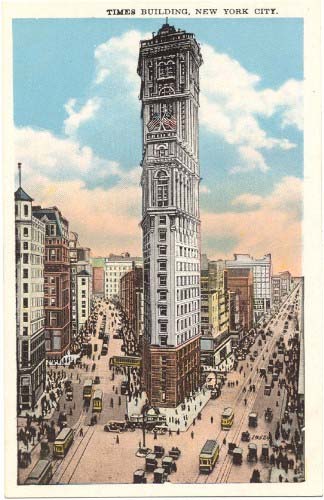
When it was built at the southern end of Longacre Square in 1903, the new headquarters of the New York Times became a landmark of midtown Manhattan, and helped publisher Adolph Ochs convince the city to rename the famous intersection in front of the building as Times Square.

One Times Square in 1904 (source).One Times Square in 2010.
Photo: Bernt Rostad/Flickr
By the mid-20th century, though, the Times had sold the building, and a new owner dismantled the intricate granite and terra-cotta facade to replace the exterior walls with plain concrete panels. In 1996, shortly after the City Council passed new laws that expelled porn theaters from the area, the building got sold again, to Sherwood Outdoor, an advertising firm. By then, the building's signage was covering most of the exterior windows, leaving the offices inside rather dark and dreary.

Rather than spend money to renovate, the new owners decided to simply abandon the building's interior above the 3rd floor, and use the top part of the building exclusively as a billboard (the lower 3 floors are still used, periodically, as retail space — it's currently a Walgreens drug store).

So for the past 15 years, the iconic building that was the namesake of Times Square itself, and a major headquarters of journalism, has become a hollowed-out shell, a mere scaffold for electronic signs.

At the Crossroads of the World, the value of advertising has trumped the value of journalism, and of work in general. 


Postscript: Illustrator Joe Mckendry has made a gorgeous before-and-after elevation drawing of the building's eastern facade in 1904 and in 2010, for his book One Times Square.

Monday, September 10, 2012

The Indian Burial Ground in the Basement

I was walking the dog this weekend along Hammond Street, a quiet residential block squeezed on the hillside between busy Washington Avenue and the industrial district of lower East Bayside here in Portland. They're building two new apartment buildings on a lot at the end of the street, and have started digging out the foundations.

Fascinatingly, the basement excavation has revealed a cross-section of the hillside, which is full of shells. Mostly longneck clams, with a few oysters here and there:


The dense layers of shells are sandwiched between clayey marine soils that are typical of our neighborhood, and they follow the slope of the hillside, such that the same layers are visible twice in the excavation: once against the vertical wall on the uphill side, and once again on the floor:


I'm pretty confident that this is a Native American shell midden — a trash heap from seafood feasts of centuries past. Though it's several blocks and a freeway crossing away from the ocean today, this hillside used to drop straight down into the tidal flats of Back Cove, as you can see in this 1837 map of Portland. The red dot shows the site of this construction site, smack dab on the old shoreline:


Back Cove is a tidal basin — exactly the kind of place where longneck clams thrive, although you wouldn't want to eat them these days. Other parts of the shore around Back Cove were probably marshy and difficult to access from land, but this location, next to a steep hillside, probably offered more direct access to the flats for humans, and for clams, there was relative proximity to the nutrient-rich tidal flows at the Cove's outlet.

I've been kind of stumped by how the shell heaps are interspersed with layers of clayey soil. This photo shows the horizontal cross-section of two layers (on the future basement floor in the foreground) as well as the sloping vertical cross-section (on the street-facing wall, in the center of the photo). At the left edge of the photo is Anderson Street, which was once the shoreline. How did all that clay get in between? 


Stranger still is how some of the shell layers seem to overlap with each other:


My guess is that the steep slopes of the hillside probably set off occasional landslides, which would periodically bury a heap of shells under a thick layer of mud washed down from the higher ground above.

Any archaeologists care to comment?

Related post: Longfellow's Garbage

Update: Howard Reiche e-mailed me this this morning (Sept. 11):
The Knudsen home, which
stood on the site until this
summer. From the City of
Portland's 1924 tax records
.
 Good for you. That was my grandfather’s (Knud Knudsen) house where he raised 13 children after immigrating from Denmark. We have a family photo of my mother, Laura Christine (Knudsen) Reiche, feeding the ducks in the water which came to the foot of their garden which I walked in many times..
    Hammond St. was named after the Hammond rope walk which was originally at that site. Possibly the “layers of clay” mystery had something to do with the construction or changing of the rope walk.